Knife Cuts — Classical French
Julienne
Also: allumette, matchstick cut, julienne cut, fine julienne
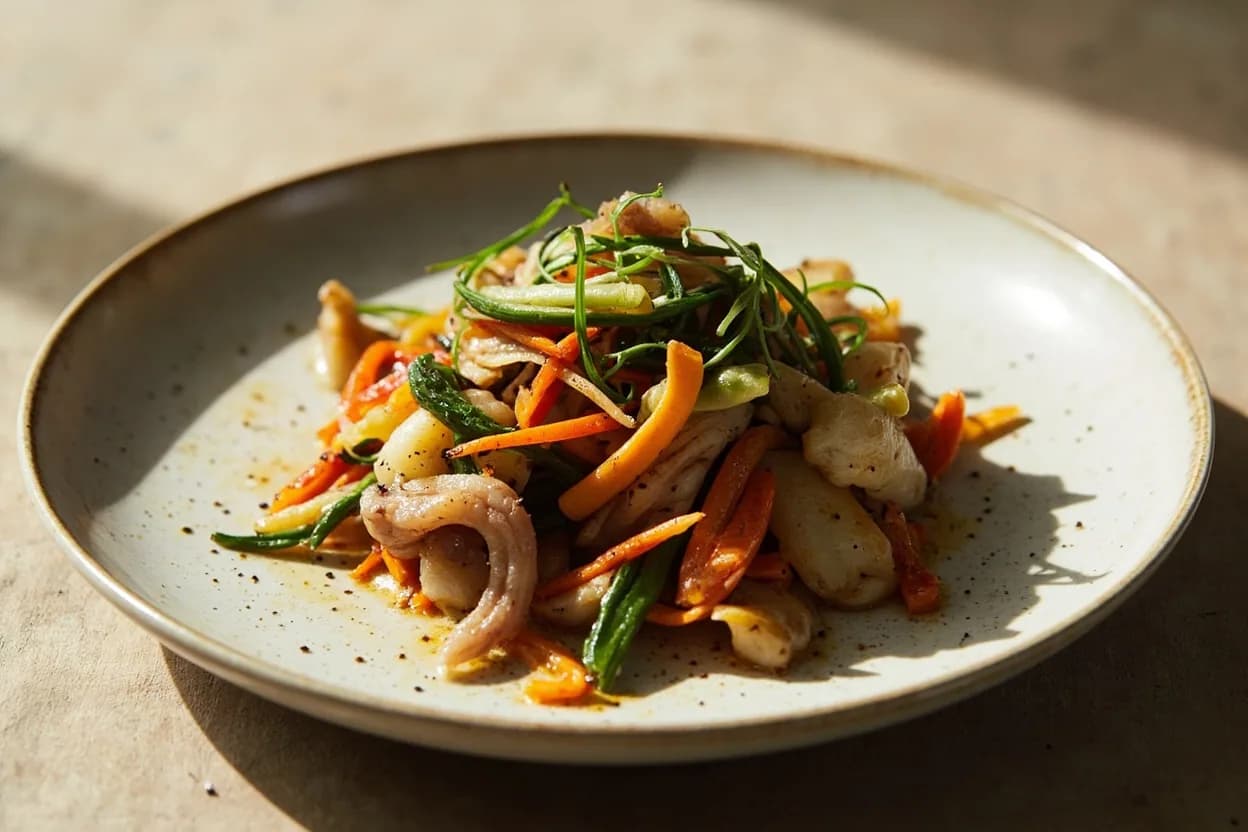
Uniform matchstick strips 3 mm × 3 mm × 5–6 cm — the French standard for garnishes, stir-fry vegetables, and refined vegetable cookery.
Julienne is a classical French knife cut producing uniform rectangular sticks measuring 3 mm × 3 mm in cross-section and 5–6 cm in length. It is derived by first cutting a vegetable into planks (batonnet thickness in reverse), then stacking and slicing into sticks. The cut maximises surface area for rapid, even cooking and creates elegant threadlike garnishes. Fine julienne (sometimes called 'chiffonade' for leaves but julienne for firm vegetables) reduces cross-section to 1.5 mm × 1.5 mm.
In photos
Where it comes from
A knife cut, not a meat cut — applied to firm vegetables (carrot, celery, leek, zucchini, bell pepper, daikon, beet, potato), some fruits (apple, pear for salads), and cured meats or cheeses used as garnish. The technique is geometry, not anatomy.
Best for
How to cook it
- 1Square the vegetable: peel, top and tail, then cut flat planks 5–6 cm long and 3 mm thick — these are the batonnet dimension reduced.
- 2Stack 3–4 planks, align edges, and cut lengthwise into 3 mm sticks. Every cut should be parallel and the same width; uneven strips cook unevenly.
- 3Keep the knife's heel-to-tip rocking motion consistent; a sharp, wide chef's knife (20–25 cm) outperforms a short or dull blade.
- 4For round vegetables (carrots, zucchini), cut a thin slice from one side to create a stable flat base before planking.
- 5Blanch julienne vegetables 60–90 seconds in well-salted boiling water, shock in ice water, and drain for crisp-tender texture in cold preparations.
- 6Sauté over high heat with minimal fat — thin sticks cook in 2–3 minutes; stir constantly.
Prep & butchery
- Peeling is typically required for root vegetables; leave skin on cucumbers and zucchini if desired for colour contrast.
- Work from a squared-off piece: any rounded surface makes planking unstable and produces uneven sticks.
- Keep a damp cloth nearby — vegetables dry out quickly once cut, especially starchy ones like potato (which also oxidise); hold potato julienne in cold acidulated water.
- For leeks: julienne only the white and pale-green parts; fan the layers open for even-width strips.
Substitutes
Larger version (6 mm × 6 mm × 6–7 cm); appropriate when delicacy of julienne is not required
For leafy greens and herbs — ribbon-cut rather than stick, but similar visual effect in garnishing
- Mandoline julienne blade
Produces julienne rapidly at consistent width; faster than hand-cutting but can compress tender vegetables
Related cuts
3 mm cube derived by rotating julienne 90° and dicing — the next step in the French precision-cut progression
Larger stick (6 mm × 6 mm × 6–7 cm) — julienne is essentially a fine batonnet
- Fine brunoise
1.5 mm cube derived from fine julienne (1.5 mm sticks)
Ribbon equivalent for soft leaves — sometimes confused with julienne
Flat irregular shapes — contrasts with the strict geometry of julienne
Appears in
References
- 1.The Professional Chef, 9th Edition — The Culinary Institute of America (Wiley, 2011)
- 2.Jacques Pépin: New Complete Techniques (Black Dog & Leventhal, 2012)
- 3.On Food and Cooking — Harold McGee (Scribner, 2004)
- 4.Larousse Gastronomique (Clarkson Potter, 2009)
Confidence: high
Notes
Allumette vs. julienne
In classical French terminology, 'allumette' (matchstick) is sometimes used interchangeably with julienne, though allumette originally referred specifically to potato strips of this dimension destined for frying. Modern culinary schools standardise on 'julienne' as the generic knife-cut term and reserve 'allumette' exclusively for the potato preparation.
Knife geometry matters
Consistent julienne requires a blade taller than the plank stack and a stable cutting board. Many students reverse the sequence — they try to julienne a round carrot directly — producing wedge-shaped rather than rectangular sticks. Squaring the vegetable first is not optional; it is the prerequisite that makes the whole cut possible.