Beef — Primal & Subprimal
Korean Hanu / Hanwoo Beef Primal Differences
Also: 한우, Hanwoo cuts, Korean beef butchery, deungsim, chadolbaegi, galbi
Korean beef butchery (Hanwoo/Hanu) defines distinct primals and a rich vocabulary of secondary cuts — chadolbaegi, deungsim, galbi, and more — that only partially overlap with USDA or Japanese nomenclature.
Hanwoo (한우) is the native Korean cattle breed, a golden-hued, well-marbled animal prized domestically and increasingly exported. The Korean beef butchery system divides the carcass into 10 primals with 39 officially named sub-cuts recognised by the Korean Livestock Products Grading Service (KLPGS, or 축산물품질평가원). The grading system runs from 1++ (highest marbling) through 1+, 1, 2, and 3. While some cuts map directly to USDA or Japanese equivalents, others — chadolbaegi (paper-thin brisket/plate cross-cut), yangji (brisket flat and adjacent muscles), and the specific galbi section — differ importantly in portioning, thickness, and intended preparation. Understanding these differences is essential for authentic Korean grilling (gogigui) and soup traditions (seollongtang, gomtang).
In photos
Where it comes from
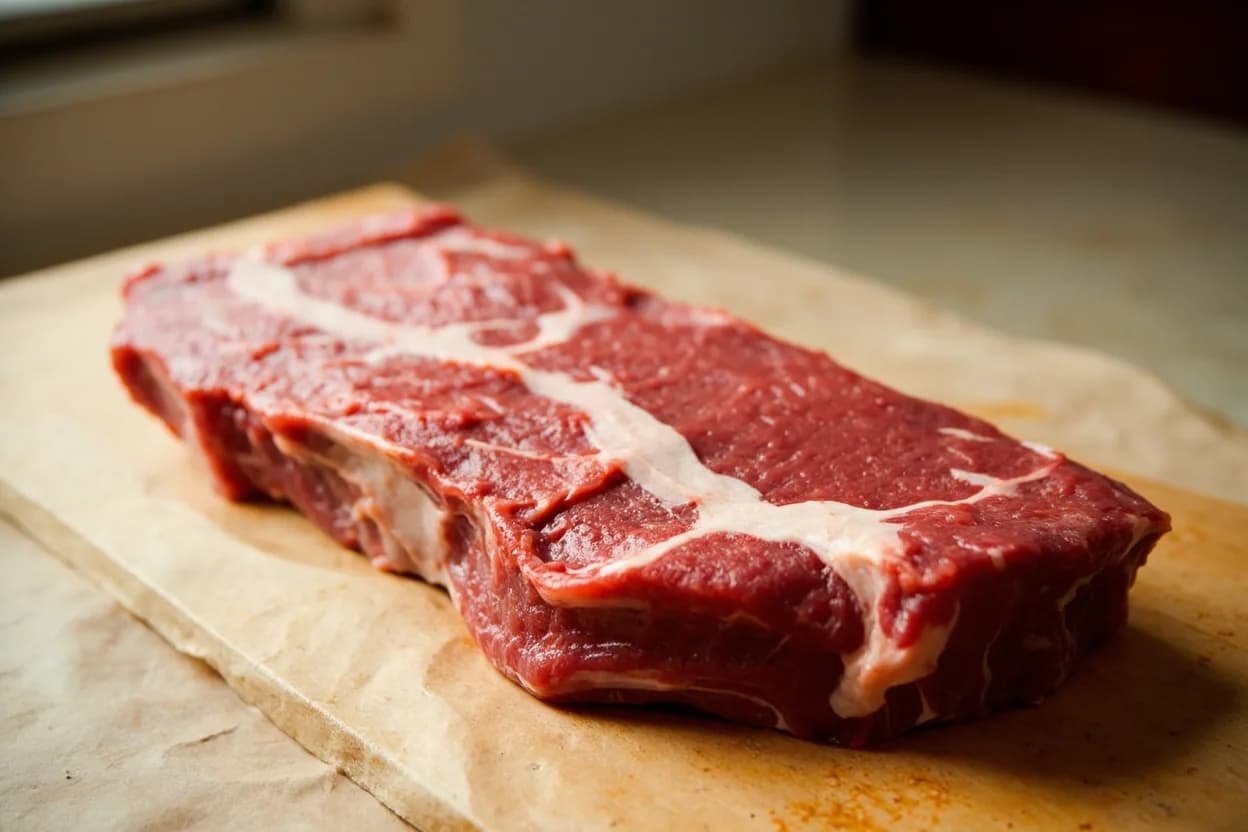
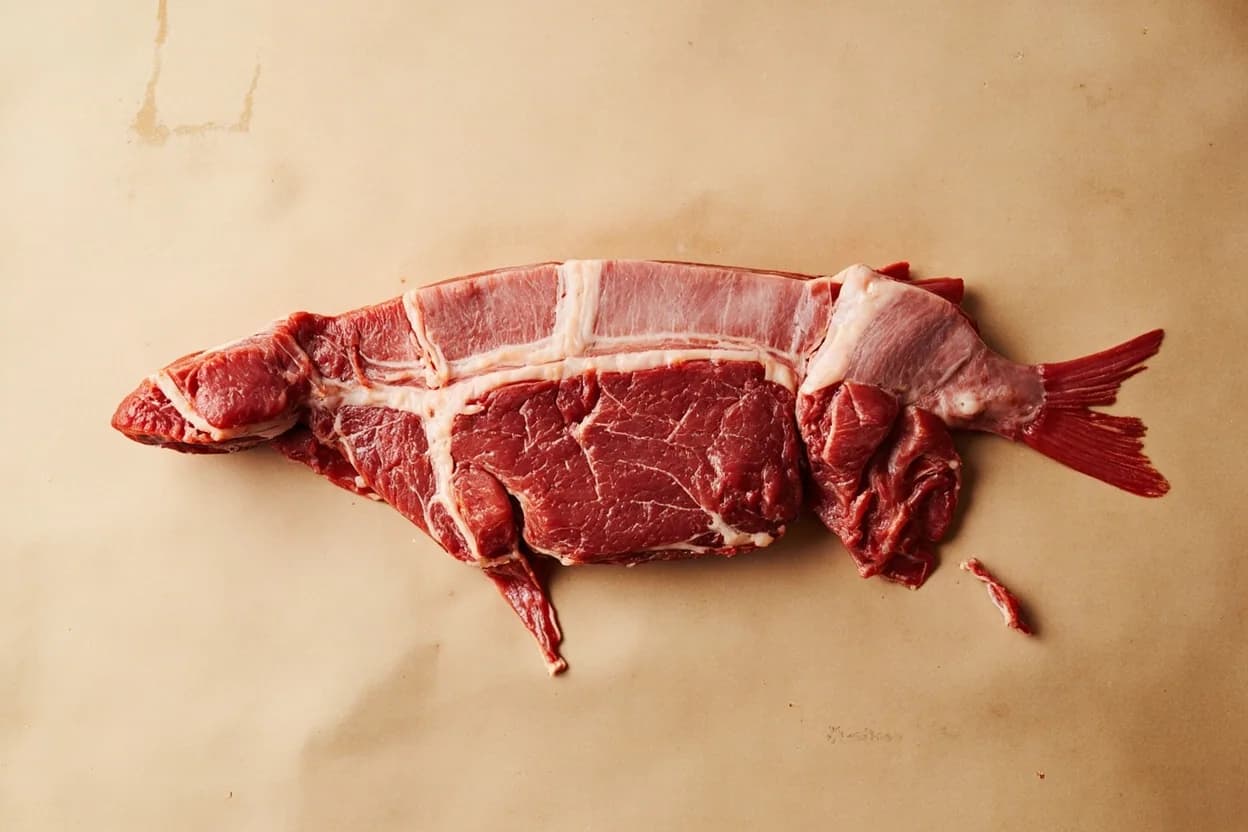
The Hanwoo carcass divided into 10 large primals: 안심 (ansim — tenderloin), 등심 (deungsim — sirloin/loin), 채끝 (chaenkeut — striploin tail/sirloin tip), 목심 (mokshim — neck/chuck), 앞다리 (ap dari — forequarter/shoulder), 우둔 (udun — rump/top round area), 설도 (seoldo — silverside/bottom round), 양지 (yangji — brisket/plate), 사태 (satae — shank), and 갈비 (galbi — rib). Each is further subdivided: galbi yields 꽃갈비 (kkotgalbi — flanken-cut short rib), LA갈비 (LA-galbi — thinner flanken cut popularised by Korean-Americans), and 갈비살 (galbisal — boneless rib meat). Chadolbaegi (차돌박이) is sliced from the chest/brisket plate at paper-thin 1–2 mm, typically from the plate or brisket flat cross-section.
Best for
How to cook it
- 1CHADOLBAEGI (thin brisket): slice frozen brisket flat at 1–2 mm on a deli slicer; lay slices on a preheated iron grill pan or tabletop grill; cook 20–30 seconds per side until just opaque; wrap in perilla leaf with doenjang, garlic, and rice.
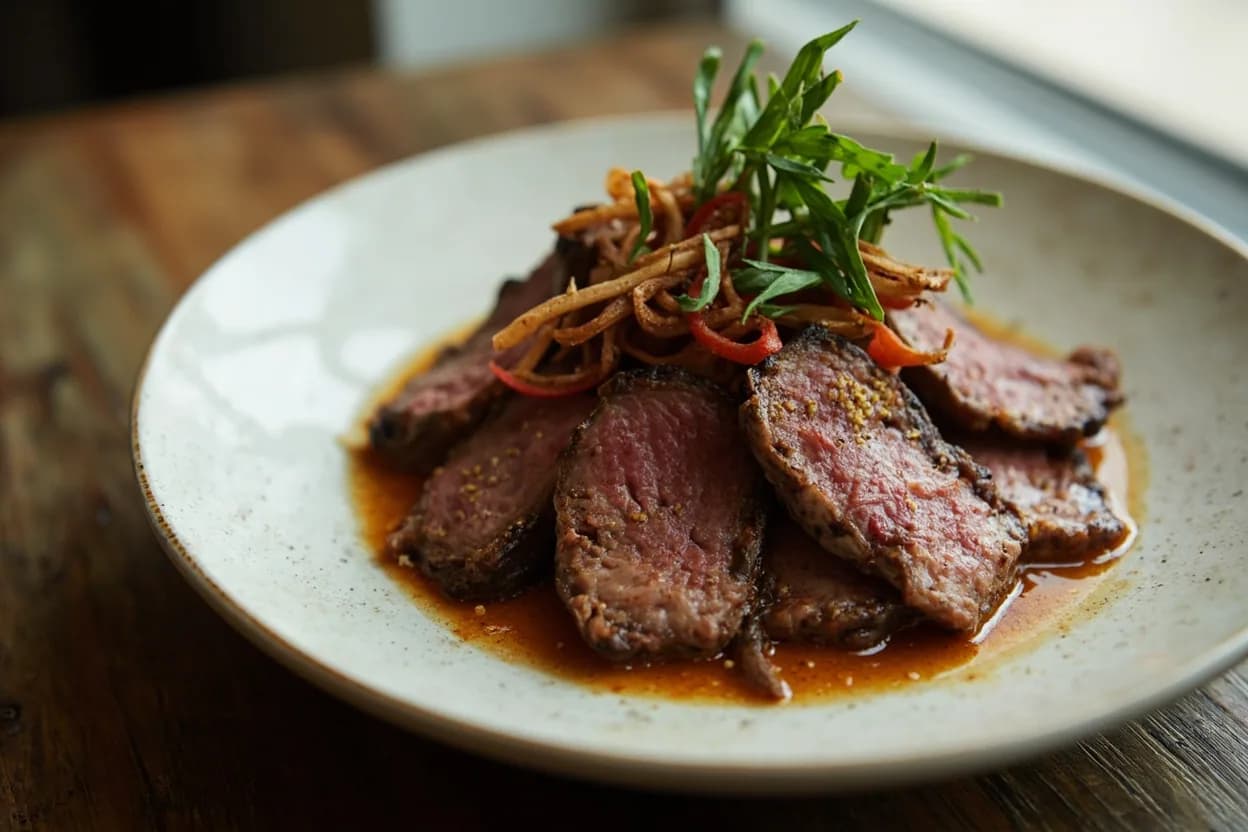
- 2DEUNGSIM (sirloin) FOR GOGIGUI: cut 6–8 mm; score the fat cap lightly so it does not curl; grill on hot iron grate (binchotan or gas) 1–2 min per side to medium-rare; scissors-cut into bite pieces at the table.
- 3GALBI (flanken short rib): score three diagonal cuts through the meat between each bone; marinate 4–6 hours in soy, Asian pear (natural tenderiser), garlic, sesame oil, sugar, ginger; grill over medium-high heat 3–4 min per side; serve sizzling.
- 4GALBI-JJIM (braised short rib): blanch bone-in galbi pieces, drain; braise in seasoned soy stock with Asian pear, chestnuts, jujubes, and mushrooms at a low simmer 1.5–2 hours; finish with sesame oil and garnish with pine nuts.
- 5SEOLLONGTANG (bone broth): crack sagol (leg bones) and boil rapidly for 8–12 hours, skimming, to produce a creamy white broth; serve with thin yangji beef, rice, and chopped green onion; season at the table with salt.
- 6BULGOGI: slice deungsim at 3–4 mm against the grain; marinate 2–4 hours in soy, Asian pear purée, sesame oil, garlic, ginger, sugar; grill on a convex dome grill (불고기판) or in a skillet until caramelised.
Prep & butchery
- Chadolbaegi: must be sliced from frozen or near-frozen brisket; room-temperature brisket slices unevenly and tears
- Galbi: score the membrane on the bone-side before marinating so seasoning penetrates to the bone
- For seollongtang, soak bones in cold water 1–2 hours and blanch before the long boil to eliminate blood and impurities
- Bulgogi marinade with Asian pear: use ripe, grated pear (배, Nashi/Asian pear); it contains bromelain-like enzymes that genuinely tenderise; do not marinate longer than 8 hours or meat turns mushy
Substitutes
- USDA Short Plate / Thin-sliced Brisket (for chadolbaegi)
Semi-freeze USDA brisket flat and slice at 2 mm — closest available substitute; flavour is identical if quality is good
- USDA Bone-in Short Ribs (for galbi)
Direct equivalent for flanken-cut LA-galbi; ask the butcher for flanken-cut (across the bones) not English-cut (parallel to bones)
- Australian Wagyu-cross Sirloin (for deungsim)
Excellent substitute for premium gogigui — similar marbling at lower price than Hanwoo 1++
Related cuts
- Chadolbaegi (Thin Brisket Plate)
The signature Korean thin-cut — paper-thin brisket plate slices, grilled instantly
- Galbi (Short Rib)
Central to Korean grilling culture; flanken-cut distinguishes it from Western bone-in short rib
- Yangji (Brisket/Plate)
Soup base cut; the collagen-rich muscle mass below the chest
Appears in
References
- 1.Korean Bapsang: A Korean Mom's Home Cooking Blog — Hyosun Ro (reference for practical cut usage)
- 2.The Food of Korea — Injoo Chun, Jaewoon Huh & Young Jin (Murdoch Books, 2010)
- 3.Korean Livestock Products Grading Service (KLPGS) — Beef Grading Standards (Ministry of Agriculture, Food and Rural Affairs, Republic of Korea)
- 4.Cook Korean! — Robin Ha (Ten Speed Press, 2016)
- 5.The Oxford Companion to Food — Alan Davidson (Oxford University Press, 3rd ed., 2014)
Confidence: high
Notes
Why chadolbaegi has no clean USDA equivalent
Chadolbaegi is sliced transversally through the brisket/plate complex — across multiple muscles and their separating fat seams — to produce a variegated slice of lean meat, fat channels, and connective tissue that cooks to a satisfying chewy-yet-rich texture in seconds. USDA butchery treats this zone as a block cut for grinding or trimming; Korean butchers make it a premium sliced product. The cut is site-specific: brisket flat gives a leaner, more uniform slice; plate gives richer but more irregular fat distribution.
LA-galbi origin
LA-galbi (엘에이갈비) was developed by Korean immigrants in Los Angeles in the 1970s–1980s who adapted American USDA short ribs (which were bone-in and thick, unlike Korean flanken galbi) by requesting flanken cross-cuts from local butchers and marinating them in the traditional soy-pear-garlic mixture. The name 'LA galbi' is now used in Korea itself to distinguish thin flanken cuts from thicker traditional galbi.