Pork — Primal & Subprimal
Korean Pork Cuts — Samgyeopsal & Moksal
Also: 삼겹살, 목살, samgyeopsal, moksal, Korean pork belly, Korean pork collar, dwaeji-galbi
The two foundational Korean grill-table pork cuts: samgyeopsal (three-layer belly) and moksal (neck/collar), sliced to precise thickness for tableside charcoal or gas grilling.
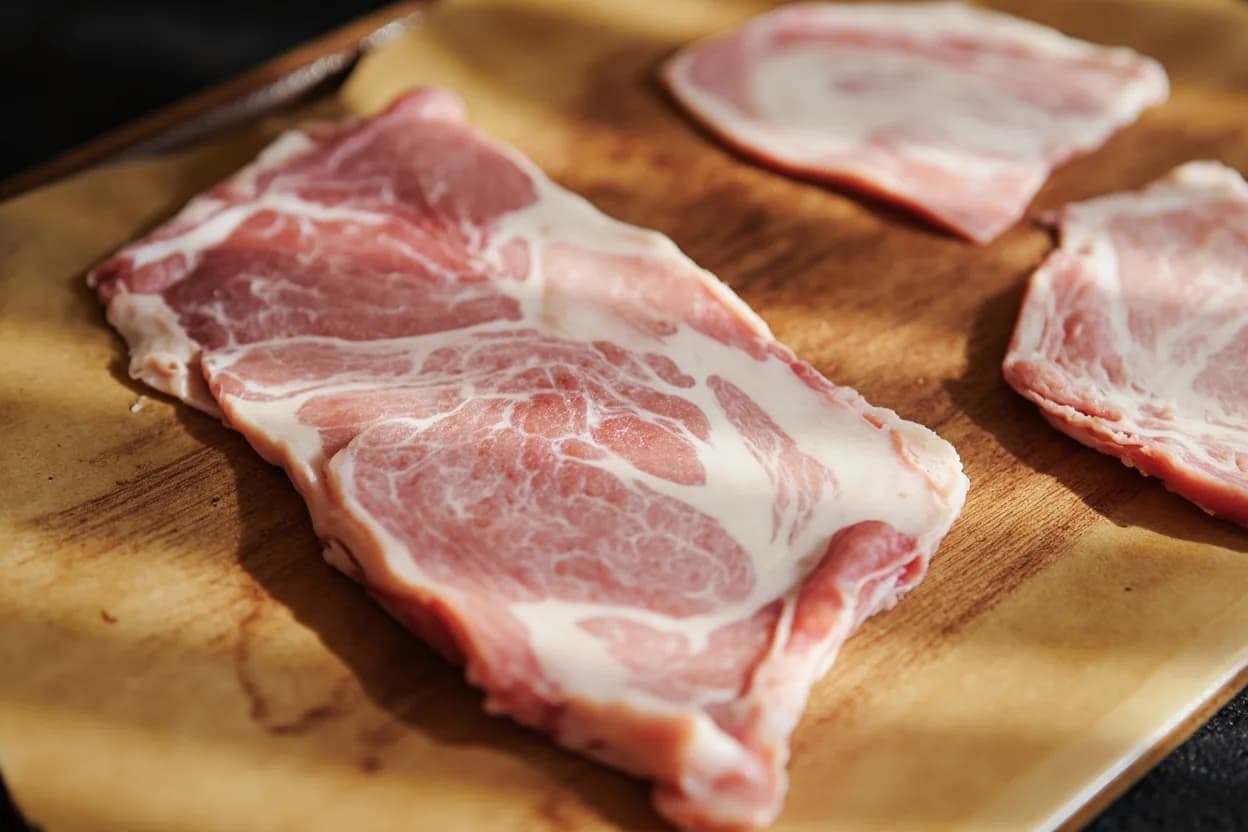
Korean barbecue culture has developed two dominant pork cuts, each prized for specific anatomical and gustatory reasons, and sliced to exacting thickness for the grill table (불판/bulpan). Samgyeopsal (삼겹살, literally 'three-layer flesh') is uncured pork belly, valued for its alternating layers of fat and lean that char and caramelise on the grill. Moksal (목살, 'neck flesh') is the pork collar or neck/shoulder, a more marbled but leaner muscle cluster that offers a slightly firmer texture. Both are served sizzling directly off the tableside grill, wrapped in perilla or lettuce leaves with doenjang, ssamjang, garlic, and kimchi.
In photos
Where it comes from
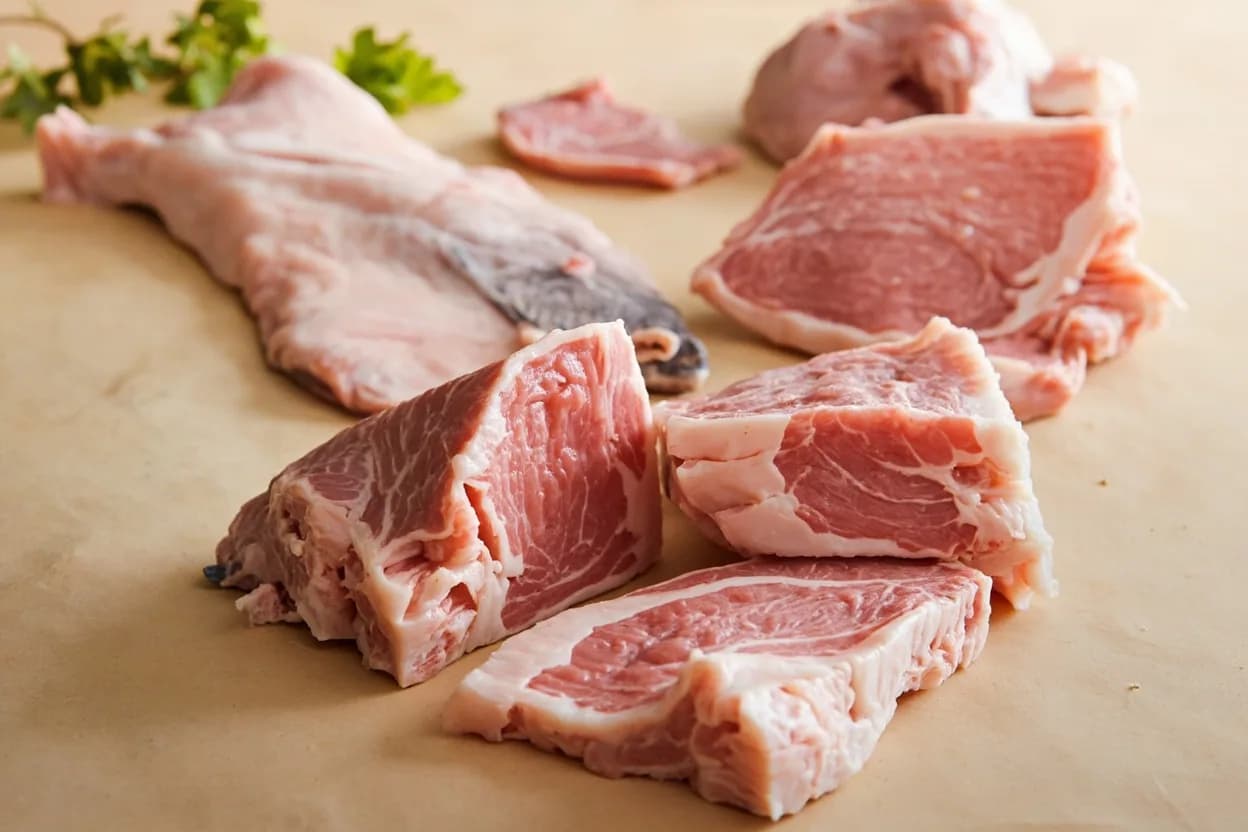
Samgyeopsal: the pork belly plate (복부/bokbu), the ventral section below the ribcage, equivalent to the pork belly or bacon cut internationally. Sliced horizontally across the belly slab, skin-on or skin-off depending on preference. Moksal: the pork collar (목/mok), the muscle cluster at the neck and upper shoulder junction (equivalent to the coppa or collar), known for natural intramuscular fat seaming.
Best for
How to cook it
- 1SLICING SAMGYEOPSAL: Freeze the belly slab for 45–60 minutes until very firm (not fully frozen); slice on a deli slicer or with a sharp long knife against the grain at 5–7 mm. Each slice should show a clear layering of fat and lean. Portion 200–300 g per person.
- 2SLICING MOKSAL: The collar has irregular muscle direction; slice perpendicular to the long axis of the neck at 7–10 mm. Chill (but do not freeze) the collar before slicing for clean cuts.
- 3GRILL SETUP: Preheat the grill table — charcoal (binchotan or hardwood briquettes) or gas — until very hot. No oil needed; samgyeopsal self-bastes in rendered fat.
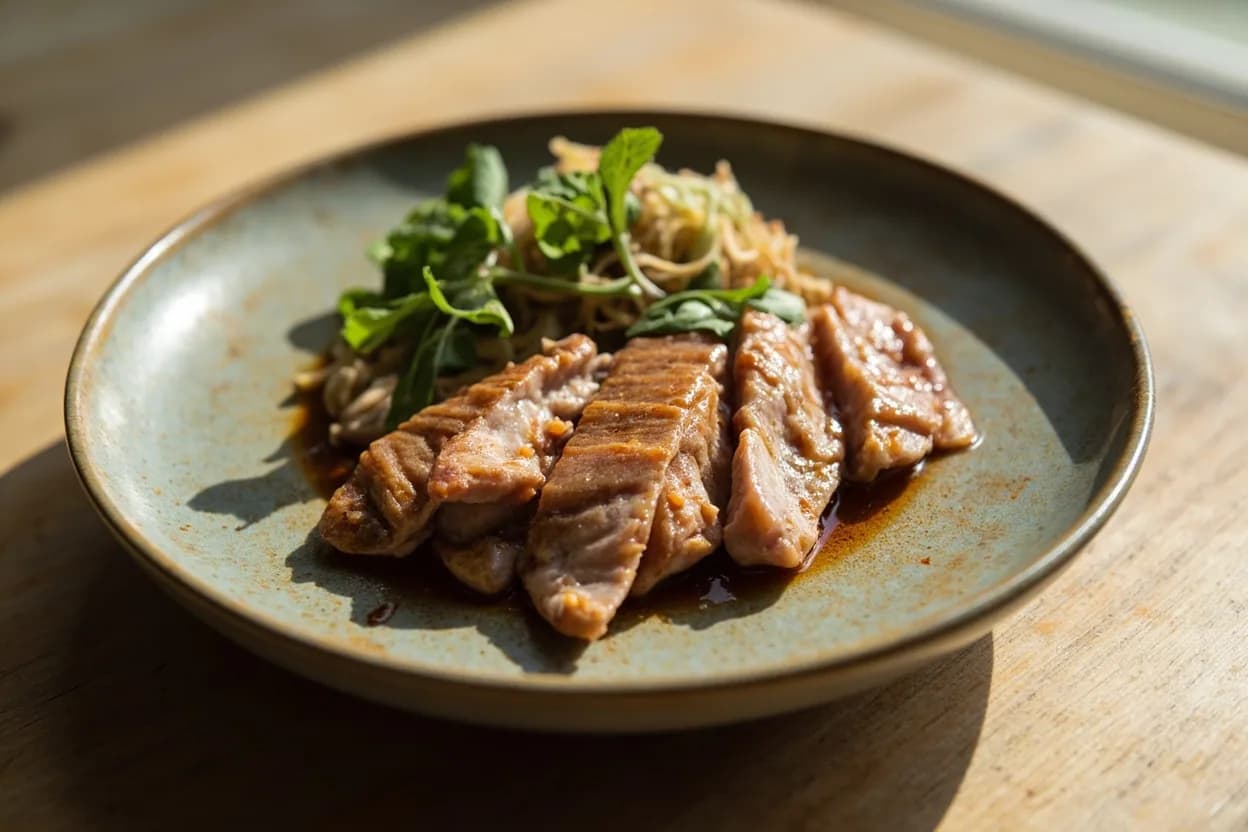
- 4GRILLING SAMGYEOPSAL: Lay slices flat on the grill; they will sizzle and curl within 60–90 seconds. Flip when the underside shows char marks and the fat is rendered. Total cook time 3–4 minutes; snip with scissors into 3 cm pieces while still on the grill.
- 5GRILLING MOKSAL: Treat similarly but allow an extra minute — the collar muscle is denser. Look for caramelised edges and white fat turning golden before snipping.
- 6SERVE: Immediately wrap grilled pieces in a lettuce or perilla leaf with a smear of ssamjang or doenjang, raw garlic, a slice of green chilli, and kimchi. Eat in one bite.
- 7FAT MANAGEMENT: Drain rendered fat into a side dish periodically using a silicone wiper to prevent flare-ups; some restaurants tip the grill slightly for gravity drainage.
Prep & butchery
- Do not marinate samgyeopsal or moksal before Korean-style grilling; the unseasoned-grill approach (소금구이/sogeum-gui — salt grill) is the canonical technique, adding a dip of sesame oil with salt and pepper only at the eating stage.
- For skin-on samgyeopsal (kkeobdegi), score the skin with a knife in a crosshatch pattern to prevent curling and speed rendering.
- Freeze belly 45–60 minutes before slicing for clean, even cuts without a slicer.
- Thickness standardisation is critical: irregular slices cook unevenly on a grill; aim for ±1 mm variance.
- Portion at 200–250 g per person for a standard Korean BBQ portion; a full table order is typically 2 portions minimum.
Substitutes
- Pork Belly (non-Korean sliced)
Functionally identical for samgyeopsal; ensure it is sliced thin (5–7 mm) and not pre-seasoned or smoked.
- Pork Collar / Boston Butt sliced thin
Acceptable moksal substitute; flavour is close, though commercial breeds have less collar marbling than Korean-favoured breeds.
- Ibérico Pluma or Secreto thin-sliced
Premium substitute; the fat profile is different (oleic acid-dominant) but behaves similarly on a hot grill.
Related cuts
- Pork Belly
International equivalent of samgyeopsal; globally available
- Pork Collar / Coppa
International equivalent of moksal; the same anatomical cut as Italian coppa before curing
- Galbi (Pork Spareribs)
A third major Korean grilled pork cut; differs from samgyeopsal/moksal in requiring marinade
- Hang-jeong-sal (항정살)
Korean term for the cheek/jowl muscle; prized specialty cut, similar to guanciale in fat content
- Gaburi-sal (가브리살)
Collar-tip sub-muscle adjacent to moksal; even more marbled, a Korean BBQ premium cut
Appears in
References
- 1.Korean BBQ: Master Your Grill in Seven Sauces — Bill Kim (2019)
- 2.The Food of Korea — Injoo Chun, Jaehoon Shim, Zimbo Chun (2012)
- 3.Koreatown: A Cookbook — Deuki Hong & Matt Rodbard (2016)
- 4.On Food and Cooking — Harold McGee (2004)
- 5.USDA IMPS Pork Series 400 — Pork Belly and Collar Specifications
Confidence: high
Notes
The Three-Layer Rule
The name samgyeopsal (三겹살) literally means 'three-layered flesh.' A high-quality belly should show at least three distinct alternating fat-and-lean striations when sliced. In Korean markets, premium belly is graded partly on the clarity and regularity of these layers — irregular or predominantly fatty cuts are considered lower quality and are often used for bossam (boiled) rather than grilling.
Grill Science: Why Thin Slices
Korean grill-table culture mandates thin slices (5–10 mm) for a specific reason: rapid Maillard reaction on all surfaces before the interior overcooks. At 5 mm, a slice of samgyeopsal can be fully cooked, caramelised on both sides, and still retain internal moisture in under 4 minutes on a hot grill. At 2 cm, the exterior chars before the centre cooks, and resting time off the grill is awkward in a communal setting. The thin slice is an ergonomic and culinary solution to tableside cooking.
Scissors as a Cooking Tool
In Korean BBQ culture, scissors (가위/gawi) are as fundamental a kitchen tool as tongs. The cook uses them to snip grilled meat directly on the hot grill surface into bite-sized pieces, maintaining heat contact and allowing further caramelisation of cut surfaces. This is a precision technique, not a shortcut — professional Korean BBQ cooks develop scissor skill as part of their tableside service.
Moksal vs. Other Collar Preparations
While Italian norcini cure the same collar muscle into coppa (a 3–6 month dry-cure), and American pitmasters smoke it as a pork collar roast, Korean culinary tradition uses it raw and thin-sliced for the grill. The same muscle yields very different eating experiences depending on fabrication and cooking approach — a useful illustration of how cultural technique shapes perceived flavour even from identical raw material.