Lamb & Goat — Primal & Subprimal
Lamb Leg — Bone-In vs. Butterflied (Gigot)
Also: gigot d'agneau, leg of lamb, butterflied leg, gigot papillon, boneless leg of lamb
The whole hind leg of lamb — roasted bone-in for maximum flavor and drama, or boned and butterflied for faster, even cooking over live fire.
The lamb leg (gigot in French) is the hind limb primal, comprising the aitch bone (pelvic bone), femur, and lower shank bones surrounded by the four primary muscle groups: the topside (semimembranosus and semitendinosus), silverside (biceps femoris), thick flank (quadriceps group), and rump. Bone-in, the leg is the classic centerpiece roast of Easter and festive cooking across Europe and the Middle East. Boned out and butterflied — opened flat like a book — the leg becomes a thinner, irregular slab ideal for marinating and grilling; the uneven thickness produces a natural gradient of doneness from rare in the thickest center to well-done at the thin edges, satisfying a range of preferences at once.
In photos


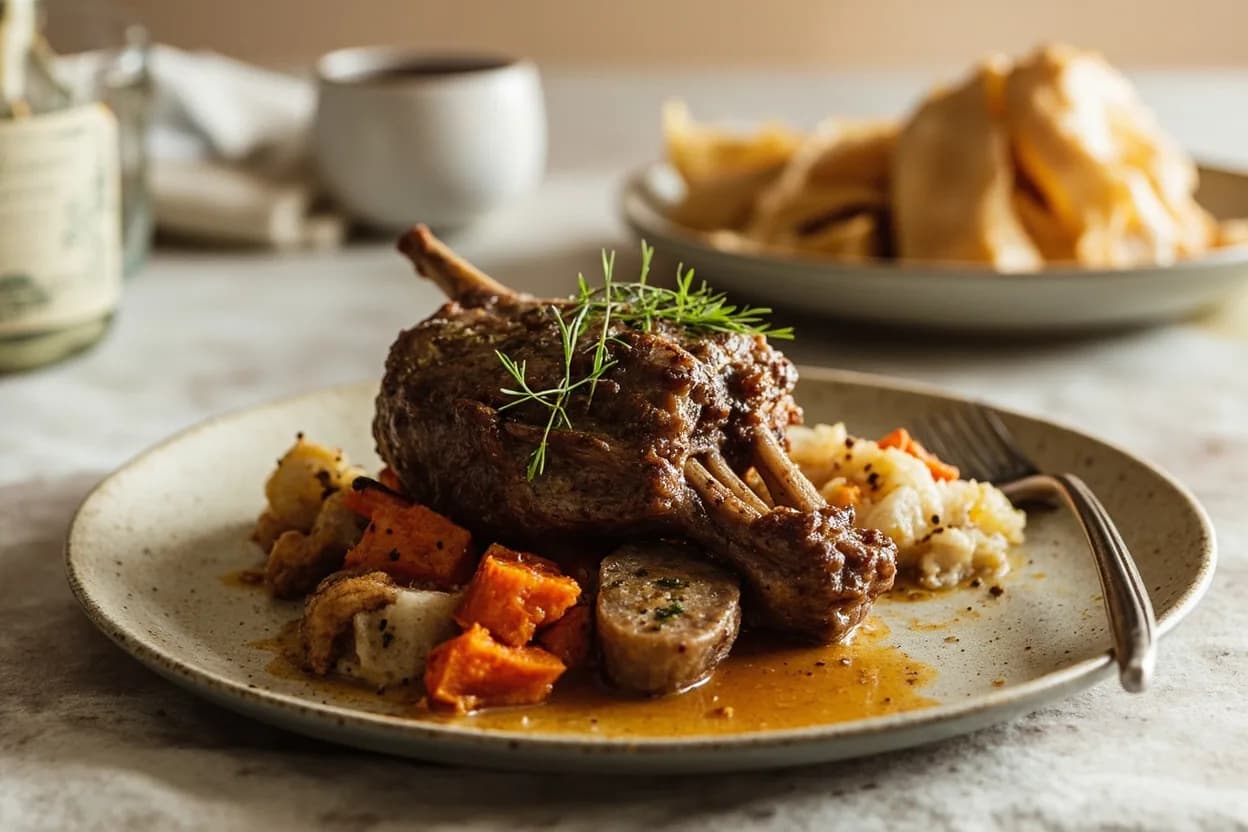
Where it comes from
Hind limb of the lamb carcass, running from the aitch bone (hip) to the stifle joint. The full leg includes the shank; a short-leg or sirloin-off preparation removes the aitch bone end for a cleaner roast. Typical bone-in weight: 2–3 kg. Butterflied boneless weight: 1.5–2 kg.
Best for
How to cook it
- 1Bone-in roast: score the surface fat, stud with garlic and rosemary, rub with olive oil and salt. Roast at 220°C for 20 minutes, then reduce to 180°C and continue until internal temperature reads 60°C (medium-rare) at the thickest point — roughly 20 minutes per 500 g. Rest 20 minutes before carving.
- 2To butterfly (gigot papillon): lay the leg fat-side down. Using a boning knife, locate the femur and cut along its length, then work the knife around the bone, keeping it pressed against bone at all times. Remove the femur; locate and remove the aitch bone and kneecap. Unroll the meat flat and make strategic cuts through the thickest portions to even out the thickness.
- 3Marinate butterflied leg for 4–24 hours in acid-based marinade (yogurt, lemon, pomegranate, or wine) to tenderize and flavor; the open grain and multiple muscle surfaces absorb marinade rapidly.
- 4Grill butterflied leg over medium-high heat, 8–12 minutes per side, pressing with a flat weight if available. Rest 10 minutes; slice across the grain from each muscle section.
- 5For even thickness when grilling, butterfly the thicker shank-side muscle partway open with a horizontal cut and fold it out (like opening a book) before marinating.
Prep & butchery
- Remove excess surface fat to a thin 0.5 cm layer — enough to baste but not render excessively in the pan
- The aitch bone (hip socket) is the most awkward to remove when boning; locate the ball-and-socket joint and cut cleanly through the cartilage to free it
- After butterflying, use the flat of your hand to press the leg evenly flat; if it still springs up, make a few shallow incisions through the thickest sections
- For bone-in roasting, ask the butcher to remove the pelvic bone and crack the shank bone for easier carving at the table
- Insert garlic slivers into deep incisions in the fat cap for a classic Provençal preparation
Substitutes
- Bone-in goat leg
Nearly identical structure; goat is leaner with a slightly earthier flavor; extend cooking time slightly
- Lamb shoulder (bone-in)
More collagen, richer flavor; requires longer cooking but produces more unctuous results for slow-roasting
- Butterflied leg of mutton
Larger, stronger in flavor; ideal for robust marinades; cook to well-done for best results
Related cuts
The lower leg section, often sold separately; pure braise cut
- Lamb Rump
Cut from the top of the leg/pelvic area; an underrated quick-cook cut
- Lamb Topside
Seam-butchered muscle from the inner thigh; makes excellent steaks or escalopes
The broader primal map context for the leg
Appears in
References
- 1.The River Cottage Meat Book — Hugh Fearnley-Whittingstall
- 2.Meat: A Kitchen Education — James Peterson
- 3.Jerusalem — Yotam Ottolenghi & Sami Tamimi
- 4.The Complete Nose to Tail — Fergus Henderson & Justin Piers Gellatly
Confidence: high
Notes
The Case for Bone-In
Bone-in roasting produces superior flavor. The femur and aitch bone release gelatin and marrow as they heat; this enriches the pan juices and creates a natural gravy far more complex than anything yielded by a boneless joint. The trade-off is longer cooking and more difficult carving — a fair exchange for a celebratory occasion.
The Gradient of Doneness
A butterflied leg's irregular thickness — thick at the hip end, thin at the shank end — is a feature, not a flaw. On the grill, the thin edges cook to well-done while the thick center stays pink; every guest gets the doneness they prefer from one piece. Slice against the grain from each muscle section and arrange on a platter to show the colour gradient.