Lamb & Goat — Primal & Subprimal
Lamb Loin Chop & Saddle
Also: lamb T-bone chop, saddle of lamb, double loin, selle d'agneau, chuleta de lomo de cordero
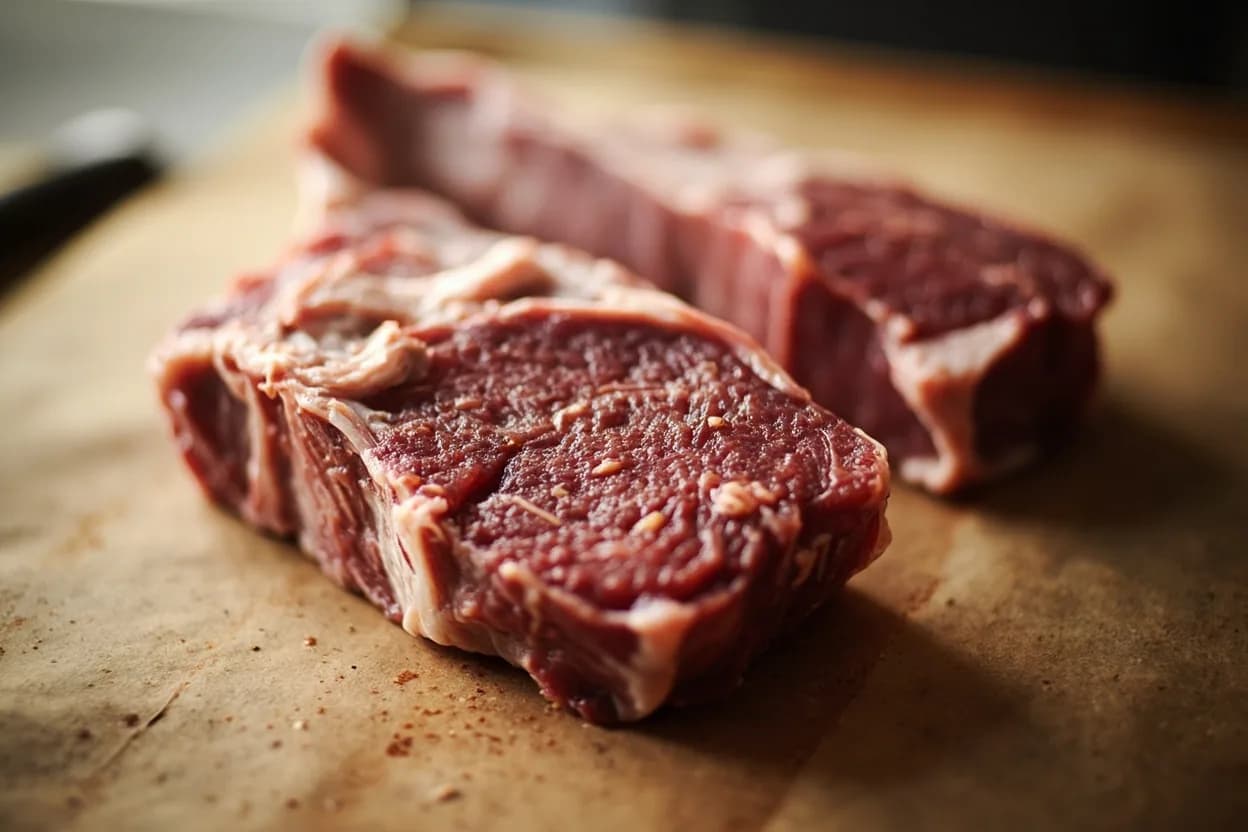
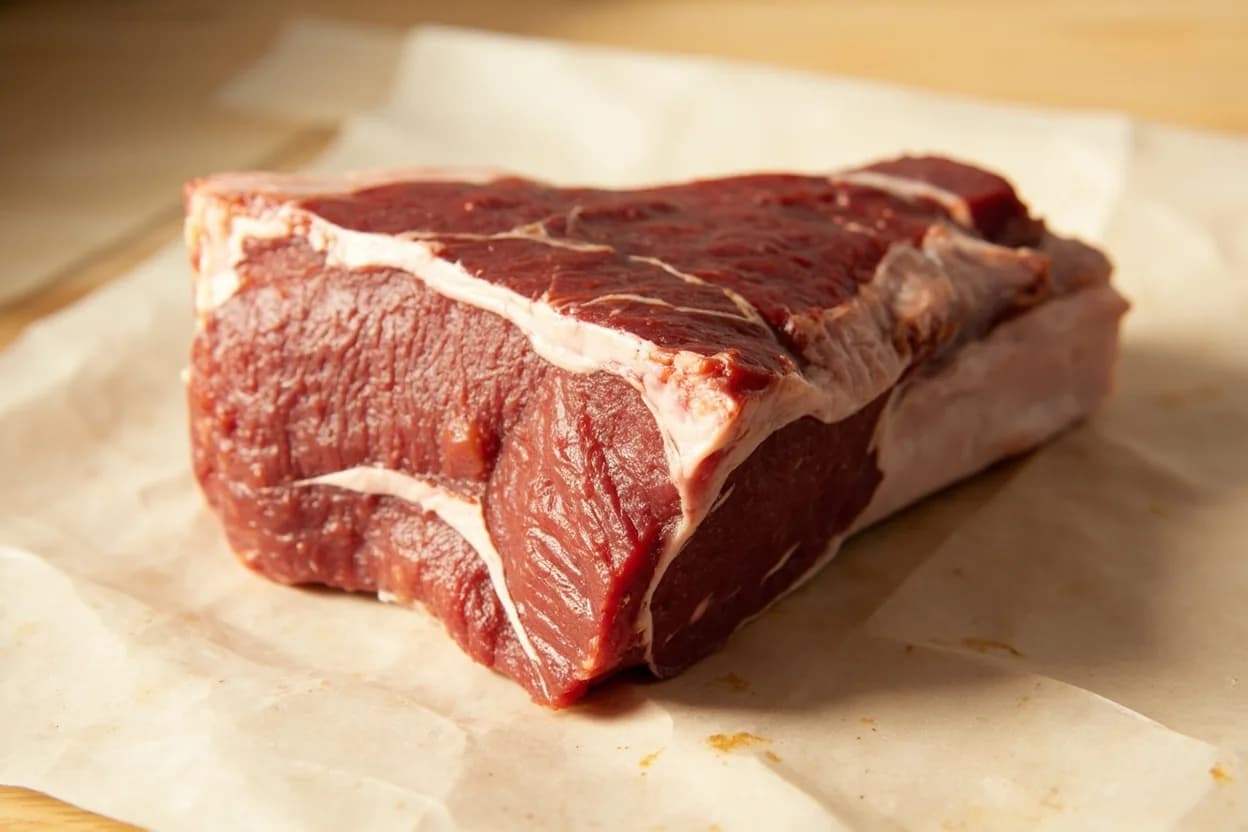
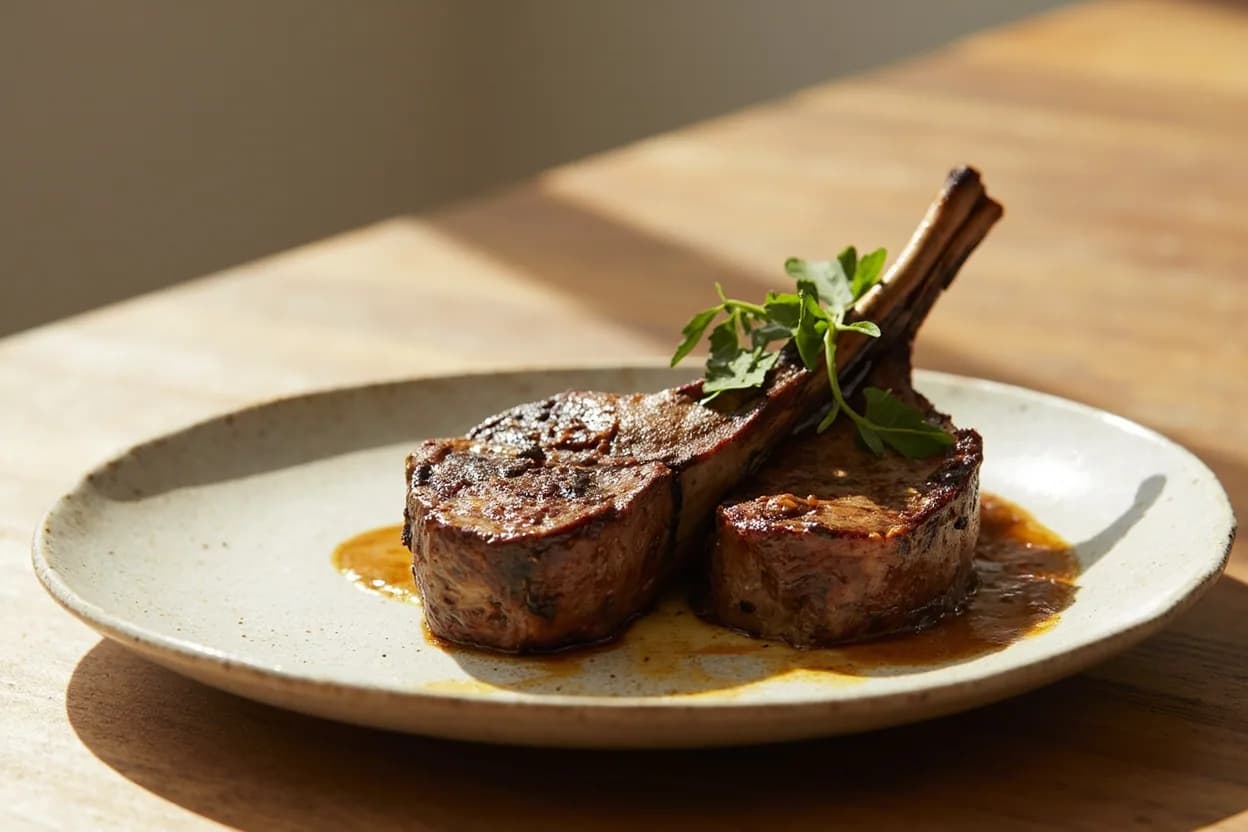
The lamb equivalent of the T-bone steak — a loin chop carries both the tenderloin and top loin on either side of a vertebra; the saddle is both loins unsplit, the showpiece roast of classic French service.
The loin of the lamb runs between the last rib and the hip, spanning lumbar vertebrae L1–L6. A single loin chop (also called a lamb T-bone) is a cross-section cut through this section: on one side of the vertebral bone lies the longissimus dorsi (top loin), on the other the psoas major (tenderloin). Both muscles are fine-grained and very tender because the lumbar region bears no weight and sees minimal movement. The saddle is the entire double loin left intact — both sides still joined at the spine — and roasted whole, a classic of French grande cuisine (selle d'agneau). The noisette is a round boneless medallion cut from the boned loin fillet, tied with the surrounding flap, typically 2–3 cm thick.
In photos
Where it comes from
The lumbar section of the lamb carcass, between the rack (rib end) and the leg. The longissimus dorsi (eye muscle) runs along the top of the spine; the psoas major (tenderloin/fillet) runs below it on the inside of the vertebrae.
Best for
How to cook it
- 1For individual loin chops: bring to room temperature for 30 minutes; season generously with salt only before cooking.
- 2Heat a cast-iron or stainless pan to nearly smoking; add a thin film of neutral oil, then lay in the chops fat-side down first to render the cap, then sear the flat faces 2–3 minutes each for medium-rare (internal 58–60 °C / 136–140 °F).
- 3Add butter, garlic, and thyme for the last minute and baste continuously; rest 3–5 minutes loosely tented.
- 4For the saddle: ask the butcher to short-trim the flanks and tie them under the loin with kitchen twine at 3 cm intervals; this keeps the thin flap meat from overcooking.
- 5Roast the saddle at 220 °C / 430 °F for 12–15 minutes per kg (targeting 57–58 °C internal for pink), then rest uncovered for 10–15 minutes; carve by removing the twine and slicing between the vertebrae.
- 6For noisettes: bone the loin, roll the surrounding flap tightly around the eye of meat, and tie at 2.5 cm intervals; slice into 2–3 cm rounds and pan-fry in clarified butter.
Prep & butchery
- Remove the fell (outer membrane) from the fat cap if present; score the fat in a crosshatch to help rendering without puncturing the muscle.
- Trim the 'tail' (flank flap) to a length of 5–6 cm so it wraps neatly around the tenderloin face when the chop is pressed flat during searing.
- For the saddle, instruct the butcher to leave the kidneys in situ if desired — the kidney fat (suet) bastes the loin naturally during roasting in the French classical tradition.
- For noisettes, bone each loin half by running a knife along both faces of the vertebrae, then trim the surrounding flap to the same length as the loin diameter before rolling.
Substitutes
- Lamb Rack Chop (single-rib cutlet)
Similar tenderness and fast-cook character; rack has a longer rib bone handle and slightly stronger flavour.
- Lamb Leg Steak (boneless)
Available everywhere; less tender and lacks the T-bone presentation but cooks similarly over high heat.
- Veal Loin Chop
Same anatomy at a larger scale; paler, milder flavour; cook identically.
Related cuts
- Lamb Rack
The rib primal immediately adjacent; similar tenderness and fast-cook profile, more dramatic frenched presentation.
- Lamb Leg (boneless)
The next primal towards the tail; tougher and more variable in texture.
- Beef T-Bone / Porterhouse
The bovine equivalent: same anatomy (loin + tenderloin divided by spine), same dual-muscle eating experience.
Appears in
References
- 1.The French Laundry Cookbook — Thomas Keller
- 2.La Technique — Jacques Pépin
- 3.The Complete Meat Cookbook — Bruce Aidells & Denis Kelly
- 4.Mastering the Art of French Cooking — Julia Child
Confidence: high
Notes
Saddle as grand service centrepiece
The saddle (selle d'agneau) was the canonical set piece of classical French banquet cookery from Escoffier through the three-star era: presented whole at table, carved tableside, and served with the juices poured from the roasting pan. Modern presentations often stuff the cavity left by the kidneys with a herb and breadcrumb farce, or truss the whole saddle around a mousse for a tighter cylindrical roast. It feeds six to eight people generously and retains heat well during table service.
The noisette
A noisette (French for 'hazelnut' — a reference to its small, round shape) is the boneless medallion punched from the eye of the loin, with the surrounding flap fat rolled around it and tied. It cooks in 3–4 minutes per side in clarified butter and is the bistro workhorse form of the lamb loin. The fat layer caramelises and bastes the meat as it cooks. Always serve pink; grey noisettes are dry and flavourless.