Knife Cuts — Classical French
Macédoine (Medium Dice)
Also: macédoine, medium dice, 1 cm dice, macedoine
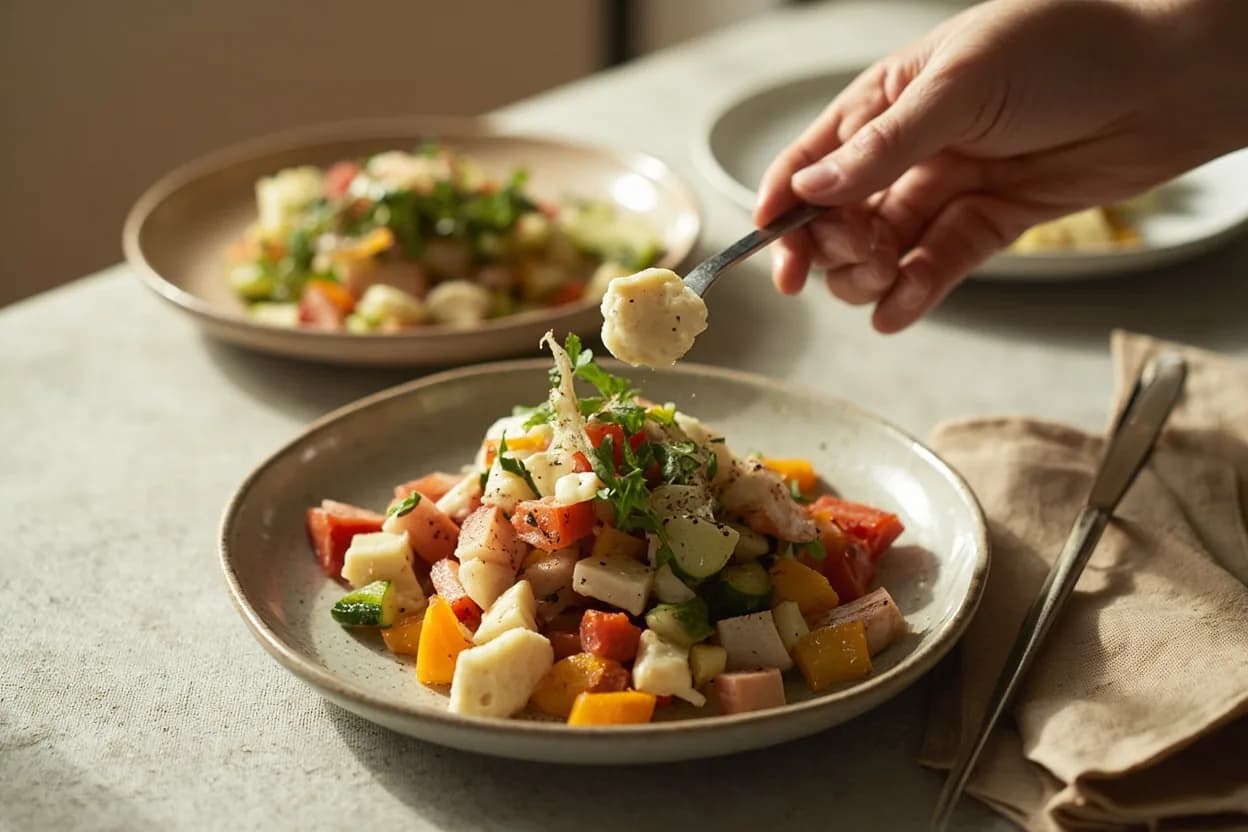
A 1 cm cube dice for fruit and vegetable salads — the iconic cut of the mixed vegetable dish that bears its name.
Macédoine refers both to a specific knife cut — a 1 cm × 1 cm × 1 cm cube — and to the classic French mixed vegetable or fruit preparation made with that cut. As a knife technique, macédoine sits between the smaller brunoise (3 mm) and the larger parmentier/large dice (2 cm) in the classical French hierarchy. The cut is produced by cross-cutting batonnet sticks at 1 cm intervals. The name is derived from the historical region of Macedonia, evoking the ethnic diversity of the Macedonian population as an analogy for the mixture of different vegetables in the dish.
In photos
Where it comes from
Applied primarily to firm vegetables (carrots, turnips, French beans, peas) for savory macédoine, and to firm fruits (apples, pears, melon, pineapple, strawberries) for macédoine de fruits. The cut always begins from a squared vegetable block reduced first to 1 cm planks, then to 1 cm batonnet-width sticks (1 cm × 1 cm × 6 cm), then cross-cut at 1 cm intervals.
Best for
How to cook it
- 1Square off the vegetable into a rectangular parade block using a chef's knife.
- 2Slice 1 cm planks parallel to the longest face of the block.
- 3Stack the planks, align their edges, and cut lengthwise to produce 1 cm × 1 cm × 6 cm batonnet sticks.
- 4Cross-cut the sticks at 1 cm intervals to yield 1 cm cubes.
- 5For savory macédoine: cook each vegetable separately in well-salted boiling water until just tender (carrots 5–7 min, turnips 4–5 min, beans 3–4 min, peas 2 min), then refresh in ice water and drain.
- 6For macédoine de légumes: dress while warm with a small amount of vinaigrette, then bind with mayonnaise once cooled.
- 7For macédoine de fruits: combine cut fruit with a light sugar syrup flavoured with lemon juice, kirsch, or Grand Marnier; refrigerate 30–60 minutes before serving.
Prep & butchery
- The 1 cm intermediate-size batonnet (not the standard 6 mm batonnet) is the specific parent cut here — each batonnet stick is 1 cm × 1 cm in cross-section rather than 6 mm.
- Cook each vegetable separately when making the classic mixed macédoine — different densities mean different cooking times, and a shared pot produces uneven results.
- Slightly undercook all vegetables by 30 seconds before refreshing; residual heat finishes the cook and the vegetables continue to soften as they cool.
- For fruit macédoine, add delicate fruits (berries, kiwi, banana) last, just before serving, to prevent bruising and discolouration.
Substitutes
- Parmentier (large dice, 2 cm)
The next size up; use when a more rustic, hearty vegetable presence is desired or for roasting applications.
- Brunoise (3 mm)
For preparations requiring a very fine vegetable texture — sauces, compound butters — where macédoine would be too large.
- Batonnet (6 mm stick)
Parent cut left in stick form; appropriate for crudité where the stick format is preferred over the cube.
Related cuts
6 mm × 6 mm × 6 cm — the standard batonnet that is cross-cut to produce small dice (6 mm) and medium dice (1 cm when using a 1 cm batonnet).
- Large Dice (Parmentier)
2 cm cube; next size above macédoine in the French hierarchy, associated with potato preparations (pommes parmentier).
3 mm cube; two sizes smaller than macédoine, used for sauces and consommé garnishes.
4 mm × 4 mm × 2 cm baton cut for mixed vegetable garnish; a close cousin of macédoine in application.
Appears in
References
- 1.The Professional Chef, 9th ed. — The Culinary Institute of America (Wiley, 2011)
- 2.Larousse Gastronomique — Prosper Montagné, ed. (Larousse, 2009)
- 3.Jacques Pépin: New Complete Techniques — Jacques Pépin (Black Dog & Leventhal, 2012)
- 4.Escoffier: The Complete Guide to the Art of Modern Cookery — Auguste Escoffier (Wiley, 2011)
Confidence: high
Notes
Etymology: From Region to Recipe
The name macédoine first appeared in French culinary literature in the early nineteenth century to describe a mixture of diverse vegetables or fruits. The geographic reference to Macedonia — a region of the Balkans known for its ethnic heterogeneity — was used as a metaphor for the mingled variety in the dish. Escoffier codified the cut and preparation in Le Guide Culinaire (1903). The term subsequently crossed languages: 'macédoine' appears in Italian (macedònia), Spanish (macedonia), and Portuguese (macedônia) to describe exactly the same fruit salad, a remarkable linguistic diffusion driven by French culinary influence.
Savory vs. Dessert Macédoine
The same 1 cm cube applies to both preparations, but the context diverges completely. Savory macédoine de légumes is a cold bound salad served as a starter or buffet item, classically dressed with a good mayonnaise (not a commercial one — the classic formula is emulsified from egg yolk, Dijon, and a neutral oil). Macédoine de fruits is a dessert of fresh seasonal fruit macerated in a light syrup, sometimes spiked with kirsch, Cointreau, or a sweet wine. The disciplined uniformity of the cut serves both: in the vegetable salad, even cubes bind with mayonnaise uniformly; in the fruit salad, they soak in syrup at the same rate and look orderly on the plate.