Knife Cuts — Classical French
Matignon
Also: edible mirepoix, fond de cuisson garni
A fine, even dice of aromatic vegetables plus cured ham, intended to be eaten with — not strained from — the finished dish.
Matignon is a classical French garnish base of aromatic vegetables — most commonly carrot, celery, and onion — cut to a precise, uniform small dice (roughly 5–8 mm) and enriched with lean cured ham or prosciutto cut to match. Unlike mirepoix, which is coarse and discarded after it surrenders its flavour, matignon is refined enough to serve alongside the principal ingredient and is therefore called 'edible mirepoix'.
In photos
Where it comes from
Knife-cut aromatic vegetables (carrot, celery, onion, sometimes mushroom or leek) plus jambon cru, jambon blanc, or prosciutto, all cut to matching small dice.
Best for
How to cook it
- 1Cut carrots, celery, and onion into a 5–8 mm dice, keeping all pieces as uniform as possible.
- 2Cut matching dice of jambon cru or prosciutto, trimming excess fat so the ham stays tender after cooking.
- 3Sweat the vegetables in clarified butter over low heat until softened but not coloured, about 8–10 minutes.
- 4Add ham dice and sweat a further 2 minutes to marry the flavours.
- 5Season lightly — the ham is already salty — and deglaze with a splash of dry Madeira or dry white wine if the recipe calls for it.
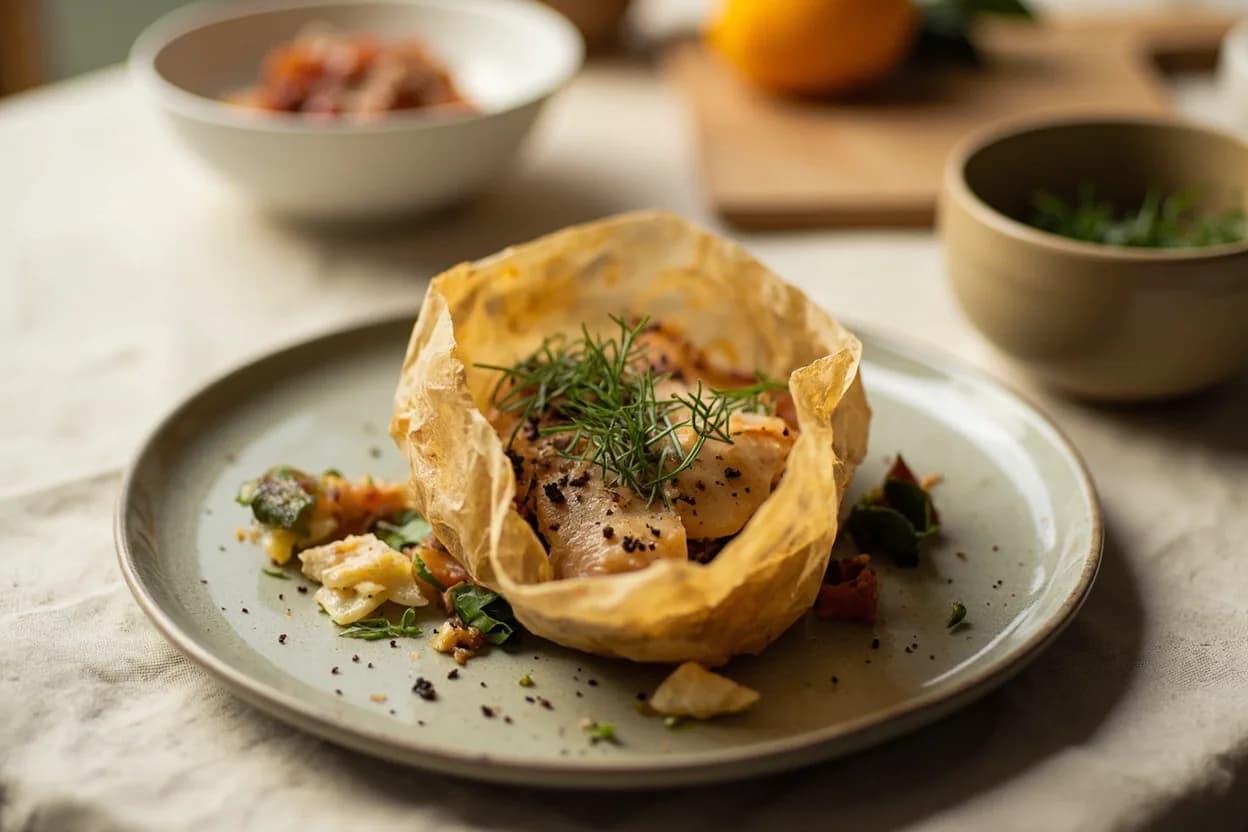
- 6Spread the matignon in the bottom of the papillote or braise vessel before adding the principal protein.
- 7After cooking, serve the matignon alongside or on top of the protein as an integral garnish.
Prep & butchery
- Square the vegetable before dicing: trim to a rectangular block first, then cut into planks, batons, and finally dice.
- Match the ham dice to vegetable dice exactly — inconsistency shows in the final plate.
- Keep knife sharp; pressure-bruising aromatic vegetables dulls their flavour.
- Blot excess moisture from mushrooms before adding if used, to prevent steaming rather than sweating.
Substitutes
Coarser cut and lacking ham; not served to the guest — use only when the garnish will be strained out.
- Soffritto
Italian equivalent without ham; finer than mirepoix but still not classical matignon.
- Brunoise of vegetables with pancetta
Acceptable substitution if jambon cru is unavailable; pancetta is fattier and more assertive.
Related cuts
The coarser, inedible aromatic base that matignon refines and enriches with ham.
An even finer dice (1–2 mm); matignon sits between brunoise and standard mirepoix in size.
- Small Dice
American culinary equivalent at roughly 6 mm — the closest standard size to a classical matignon cut.
- Duxelles
A separate aromatic base of finely chopped mushrooms; sometimes combined with matignon in stuffings.
Appears in
References
- 1.Escoffier: The Complete Guide to the Art of Modern Cookery — Auguste Escoffier (1903; English trans. H.L. Cracknell & R.J. Kaufmann, 1979)
- 2.Larousse Gastronomique — Prosper Montagné (2001 English edition)
- 3.The Professional Chef, 9th ed. — The Culinary Institute of America (2011)
Confidence: high
Notes
Origin of the name
The cut is said to be named after the Comte de Matignon, an eighteenth-century French nobleman whose cook — possibly Laguipierre — developed the preparation. The name has been attached to several classic dishes and a specific garnish doctrine in French haute cuisine since at least Escoffier's time.
Size discipline
Classical sources specify a cut of roughly 5 mm square, though modernised restaurant practice sometimes goes as small as 4 mm to accelerate cooking and improve mouthfeel. Going larger risks undercooking the vegetable during en-papillote preparations where internal temperatures are gentle.