Seafood & Shellfish Breakdown
Octopus Cleaning & Head-to-Mantle Separation
Also: octopus butchery, octopus preparation, pulpo cleaning
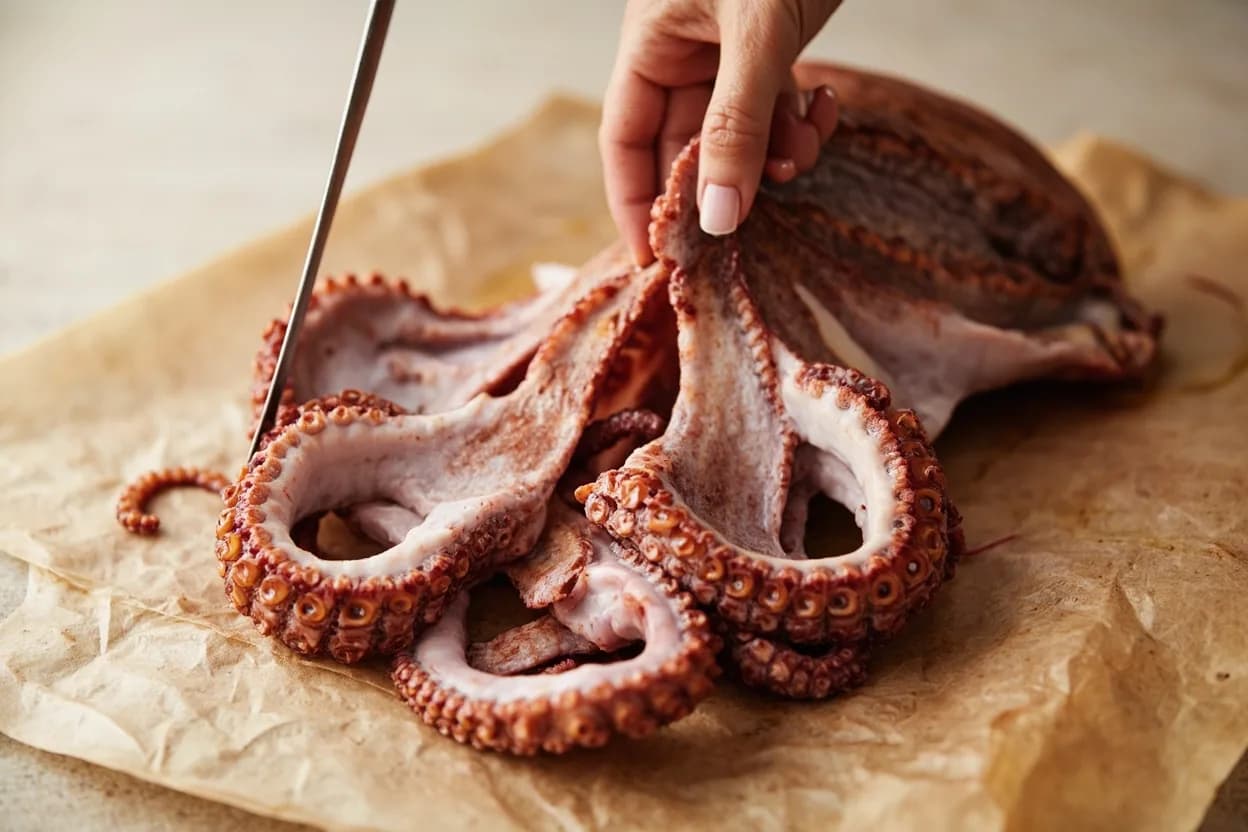
Turning the head sac inside out, purging ink and organs, removing the beak and eyes, then portioning tentacles for cooking.
Whole octopus preparation encompasses three distinct tasks: evisceration of the mantle (head sac) by turning it inside out to remove the viscera and ink sac; excision of the hard chitinous beak and gelatinous eyes at the body-tentacle junction; and separation of the tentacle crown into individual or paired arms. Tenderization — whether by freezing, vigorous massage against a surface, or traditional rock-beating on a pier stone — is as much a part of 'breaking down' octopus as the knife work itself.
In photos

Where it comes from
Octopus (Octopus vulgaris and related species) is a cephalopod mollusc. The mantle is the muscular body sac housing the organs, ink sac, and gills. The beak is a hard, parrot-like structure of chitin located at the center of the tentacle crown (the 'mouth'). The tentacles radiate outward in two rows of suckers; in O. vulgaris they number eight, of roughly equal length.
Best for
How to cook it
- 1Freeze the whole octopus solid (at least 24 hours) then thaw in the refrigerator; freezing ruptures cell walls and significantly tenderizes the flesh.
- 2Grip the mantle sac and turn it completely inside out under cold running water; pull away the silvery ink sac, viscera, and gills with your fingers — rinse thoroughly.
- 3Locate the beak at the center of the tentacle crown; push it out from the underside with your thumb, or cut a circle of flesh around it and squeeze it free. Discard.
- 4Cut the eyes from the mantle-tentacle junction with a small paring knife; discard.
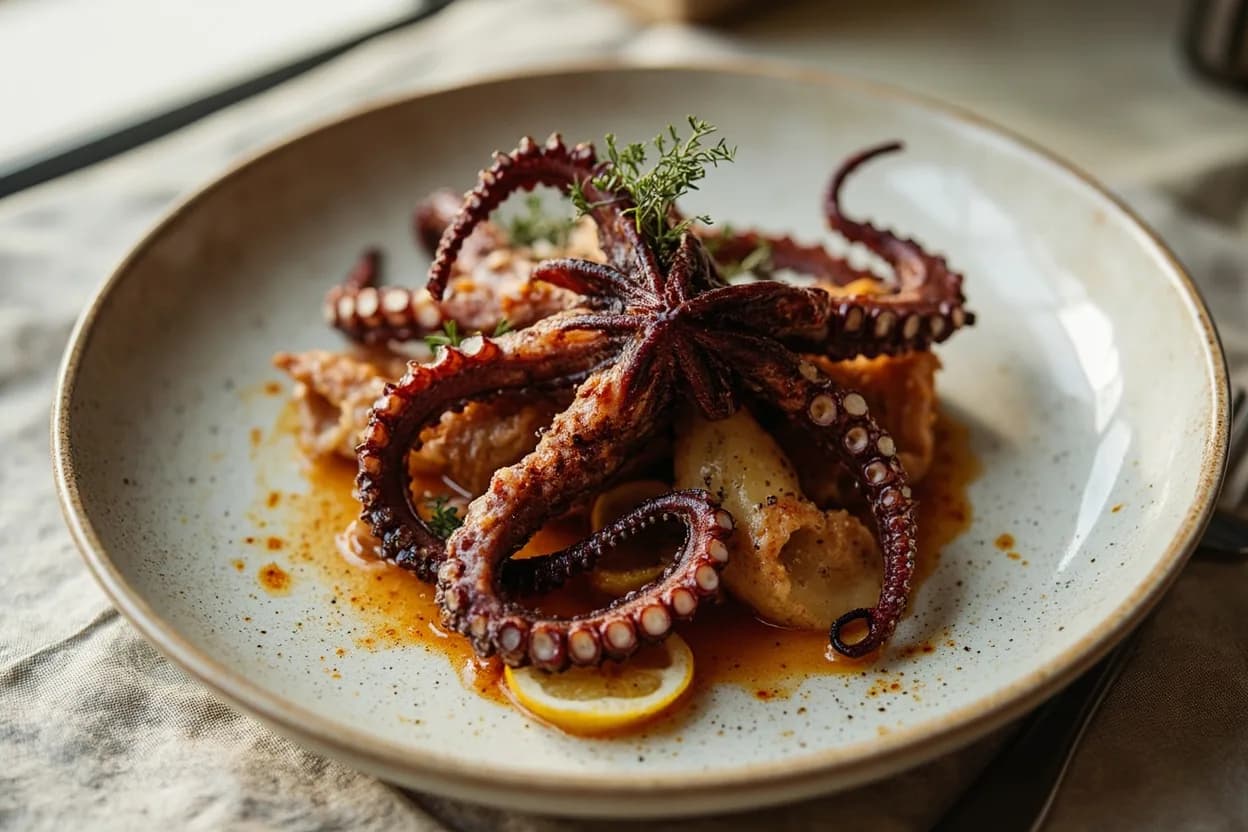
- 5Separate individual tentacles by cutting between them with a sharp chef's knife; leave in pairs (two tentacles joined at the crown) for rustic presentations, or leave the crown whole for Galician-style service.
- 6For braising: place in a cold pot with aromatics, bring slowly to a bare simmer (never boil hard), and cook 45–90 minutes until a skewer meets no resistance.
- 7For grilling: parboil until just tender, chill, then grill over high heat to char the skin; crisp skin is part of the appeal.
Prep & butchery
- A freezing step is non-negotiable for wild-caught octopus; farmed octopus (often pre-tenderized) may skip it.
- Wear kitchen gloves when handling fresh octopus to avoid ink staining hands.
- If the ink sac is intact and desired for cooking, puncture it into a bowl before eviscerating.
- Salt-massage technique: rub the raw tentacles with a generous handful of coarse salt for 5 minutes to slough off surface slime; rinse before cooking.
- Rock-beating: traditional coastal method — 50–100 firm beats on a stone surface breaks collagen without freezing.
Substitutes
- Cuttlefish (mantle)
Similar cleaning technique; mantle flips inside out the same way; cuttlebone must be pulled free instead of a beak
- Squid (whole)
Same evisceration logic but simpler — no beak excision; mantle and tentacles separate more cleanly
Related cuts
- Squid Tubes & Tentacles
Same cephalopod cleaning family; simpler anatomy with no beak
- Cuttlefish Mantle
Directly analogous mantle-flip evisceration; cuttlebone removal differs
Appears in
References
- 1.Fish & Shellfish — James Peterson (William Morrow, 1996)
- 2.The Whole Fish Cookbook — Josh Niland (Hardie Grant, 2019)
- 3.On Food and Cooking — Harold McGee (Scribner, 2004)
- 4.Aponiente kitchen notes — Ángel León, published in Madrid Fusión proceedings
Confidence: high
Notes
Why freeze?
Octopus muscle is reinforced by a dense interlocking collagen matrix. Ice-crystal formation during freezing physically ruptures cell walls and disrupts this matrix — achieving in hours what the old Greek fisherman accomplished by beating the animal against harbour rocks. The result is reliably tender flesh without the guesswork of timed beating.
Ink sac uses
Intact ink sacs from medium-to-large octopus yield enough ink to sauce a pasta or darken a braising liquid. The ink is rich in melanin, amino acids, and glutamate — it adds saline umami depth alongside the dramatic black colour. Freeze any excess in an ice-cube tray.