Regional Meat Cuts
Pork Belly Thin-Slice for Hot Pot
Also: shabu pork belly, hot pot pork, 五花肉片, hoi pork sliced, buta bara shabu
Paper-thin 1–2 mm machine-sliced pork belly, frozen first for structural rigidity, producing translucent fat-and-lean spirals ideal for swishing through Sichuan malatang or Japanese shabu-shabu broth.
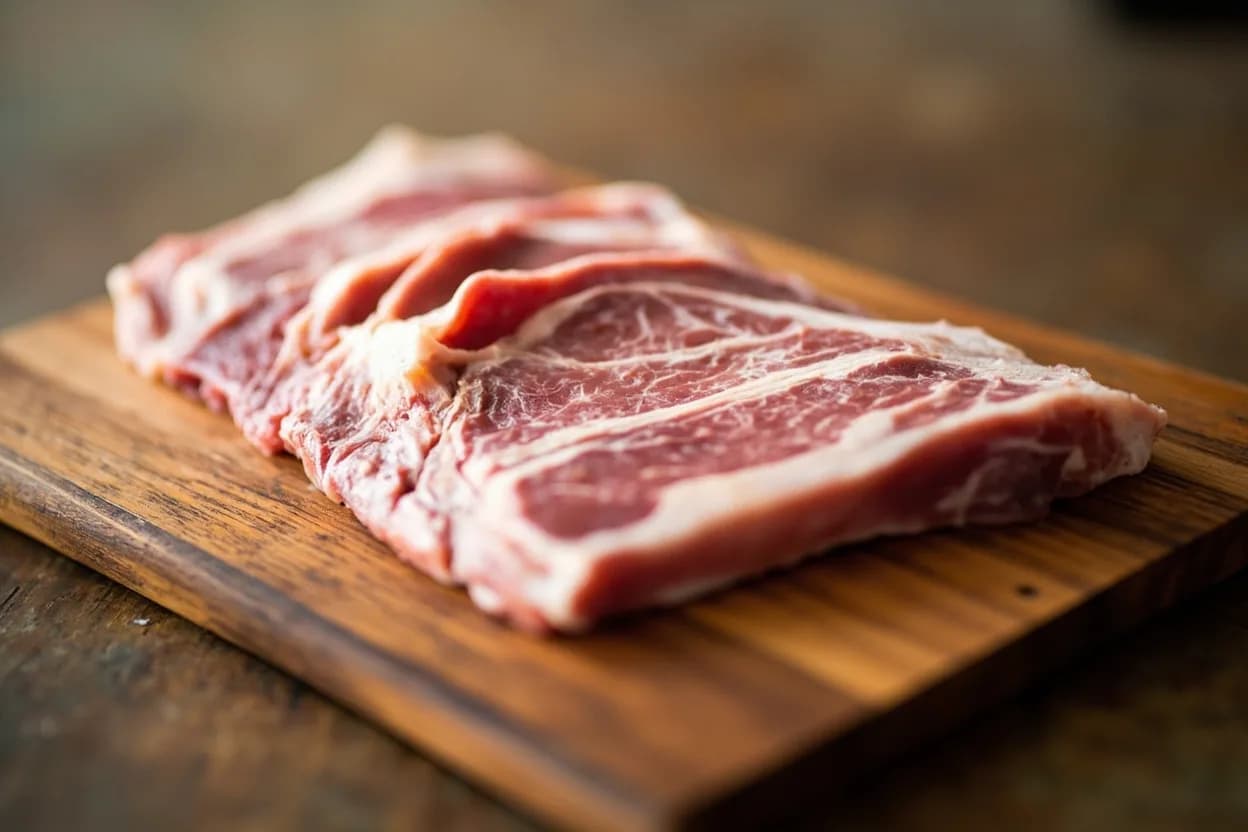
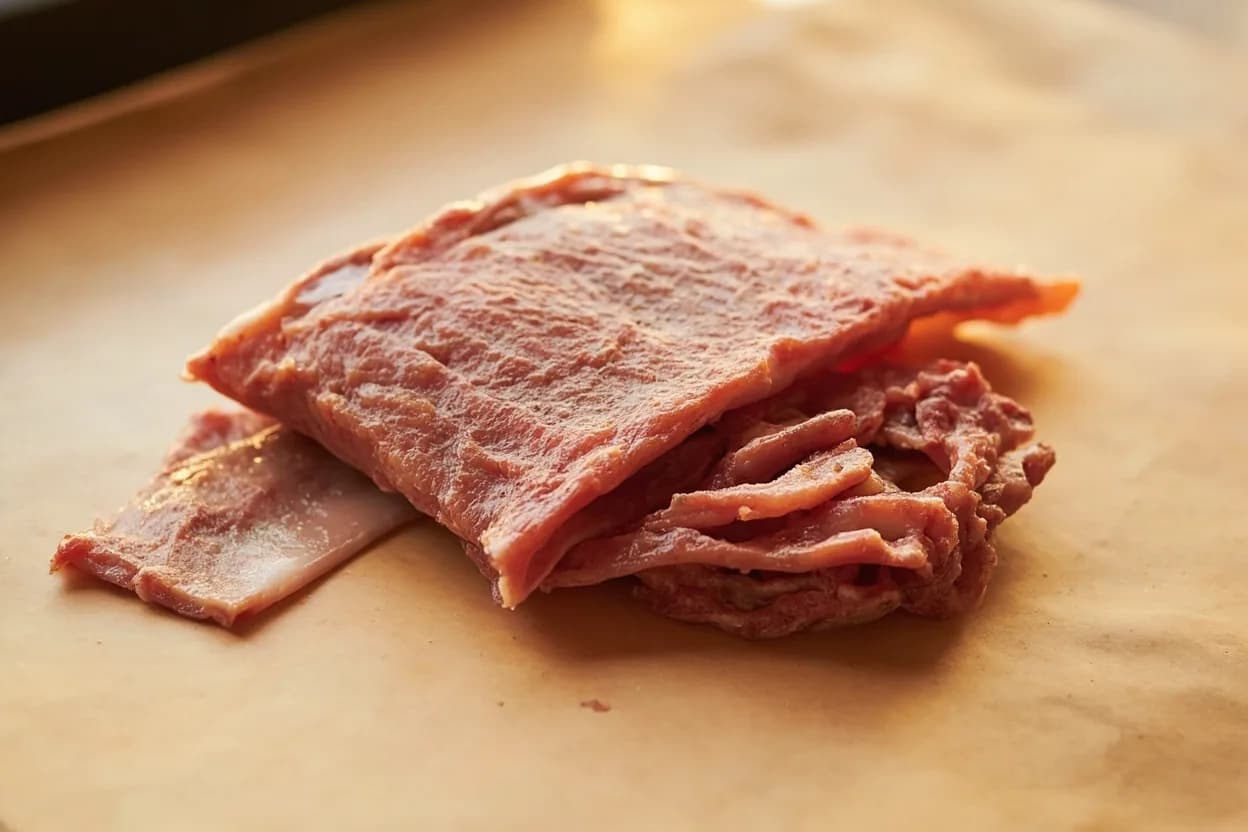
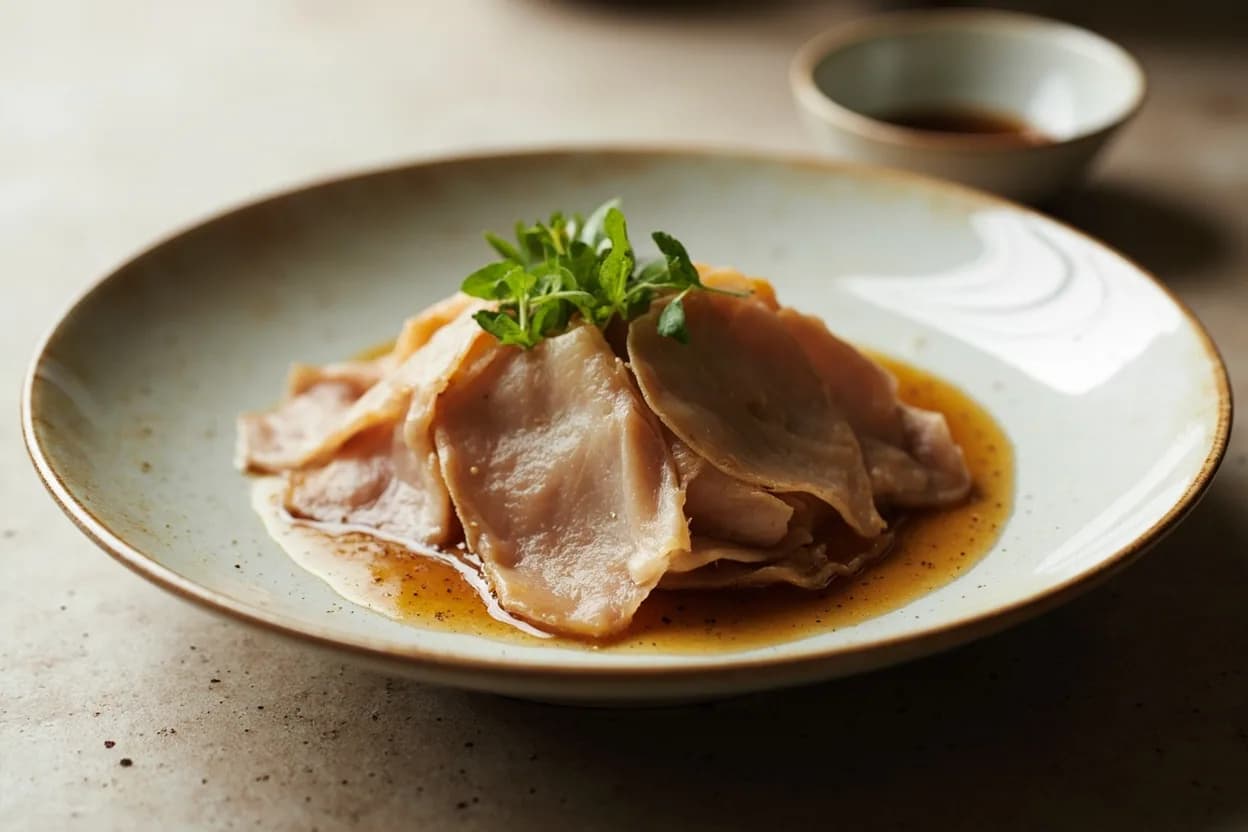
Hot-pot pork belly slices are not simply thin cuts of pork belly — they are a specific machine-processed product produced by hard-freezing a whole or half belly slab (skin-on or skinless) and running it through a commercial deli slicer or meat slicer at 1–2 mm. At this thickness, the belly's characteristic alternating layers of fat and lean become translucent and visible as concentric spirals in the rolled or folded slice. The thinness is essential: at 1–2 mm, the slices cook in 10–20 seconds in boiling broth, allowing the fat to render almost instantly into the soup while the lean remains silky rather than chewy.
In photos
Where it comes from
The pork belly (wuhua rou / 五花肉 in Mandarin, meaning 'five-flower meat' for its layered appearance) runs from the first rib to the last lumbar vertebra, between the loin above and the skin below. It comprises alternating bands of subcutaneous fat, intermuscular fat, and the serratus ventralis and internal/external oblique muscles. For hot-pot slicing, the whole belly is used — skin may be left on (adds collagen to broth) or removed depending on preference.
Best for
How to cook it
- 1Freeze the belly slab completely solid — at least 4 hours in a domestic freezer or 1–2 hours in a blast chiller. The slab must be rigid enough that the slicer blade does not compress the layers as it cuts.
- 2Set the commercial slicer or mandoline-style meat slicer to 1–1.5 mm for Japanese-style hot pot; 2 mm for Sichuan hot pot where slices cook a little longer.
- 3Arrange slices overlapping on a cold tray, refrigerate until needed, and consume within 24 hours of slicing — very thin pork oxidises quickly.
- 4For shabu-shabu: hold one slice with chopsticks and swish in simmering dashi or kombu broth in a figure-of-eight motion for 8–12 seconds until the colour changes from pink to white-grey. Do not boil aggressively — a gentle simmer preserves the texture.
- 5For Sichuan hot pot: drop 3–4 slices at once into the boiling mala broth; remove after 20–30 seconds; eat immediately with sesame paste and chili oil dipping sauce.
Prep & butchery
- Always freeze before slicing — room-temperature belly compresses under any blade thinner than 4 mm and produces ragged, uneven cuts
- Remove the skin before freezing if you prefer skinless slices, or freeze skin-on and slice through it for a collagen-rich hot-pot addition
- Commercial pre-sliced hot-pot pork belly (found frozen in Asian supermarkets) is already the correct thickness — thaw in the refrigerator, not at room temperature
- Do not attempt 1–2 mm slices with a chef's knife; a Japanese mandoline or a commercial deli slicer is the minimum equipment required
Substitutes
- Pork Shoulder Thin-Sliced
Less fat, tighter grain — cooks slightly drier; use at the same 1–2 mm thickness and reduce cook time to 6–8 seconds
- Pork Leg Thin-Sliced
Leaner still; used in Japanese cold shabu-shabu salads (hiyashi shabu) where the fat of belly would be cloying when cool
- Beef Short Rib Paper-Thin (chadolbaegi)
Korean hot pot equivalent — same machine-slice technique applied to short rib; richer flavour but not a pork substitute
Related cuts
- Pork Belly (whole)
The parent primal from which hot-pot slices are produced
- Pork Collar Thin-Sliced
Used interchangeably in some Japanese hot-pot menus; less fat, more complex marbling
- Sukiyaki Beef Thin-Slice
Same machine-slicing technique applied to beef chuck roll or rib eye for sukiyaki — a parallel product
Appears in
References
- 1.Japanese Farm Food — Nancy Singleton Hachisu (2012)
- 2.Land of Fish and Rice — Fuchsia Dunlop (2016)
- 3.The Food of Sichuan — Fuchsia Dunlop (2019)
- 4.Japanese Soul Cooking — Tadashi Ono & Harris Salat (2013)
- 5.On Food and Cooking — Harold McGee (2004)
Confidence: high
Notes
The physics of freeze-slicing
Pork belly's fat layers are the technical challenge: at room temperature, subcutaneous fat is soft enough to smear and compress under a blade rather than shear cleanly, producing slices with ragged fat edges and varying thickness. Freezing resolves this by hardening the fat to nearly the same rigidity as the muscle, allowing the slicer blade to cut both materials simultaneously at the same speed. The ideal temperature at the blade face is between −5°C and −10°C — cold enough for rigidity but not so cold that the thin slices shatter. In Chinese and Japanese supermarket butcheries, a blast chiller holds slabs at exactly this range during the slicing run.
Cultural context: wuhua rou in Chinese cuisine
The Chinese name 五花肉 (wuhua rou, 'five-flower meat') reflects the aesthetic appreciation of the belly's layering — the five visible alternating bands of fat and lean in a cross-section. This layered pattern is considered visually beautiful in Chinese food culture and is why thin-sliced belly arranged in rosette or overlapping fan patterns is a fixture of premium hot-pot menus. The slicing technique that makes these patterns visible is treated as a skilled task: a poorly sliced belly with torn fat layers is considered a mark of poor kitchen craft.