Pork — Primal & Subprimal
Pork Belly — Skin-On Slab & Cuts
Also: pork belly, side pork, fresh belly, streaky pork, samgyeopsal, wuhua rou, five-flower pork, pancetta slab, belly slab
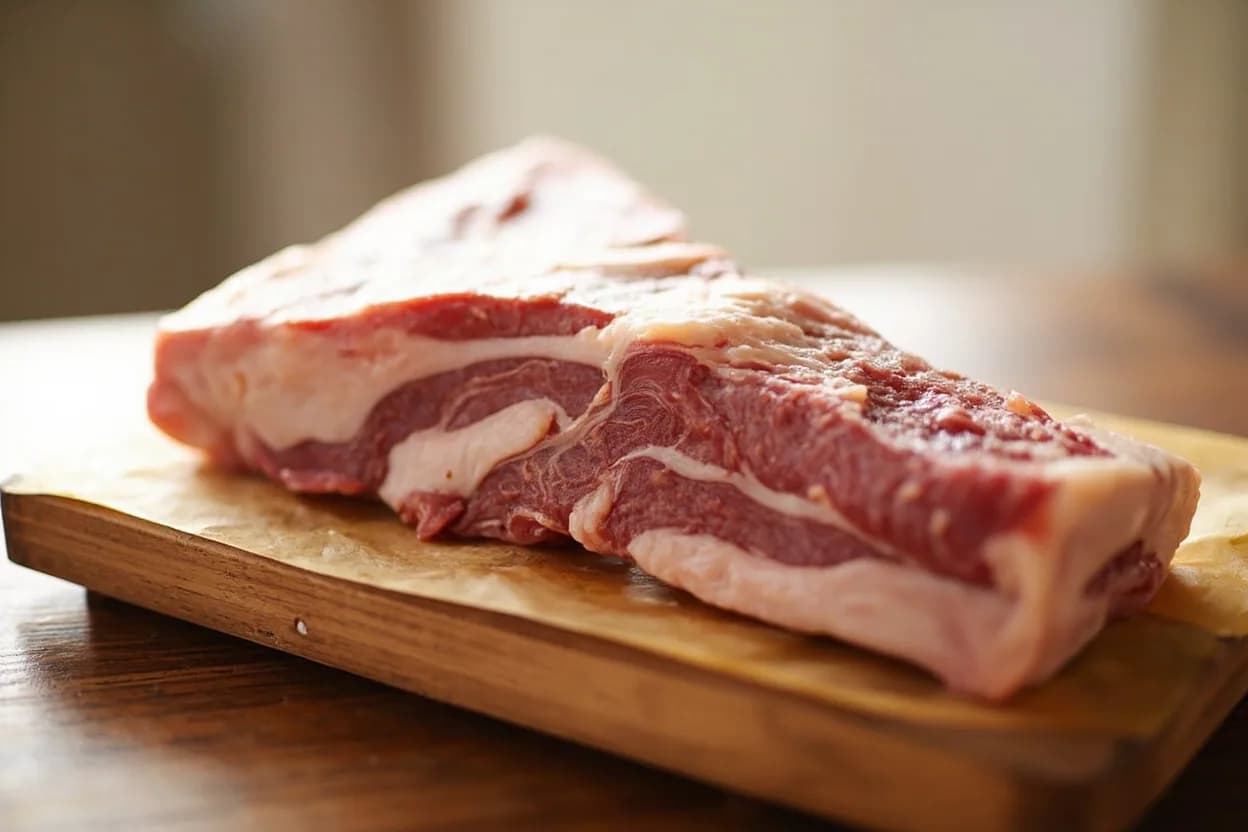
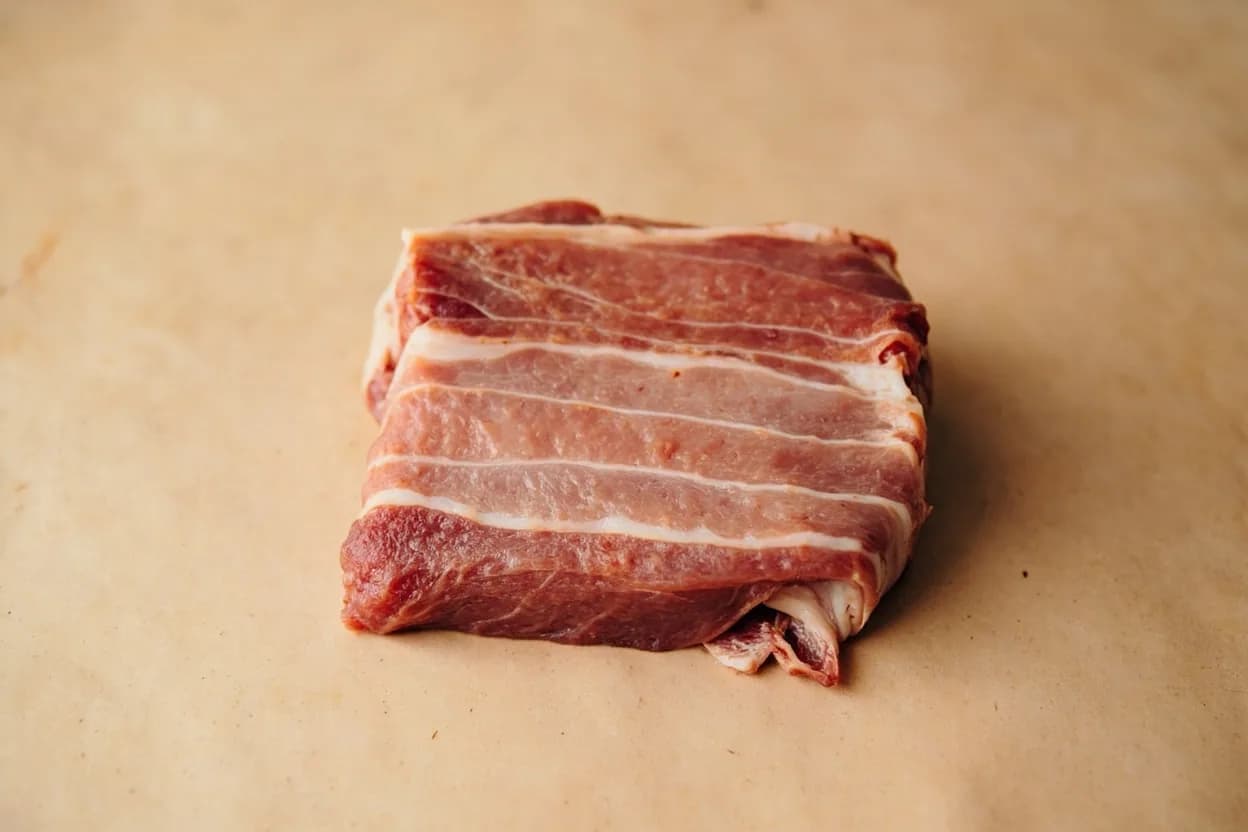
The layered fat-and-lean ventral slab of the pork carcass — source of bacon, pancetta, samgyeopsal, and char siu — prized globally for its alternating strata of snow-white fat and rose-pink lean.
Pork belly (NAMP 408) is the unsplit ventral section of the pork carcass, running from the 5th rib to the hipbone. It is a rectangular slab of alternating subcutaneous fat, muscle (primarily the external and internal oblique, transversus abdominis, and rectus abdominis), and deeper intermuscular fat layers — typically 3–5 distinct strata depending on the animal's finish. A full skin-on belly is 10–14 inches wide and 16–20 inches long; retail sections are smaller. The skin (rind) adds an additional collagen-rich layer above the outermost fat stratum. The belly contains no structural bones in the retail configuration (spare ribs are removed at the loin-belly separation cut), though cartilaginous false-rib ends may remain on the inner face.
In photos

Where it comes from
Sits below the loin primal on the underside of the carcass. The boundary with the loin is established by a straight horizontal cut through the ribcage — the height of this cut determines how many rib-end bones (buttons) remain on the belly versus on the loin. The belly runs from the shoulder-belly junction anteriorly to the hip posteriorly. The ventral midline (where the two sides of the belly join in the live animal) is the thinnest point.
Best for
How to cook it
- 1Korean samgyeopsal (skin-off, thick-sliced): cut 8–10 mm slices against the grain; grill on a cast-iron or wire grill at high heat; 3–4 minutes per side until fat is rendered and edges are lightly charred; serve with ssamjang, garlic, perilla.
- 2Cantonese siu yuk (crispy roast pork, skin-on): score skin deeply in a diamond pattern; dry-brine with salt overnight in the refrigerator skin-side up; roast at 375 °F (190 °C) for 40 minutes, then broil or blast at 475 °F (246 °C) for 15–20 minutes until skin is completely blistered and crackling.
- 3Chinese red-braised (hong shao rou): cut skin-on belly into 4 cm cubes; blanch 3 minutes; sear; braise in soy, Shaoxing wine, rock sugar, star anise, and cinnamon at a gentle simmer for 90 minutes until sauce is lacquered and pork is spoonable.
- 4Japanese kakuni: cut into 6 cm blocks; simmer in water 1 hour; transfer to fresh pot with dashi, sake, mirin, soy; braise covered 60–90 minutes until chopstick-tender; reduce sauce to glaze.
- 5Pancetta (Italian cure): rub a 2.5 kg skin-off belly slab with 3% kosher salt, 0.25% pink salt #1, black pepper, juniper, thyme, rosemary; cure refrigerated 7–10 days; rinse, roll tightly with the lean to the outside, truss every 2 cm; hang at 55 °F (13 °C) for 4–8 weeks.
- 6Skin management: for crackling, the skin must be completely dry before high-heat roasting (air-dry uncovered in the fridge overnight minimum, or use a heat gun); any surface moisture converts to steam and prevents blistering.
Prep & butchery
- Skin-on vs. skinless: skin is removed by running a sharp knife between the rind and the outer fat layer in a single flat stroke; request skin-on from a butcher who has not pre-stripped it.
- For Korean samgyeopsal: chill the belly slab in the freezer 30 minutes before slicing to firm the fat and achieve clean uniform cuts with a sharp slicing knife.
- For Chinese block braises: cut across the width of the belly to create uniform blocks that include all fat-and-lean layers in each piece.
- Score the skin in a diamond pattern with a sharp knife or Stanley blade before any skin-on roasting — cuts should reach the fat but not penetrate the meat below.
- For pancetta or bacon: the belly must be skinless (in Europe, skin is typically left on for pancetta; in the US, skin is removed for most bacon production — specify with your butcher).
- Debone false-rib cartilage ends (riblets) from the inner face of the belly if present — they are edible but create uneven thickness in sliced applications.
Substitutes
- Pork shoulder (skinless)
Higher collagen, less uniform layering; works in braises but lacks the belly's fat-to-lean laminate structure and does not produce crackling.
- Pork jowl
Similarly high-fat with alternating fat and lean; can substitute in braises and some charcuterie applications; smaller size limits whole-slab uses.
- Duck confit legs
For Asian braises where belly is used as a rich protein centrepiece — an unusual substitute but shares the richness and self-basting quality if pork belly is unavailable.
Related cuts
- Spare Ribs
Separated from the belly at the rib line; the rib cage that was above the belly before the loin-belly cut.
- St. Louis–Style Spare Ribs
Spare ribs trimmed of the brisket flap and sternum — the brisket flap is a belly extension, sometimes kept attached for braises.
- Pork Side / Side Pork
North American retail term for the unsplit fresh belly slab before curing — same cut, different nomenclature.
Cured pork jowl — the traditional Italian substitute for pancetta in carbonara and amatriciana; adjacent cut, similar fat profile.
Appears in
References
- 1.The Food of Sichuan — Fuchsia Dunlop (W. W. Norton, 2019)
- 2.Charcuterie: The Craft of Salting, Smoking, and Curing — Michael Ruhlman & Brian Polcyn (W. W. Norton, 2005)
- 3.Korean BBQ: Master Your Grill in Seven Sauces — Bill Kim (Ten Speed Press, 2019)
- 4.The River Cottage Meat Book — Hugh Fearnley-Whittingstall (Hodder & Stoughton, 2004)
- 5.NAMP Meat Buyer's Guide, 8th ed. — North American Meat Processors Association (2010)
- 6.Land of Fish and Rice: Recipes from the Culinary Heart of China — Fuchsia Dunlop (W. W. Norton, 2016)
Confidence: high
Notes
Layer count as quality signal
The Chinese name for pork belly — wuhua rou (五花肉, 'five-flower meat') — refers to the ideal of five distinct alternating layers: skin, fat, lean, fat, lean. The layer count in a cross-sectional slice is a reliable indicator of belly quality in Chinese culinary tradition. Intensively reared hogs often show only two or three layers due to the fat layers merging; heritage breeds (Berkshire, Duroc, Mangalitsa) reliably produce five or more visible strata and command a premium in both Asian and Western markets.
Crackling science
Pork skin is roughly 30% water and 70% collagen. Crackling requires the water to be fully expelled (by air-drying or high-heat roasting) so the collagen can undergo a rapid conversion to a puffed, rigid amorphous solid when heated above 200 °C (392 °F). Any residual moisture converts to steam, softening rather than crisping the skin. The small protein bubbles in properly crisped crackling are CO₂ produced by the rapid denaturation of the collagen network. Vinegar or bicarbonate of soda washes (applied to the scored skin before drying) further weaken the collagen network and promote more dramatic blistering.
Global cut-thickness conventions
Belly thickness varies dramatically by cuisine: Korean samgyeopsal is sliced 8–12 mm thick (thick enough to grill directly); Japanese kakuni is cut into 4–6 cm blocks for braising; Chinese hong shao rou uses 3–4 cm cubes; Italian pancetta is rolled whole (10–12 cm diameter) and sliced paper-thin for cooking; British streaky bacon is 2–3 mm; US bacon is typically 3–4 mm. Each thickness is optimised for a specific heat source and timing — the cut is not interchangeable without adjusting cooking method.