Pork — Primal & Subprimal
Pork Tenderloin vs. Loin Chop
Also: pork fillet, pork filet, pork medallion, tenderloin medallion
The tenderloin and the loin chop come from the same primal but are anatomically distinct muscles with opposite fat levels, radically different cooking windows, and no real substitutability for one another.
The pork tenderloin (psoas major) is a slender, tapered muscle that hangs inside the abdominal cavity, suspended from the lumbar vertebrae. It is the least-worked muscle on the pig — and therefore the most tender. The loin chop is a cross-section of the back loin, dominated by the longissimus dorsi, and is cut perpendicular to the spine. These two muscles are neighbors but behave completely differently at the stove.
In photos
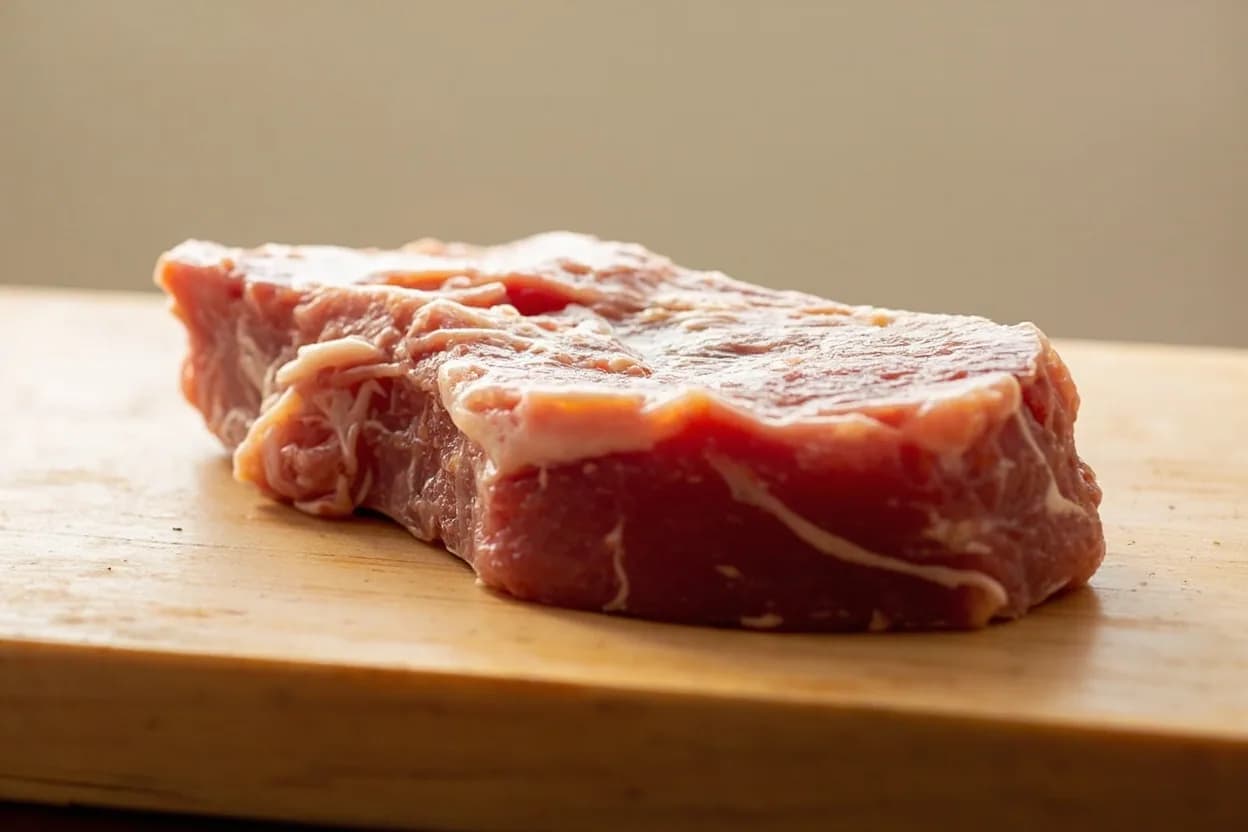
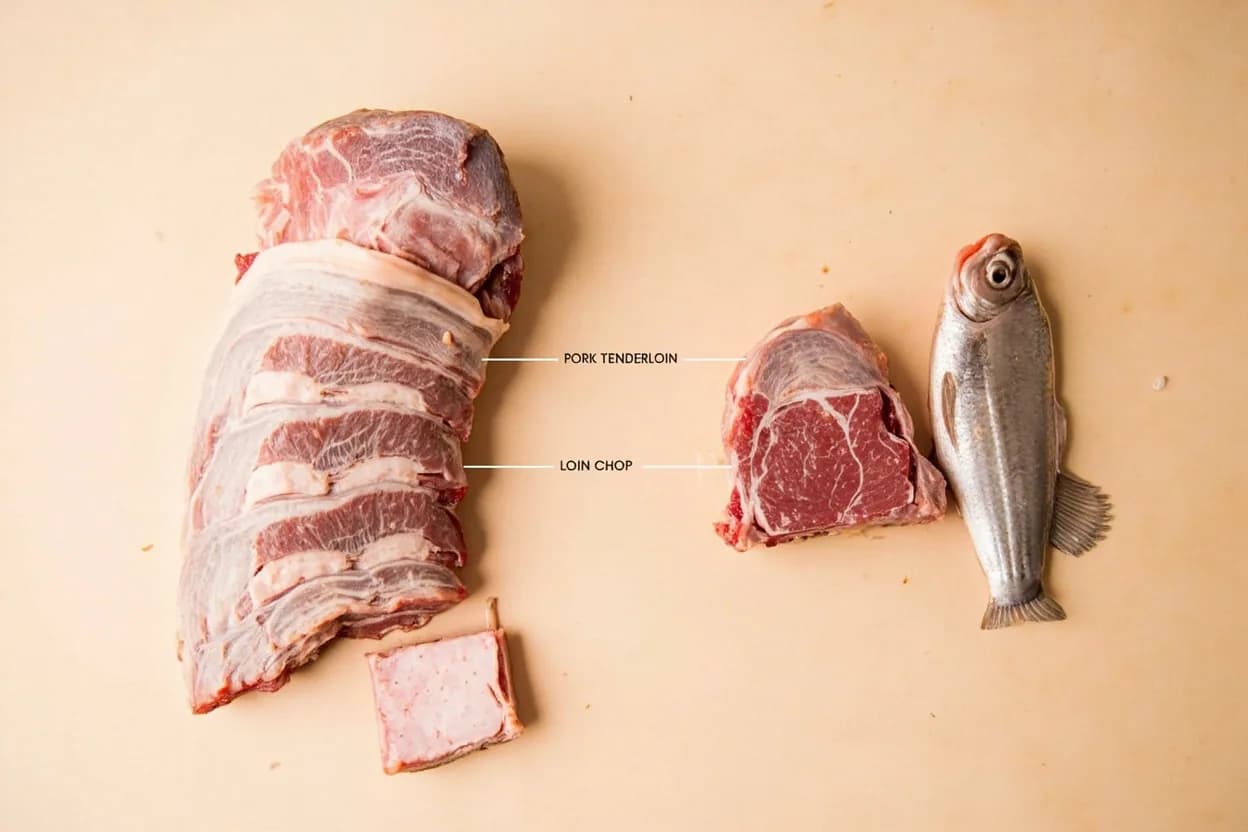
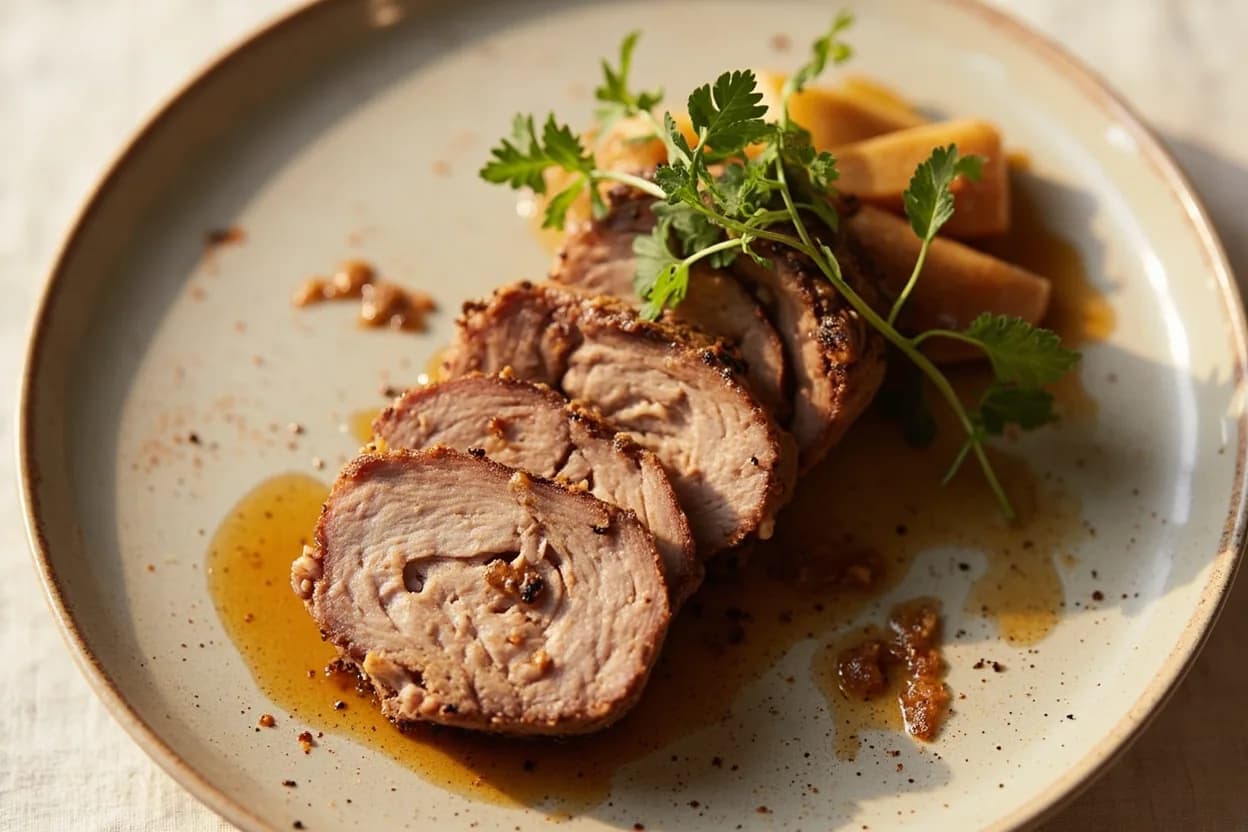
Where it comes from
The tenderloin runs inside the body cavity, beneath and parallel to the loin. It has no load-bearing function, which is why it has virtually no collagen. A full tenderloin weighs 12–18 oz (340–510g) and tapers sharply at the 'tail' end. The loin chop, by contrast, is a cross-section of the back, including the longissimus dorsi on one side of the T-bone and sometimes the tenderloin eye on the other — making a T-bone or porterhouse pork chop when both muscles are present.
Best for
How to cook it
- 1Tenderloin — whole roast: sear all sides in oil over high heat (2 min per side), transfer to 425°F (220°C) oven for 12–15 min until internal temp reaches 140–145°F (60–63°C). Rest 5 min; slice across the grain into medallions 1.5 inches thick.
- 2Tenderloin — remove silverskin first: insert knife tip just beneath the silver membrane, angle the blade slightly upward and slide the length of the muscle in one stroke, pulling the membrane taut with your free hand.
- 3Tenderloin medallions: cut the thick end into 1.5-inch rounds, butterfly the thin tail-end piece for uniform thickness, then sauté 2 min per side in clarified butter — they finish cooking in the residual heat while resting.
- 4Loin chop — sear and rest: dry-brine 4–12 hours. Sear 3–4 min per side in cast iron, then rest on a rack for 5 min. For thick chops over 1.25 inches, finish in a 375°F (190°C) oven after searing.
- 5Avoid marinades for tenderloin beyond 2 hours — acid degrades the delicate muscle fibers and turns the surface pasty.
- 6Do not crowd the pan for either cut; steam is the enemy of a good sear.
Prep & butchery
- Silverskin removal is mandatory for tenderloin — it contracts into a tight band under heat, buckling the meat and creating a rubbery strip
- Tie the tenderloin with butcher's twine at 1-inch intervals if stuffing, or if the tail is too thin to cook evenly alongside the thick end; alternatively fold the tail under and secure with a toothpick
- For loin chops, score the fat cap edge in two or three cuts to prevent the chop from curling in the pan
- Pat completely dry before any sear — surface moisture prevents the Maillard reaction
- For medallions, slice the tenderloin when cold (just out of the refrigerator) for cleaner, more uniform rounds
Substitutes
- Veal tenderloin
Even more delicate; near-identical cooking method and time
- Chicken breast
Similar leanness and cooking-window sensitivity; no fat to buffer heat
- Beef filet mignon medallions
Analogous anatomy in beef; richer flavor, higher fat, more tolerant of slight overcooking
Related cuts
- Pork Loin — Center Cut
The longissimus dorsi cross-section; neighbors the tenderloin in the same primal
- Beef Filet Mignon
The psoas major equivalent in beef; same functional anatomy, richer fat
- Pork Porterhouse Chop
A thick T-bone pork chop containing both the loin and a cross-section of the tenderloin simultaneously
Appears in
References
- 1.The River Cottage Meat Book — Hugh Fearnley-Whittingstall
- 2.The Professional Chef, 9th ed. — The Culinary Institute of America
- 3.On Food and Cooking: The Science and Lore of the Kitchen — Harold McGee
- 4.USDA Institutional Meat Purchase Specifications (IMPS) — Fresh Pork Series 400
Confidence: high
Notes
The Overcooking Problem
The tenderloin's extreme leanness means its safe margin between perfectly cooked and overdone is narrow — roughly 5–8°F (3–4°C). At 145°F (63°C) it is juicy with a faint pink center. At 160°F (71°C) it is dry and chalky. A reliable instant-read thermometer is non-negotiable. The loin chop is slightly more forgiving due to its fat cap, but both cuts benefit from resting covered loosely with foil to allow carryover cooking to equalize without overshooting.
Spotting the Difference at the Butcher Counter
Tenderloin is a whole muscle sold intact (never sliced), cigar-shaped, with a visibly silver membrane and zero fat cap. It typically comes vacuum-sealed in pairs. A loin chop is always a cross-section: oval, with a distinct fat band on one edge and a clean bone (if bone-in) or smooth cut face (if boneless). Grocery stores sometimes mislabel boneless loin chops as 'pork tenderloin' — check for the fat cap and rectangular cross-section that betrays the loin.