Knife Cuts — Japanese
Sainome-giri (Small Dice)
Also: sainome giri, 賽の目切り, dice cut, Japanese small dice
Japanese small-dice cut producing 1 cm cubes, used for tofu, firm vegetables, and ingredients destined for miso soup, aemono, and simmered dishes.
Sainome-giri (賽の目切り, literally 'dice-eye cut', referring to the dots on a die) is the Japanese standard for a small, even cube approximately 1 cm on each side. The name evokes the square face of a game die; the goal is geometric uniformity so all pieces cook at the same rate and present cleanly in broth or salad.
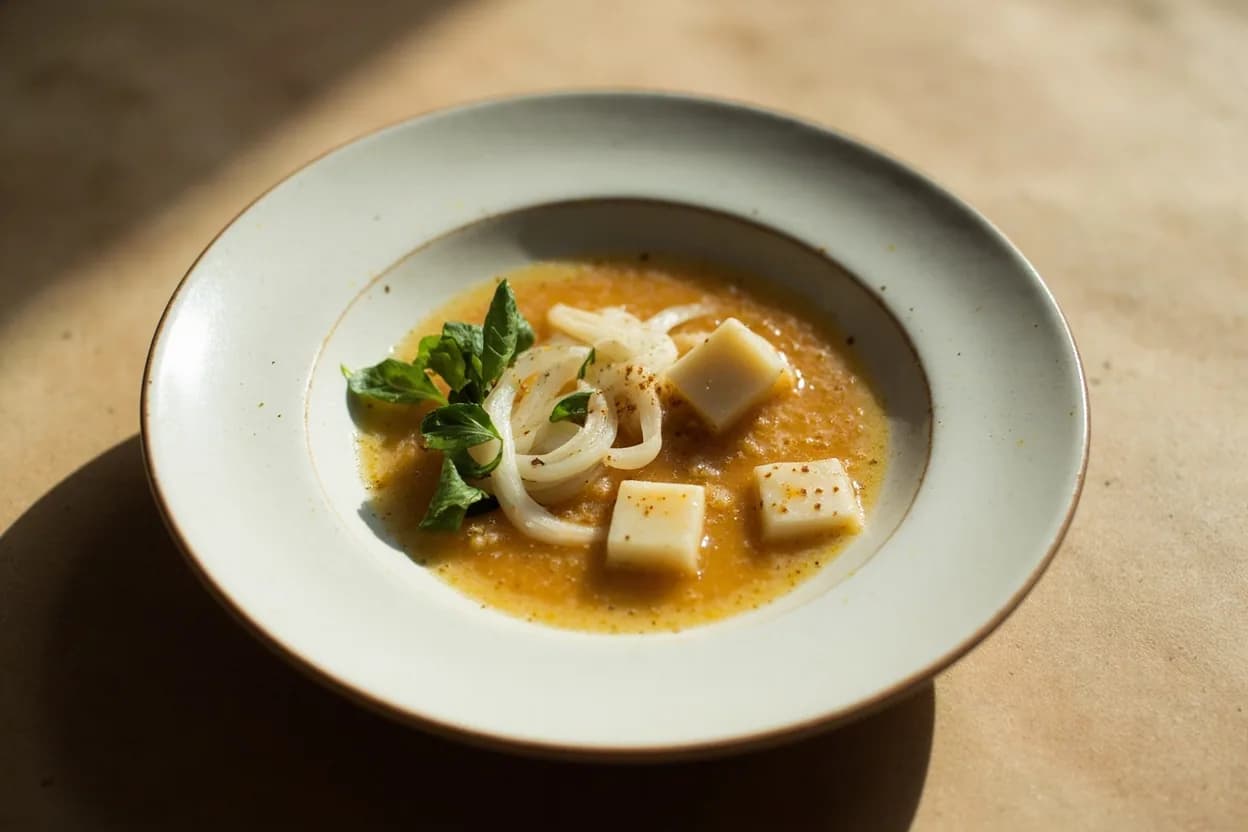
In photos
Where it comes from
Knife technique applied to block or cylindrical vegetables, firm tofu, konjac (konnyaku), potato, daikon, carrot, and similar ingredients. Derived from first cutting planks, then batons, then cubing.
Best for
How to cook it
- 1Square off the vegetable by removing any curved sides to produce a neat rectangular block — trim scraps go into stock.
- 2Slice the block lengthwise into planks 1 cm thick, keeping them stacked and aligned.
- 3Rotate the stack 90° and slice again into 1 cm batons.
- 4Gather the batons and slice crosswise at 1 cm intervals to produce even cubes.
- 5For silken tofu, drain on kitchen paper for 10 minutes to firm slightly before cutting; use a gentle downward press rather than a sawing motion to avoid crumbling.
- 6For konnyaku, score the surface lightly after dicing — this opens the surface and allows seasoning to penetrate faster during simmering.
Prep & butchery
- A gyuto (chef's knife) or nakiri (vegetable cleaver) both work well; the nakiri's flat blade contacts the board along its full length, reducing rocking and improving cube uniformity.
- Squaring off the vegetable before cutting is non-negotiable for true sainome-giri — it distinguishes the technique from a rough dice.
- For firm root vegetables like carrot or daikon, a moist cutting board prevents skidding.
- Drain tofu on a tilted board under a light weight for 10 minutes before cutting to improve cube integrity.
Substitutes
- Brunoise (fine dice, 3 mm)
Western fine dice; much smaller — use when the recipe calls for a more refined garnish rather than a substantial dice.
- Rough chop
Loses the uniform cooking-rate benefit; acceptable for long-simmered dishes only.
- Niku-jaga potato chunks
Larger irregular pieces traditional in comfort nimono; not a precision substitute but contextually appropriate.
Related cuts
- Sengiri
Fine julienne shreds — the plank stage of sainome-giri, extended into strips rather than cubed.
- Hyoshigi-giri
Rectangular batons (~1 cm × 1 cm × 4 cm); the intermediate stage before the final cross-cut of sainome-giri.
- Icho-giri
Quarter-moon cut from cylindrical vegetables; different geometry but similar size range.
- Mijin-giri
Micro-mince — the extreme fine end of the Japanese dicing spectrum.
Appears in
References
- 1.Japanese Cooking: A Simple Art — Shizuo Tsuji
- 2.Washoku: Recipes from the Japanese Home Kitchen — Elizabeth Andoh
- 3.The Japanese Kitchen — Hiroko Shimbo
- 4.Mastering the Art of Japanese Home Cooking — Masaharu Morimoto
Confidence: high
Notes
Name etymology
The 'sai' in sainome-giri references 'sai no me' (賽の目), the pip face of a die. In classical Japanese culinary vocabulary, the cut is explicitly defined by this die-face analogy — all six sides equal, all angles 90°. This sets it apart from a casual rough dice and aligns it with a precision standard comparable to the French brunoise/macédoine family.
Tofu handling
Silken tofu (kinugoshi) is rarely cut sainome-giri because it collapses; the technique is standard for firm tofu (momen), which holds a clean cube face. When tofu cubes appear in miso soup, the sainome dimension (roughly 1 cm) is calibrated to float naturally and cook through in the 2–3 minutes the soup sits before service.