Knife Cuts — Regional & Global
Tasajo Butterfly Accordion Slice
Also: accordion cut, unrolled butterfly cut, tasajo unfurl cut, continuous butterfly
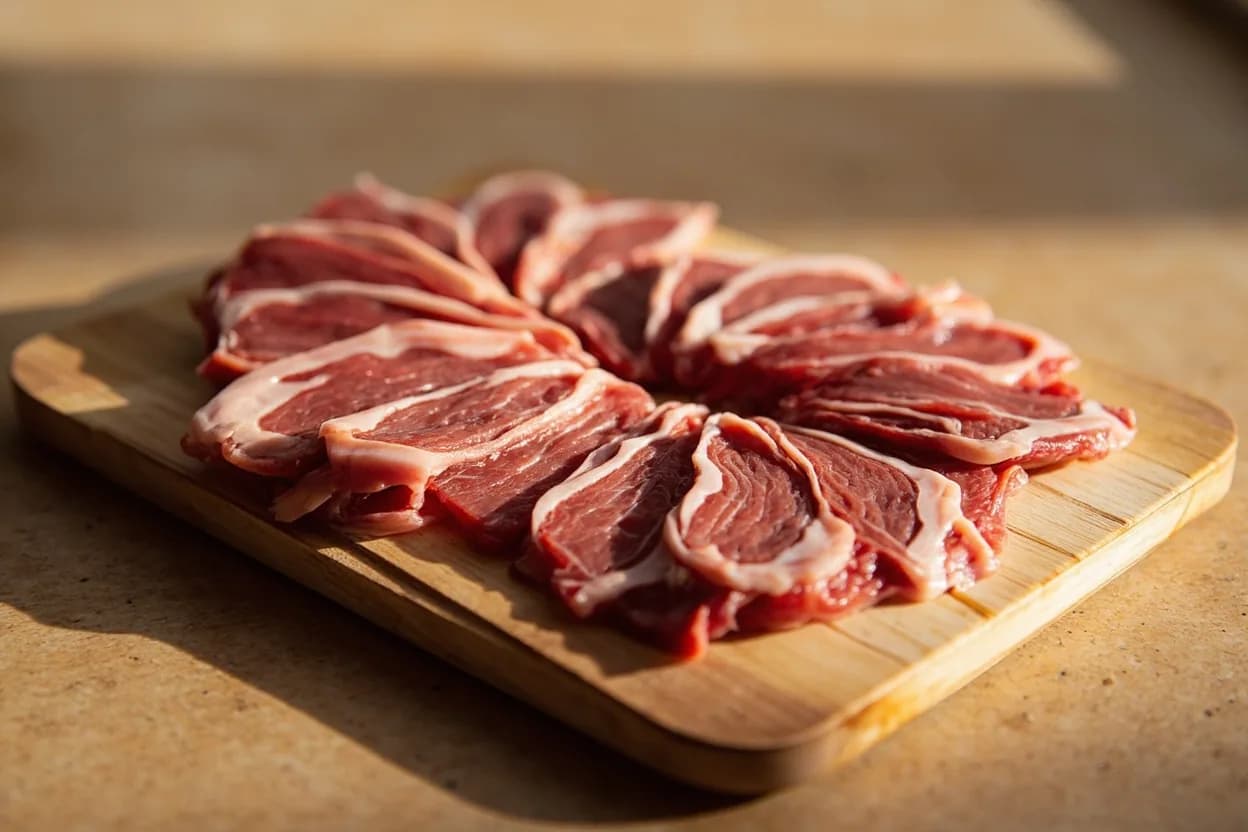
A continuous, back-and-forth butterfly cut that unfurls a whole beef muscle into a single long, thin, flat sheet ready for salt-drying — the defining technique of Oaxacan tasajo.
An extended variation of the butterfly cut in which the knife makes repeated parallel passes through a whole muscle, each cut stopping short of the opposite edge so the meat remains in one connected piece. The muscle literally unfolds like an accordion or a scroll to reveal a continuous flat sheet 4–8 mm thick. This maximizes drying surface area and ensures even salt penetration and airflow across the entire mass of meat with no thick interior pockets — critical for the safe production of tasajo, the salted, air-dried beef central to Oaxacan cuisine.
In photos

Where it comes from
Applied to whole beef muscles — typically the sirloin tip (cuete), eye of round, or similar lean, elongated cuts — purchased or butchered in Oaxaca's mercados. The technique is performed by specialist tasajo butchers (tasajeros) who develop speed and consistency through daily practice.
Best for
How to cook it
- 1Begin with a whole, trimmed, lean beef muscle weighing 1–3 kg; chill until firm.
- 2Place the muscle on a large, stable board. Make the first horizontal butterfly cut from one long side, stopping 1–2 cm from the opposite edge — do not sever.
- 3Open the flap outward (as with a standard butterfly). Now the double-thick section that remains becomes the new 'block.'
- 4Continue making parallel horizontal cuts through the remaining block, each stopping 1–2 cm from the opposite edge and opening the flap in the opposite direction.
- 5Repeat until the entire muscle is one continuous flat sheet, 4–8 mm thick throughout.
- 6Rub both surfaces with coarse sea salt (approximately 2–3% by weight), optionally with dried chile and garlic, and hang or lay flat to air-dry in a cool, ventilated space for 12–48 hours.
- 7To cook: grill directly over high charcoal heat for 2–3 minutes per side; the thin sheet cooks rapidly.
Prep & butchery
- A long, thin, sharp boning knife or flexible slicing knife is essential; a stiff blade makes horizontal passes through a wide muscle difficult to control.
- Chill the meat to near-freezing for cleaner, more consistent horizontal cuts — warm meat compresses under the blade.
- Identify the muscle's fiber direction before starting; cutting parallel to long fibers yields a more cohesive sheet than cutting across them.
- Work slowly on the first pass to gauge the hinge thickness; a torn hinge ruins the continuous-sheet goal.
- After unrolling, check thickness by feel; thick spots can be thinned with an additional pass of the knife.
Substitutes
- Cecina slice (single butterfly)
A single butterfly cut produces a thicker, folded piece suitable for cecina but lacks the fully unfurled geometry needed for tasajo's even drying.
- Thin-sliced sirloin sheets (shabu-shabu style)
Machine-cut thin slices approach the thickness but are separate pieces, not a continuous sheet; drying behavior and texture differ.
- Pounded escalope
Achieves similar thinness mechanically rather than by slicing; fiber structure is damaged and unsuitable for drying.
Related cuts
- Butterfly cut
The single-pass version of the same hinge-open technique; tasajo uses multiple passes to unfurl the whole muscle
- Cecina cut
Related Mexican cured-meat preparation using a similar accordion technique on pork
- Bresaola-prep slice
Italian air-dried beef from the same category of whole-muscle thin-cure preparations, though typically not accordion-cut
Appears in
References
- 1.Oaxaca al Gusto — Diana Kennedy
- 2.Truly Mexican — Roberto Santibañez
- 3.The Food of Mexico — Marilyn Tausend & Miguel Ravago
- 4.Modernist Cuisine: The Art and Science of Cooking — Nathan Myhrvold et al.
Confidence: high
Notes
Why the accordion geometry matters for food safety
Air-drying beef without refrigeration is safe only when water activity drops quickly and uniformly across the entire piece. A whole muscle has a protected interior where moisture lingers, creating conditions for spoilage. The accordion cut eliminates that interior entirely — every point in the sheet is within 4 mm of an air-exposed surface, so the critical water-activity threshold is reached throughout the piece before harmful bacteria can proliferate at temperature.
The tasajero's skill
Oaxacan tasajeros can accordion-cut a 2 kg muscle into a continuous sheet in under three minutes, making passes at nearly identical depth and stopping precisely at the hinge. The skill is learned through apprenticeship and is considered a specialized trade distinct from general butchery. Visitors to Oaxaca's Mercado de Benito Juárez can watch the technique performed live at the meat stalls before the cuts are salted and hung on hooks immediately behind the counter.