Veal — Primal & Subprimal
Veal Osso Buco Cross-Cut
Also: osso buco, ossobuco, veal shank cross-cut, cross-cut veal shank, jarret de veau
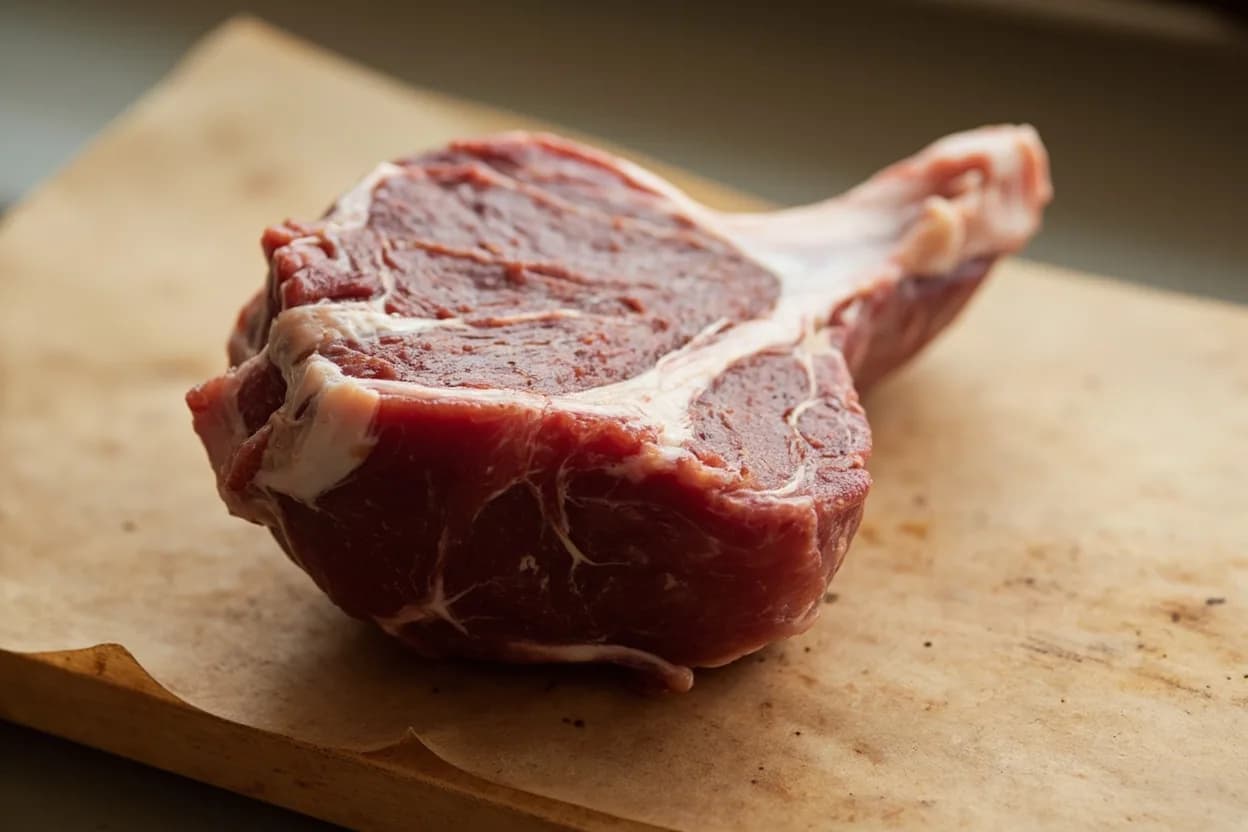
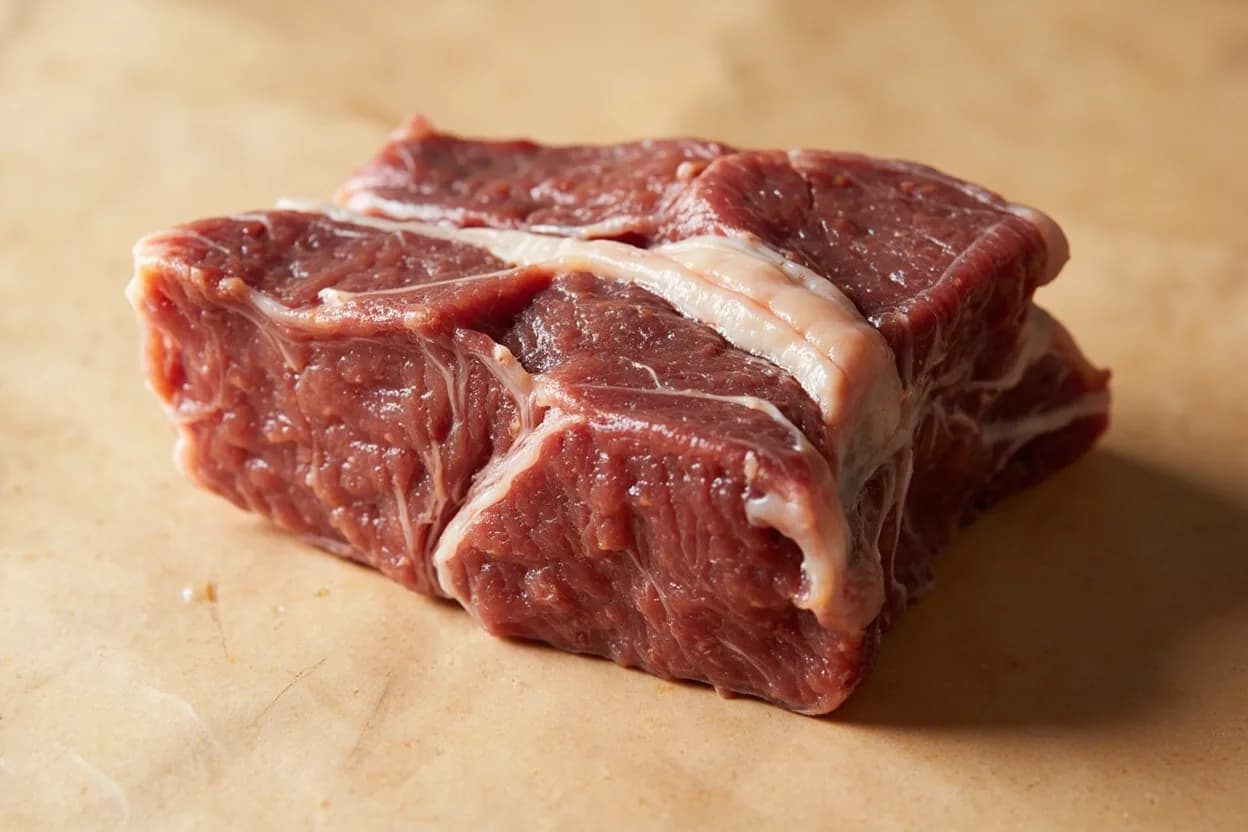
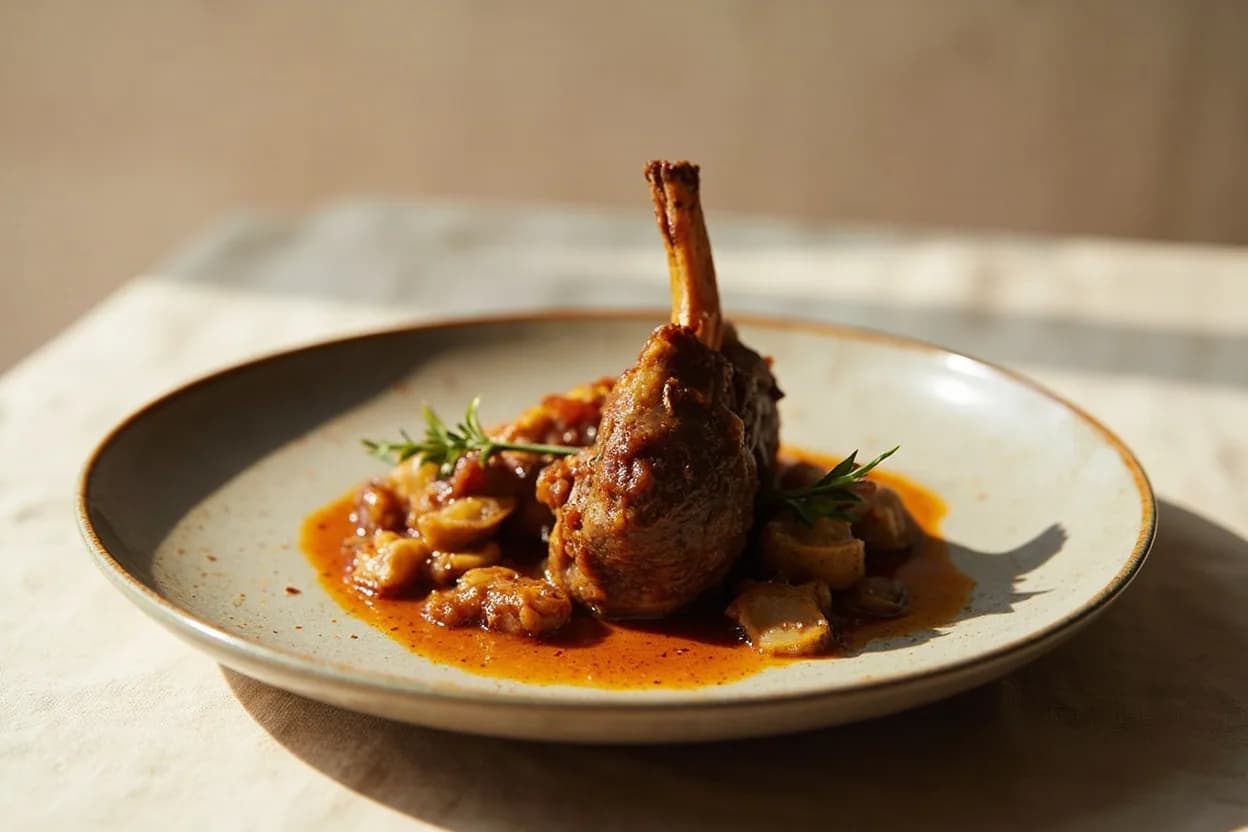
A transverse cross-section of the veal hind shank cut to expose the marrow-filled bone — the anatomical and culinary centerpiece of the Milanese braise that bears its name.
Osso buco — Italian for 'hollow bone' or 'bone with a hole' — is a medallion cut produced by sawing the hind shank of a veal calf transversely across the tibia. The cut exposes a central cavity of bone marrow surrounded by a ring of dense shank muscle (primarily the gastrocnemius and digital flexors) enclosed in a thick mantle of collagen-rich connective tissue. The standard thickness is 3.5–5 cm, producing a cross-section that resembles a miniature wheel: marrow at the hub, shank muscle as the spokes and rim, and a band of exterior connective tissue as the tire. This geometry concentrates three different textures — soft marrow, yielding braised muscle, and gelatinized collagen — in a single medallion.
In photos
Where it comes from
Cut exclusively from the veal hind shank, the segment of the leg below the stifle joint (knee) and above the ankle. The hind shank is preferred over the fore shank for osso buco because it is significantly meatier — the fore shank has a higher bone-to-meat ratio and produces thinner, less impressive medallions. Butchers produce the medallions using a band saw; a handsaw can be used but requires a guide to maintain uniform thickness.
Best for
How to cook it
- 1Tie each medallion around its circumference with a single loop of butcher's twine before browning — the connective tissue band shrinks faster than the muscle as it heats, causing the medallion to bow and lose its disk shape without this support. Remove the twine before serving.
- 2Pat completely dry with paper towels, then dredge lightly in flour seasoned with salt and pepper. Shake off excess. The flour creates a thin crust during browning that helps the medallion hold its shape and provides body for the braising sauce.
- 3Brown in a mixture of clarified butter and olive oil in a wide, heavy-bottomed braising pan over medium-high heat — approximately 4 minutes per side. Brown all four surfaces (top, bottom, and the two cut-bone edges) for maximum Maillard development.
- 4Set aside the browned medallions. Build the soffritto (diced onion, carrot, celery) in the same fat. Deglaze with dry white wine, scraping up all fond. Add veal or chicken stock to just below the level of the medallions' midpoint — never fully submerge.
- 5Braise covered in a 165°C oven for 1 hour 40 minutes to 2 hours. The meat should pull slightly from the bone and a skewer should meet no resistance. The marrow should be soft and jiggly, not set.
- 6Spoon gremolata (minced flat-leaf parsley, lemon zest, garlic) over each medallion just before serving — it is a finishing condiment, not a cooking ingredient, and loses its brightness if added during braising.
Prep & butchery
- Cut thickness is critical: under 3 cm and the medallion falls apart before the braise is done; over 6 cm and the muscle remains tough when the marrow is already overcooked and oily. The target is 4 cm for home cooking, 3.5 cm for restaurant service (faster braise, neater plating).
- Ask the butcher for hind shank only — some butchers sell mixed fore/hind packs, and the fore shank medallions are notably thinner and boney
- Score or tie: if the outer connective tissue band is unusually thick, score it vertically in 2–3 places (in addition to tying) so it does not constrict the muscle as it contracts
- Check the marrow before purchasing — it should be pale ivory to pink, firm, and fill the entire cavity without gaps. Dark, recessed, or shrunken marrow indicates the animal was older or the shank was cut too thin
Substitutes
- Beef shank cross-cut
Same technique; requires 3–4 hours braising instead of 1.5–2; stronger flavor, larger medallions — impressive but different in character
- Lamb shank (whole)
Cannot be cross-cut like osso buco but takes a comparable braise; no marrow exposure
- Pork shank cross-cut
Works well; much higher gelatin yield from pigskin collagen; milder flavor
Related cuts
- Veal Shank (whole)
The uncut primal before cross-sectioning; used for stock or whole-roasted preparations
- Beef Osso Buco (cross-cut beef shank)
Larger, fattier, longer-cooking version of the same cross-cut technique
The shank is one of the six veal primals; the hind shank yields osso buco, the fore shank is used for stock
Appears in
References
- 1.The Silver Spoon (Il cucchiaio d'argento) — Phaidon Press edition
- 2.Italian Food — Elizabeth David
- 3.Mastering the Art of French Cooking — Julia Child, Louisette Bertholle & Simone Beck
- 4.The Complete Meat Cookbook — Bruce Aidells & Denis Kelly
Confidence: high
Notes
The marrow: etiquette and anatomy
The bone marrow in the osso buco medallion is the defining luxury of the dish. Classical Milanese service includes a small marrow spoon (a narrow-bowled demitasse spoon) for each guest to extract the marrow from the open bone cavity at the table. The marrow should be barely set — warmed through but not rendered liquid by overcooking — with a texture between soft butter and ricotta. Chefs who leave the marrow raw (under-braise) or overcooked (marrow fat separating into an oily pool) are considered to have failed the dish regardless of the sauce quality.
Fore shank vs. hind shank: why it matters
The fore shank (shin, brachio-cephalicus muscle group) of veal produces thinner, less meaty cross-sections with a higher bone-to-meat ratio than the hind shank (gaskin, tibia-associated muscle group). A fore shank medallion cut to 4 cm may have a diameter of only 7–8 cm with the marrow cavity occupying half the cross-section; a hind shank medallion at the same thickness is 9–11 cm in diameter with proportionally more meat. Italian tradition uses the hind shank exclusively (osso buco di stinco posteriore). Mixed packs sold at retail often include both; the difference is visually obvious and flavors the buying decision.