Veal — Primal & Subprimal
Veal Scallopine / Escalope
Also: scallopine, scaloppine, escalope de veau, schnitzel cut, veal scallop, piccata cut
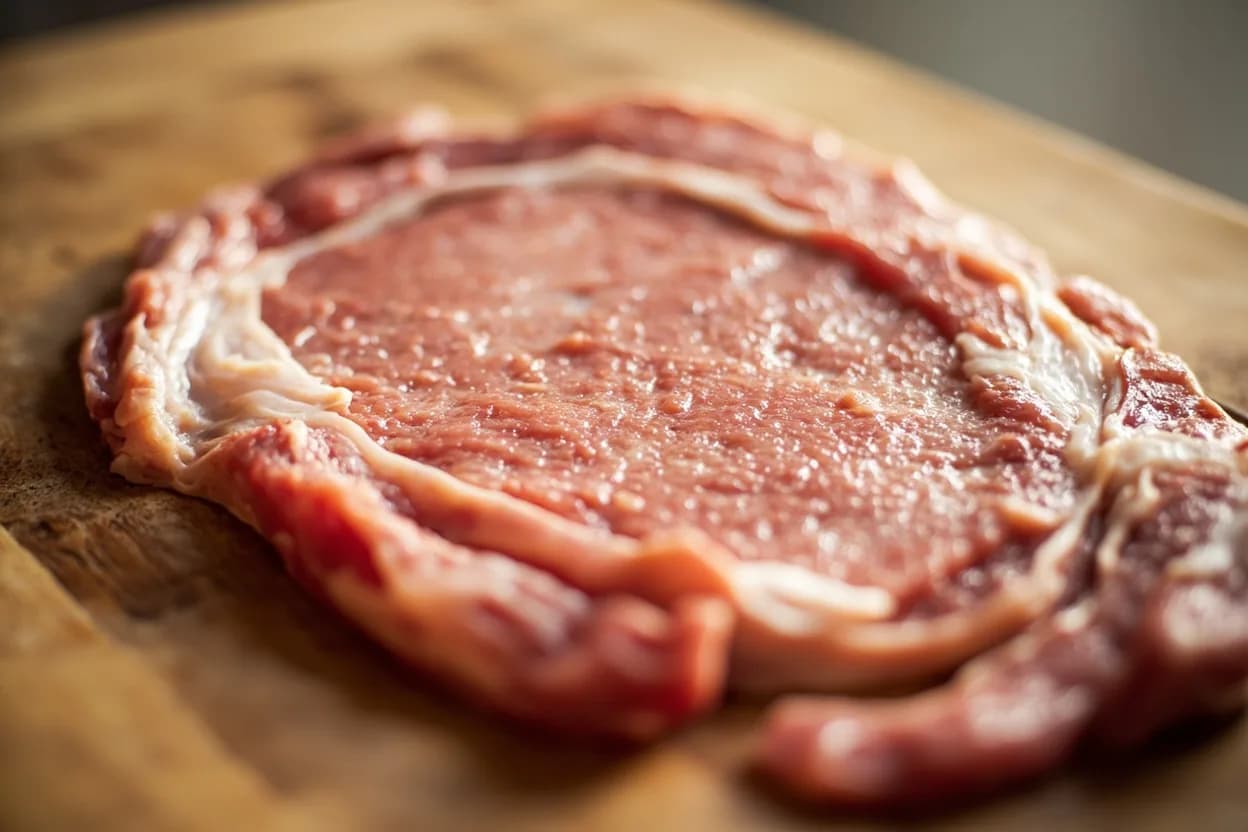
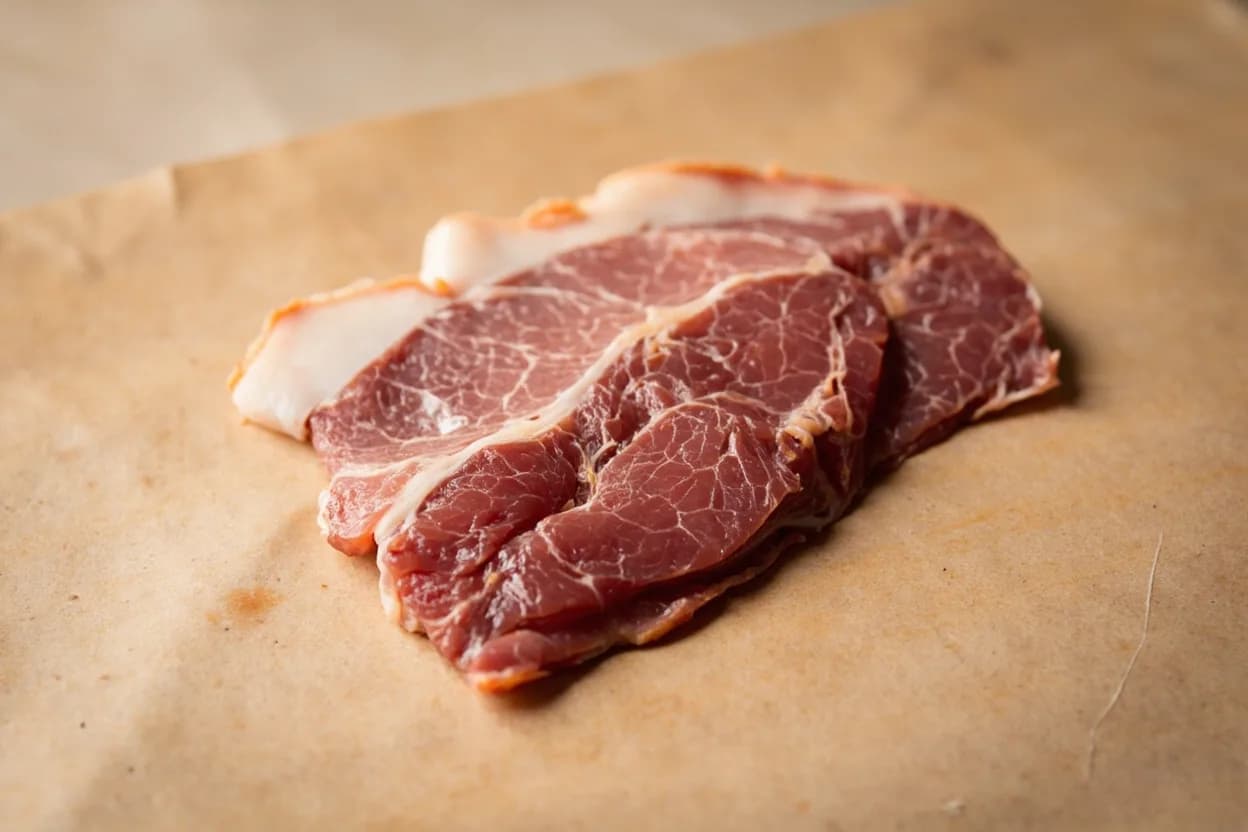
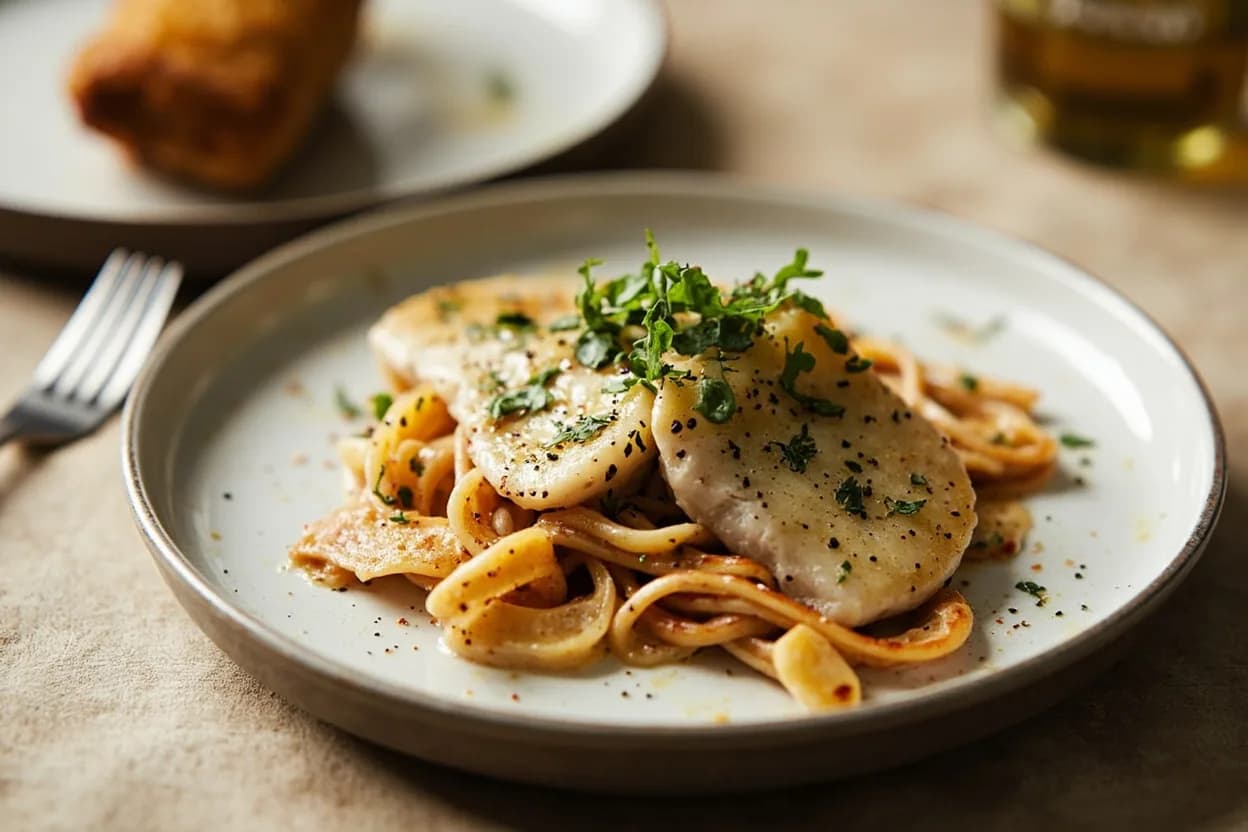
A thin, even slice cut against the grain from the veal leg top round, then pounded to uniform translucency — the building block of piccata, Milanese, saltimbocca, and Wiener Schnitzel.
A scallopine (Italian) or escalope (French) is a boneless, thin slice of meat cut transversely against the muscle grain, then mechanically thinned by pounding with a meat mallet to a uniform thickness of 3–6 mm. The term describes both the preparation technique and the resulting cut. For veal, the top round (Italian: fesa; French: noix) of the leg is the canonical source because it offers the largest single-muscle cross-section with the most consistent grain direction, the lowest connective tissue content of any veal subprimal, and a neutral, mild flavor that serves as a blank canvas for the acid-bright, butter-rich pan sauces that define the scallopine canon. The technique is also applied to the inside round and the eye of round, though these are slightly less prized.
In photos
Where it comes from
The top round (noix / fesa) is the largest muscle of the veal leg's medial surface — the semimembranosus and adductor group. The butcher removes the top round from the leg as a single boneless block, then slices it transversely (perpendicular to the muscle fibers, not parallel to them) into oval or round medallions 5–8 mm thick before pounding. Grain direction is the decisive factor: a slice cut with the grain rather than against it will shred under the mallet and tear when sautéed rather than holding together as a unified sheet.
Best for
How to cook it
- 1Begin with a cold, boneless veal top round block. Identify the grain by looking at the long striations running through the muscle. Position the block so you are cutting across these striations, not parallel to them.
- 2Slice with a sharp, long-bladed knife (a 25–30 cm slicer or chef's knife) in one smooth drawing stroke — avoid sawing, which compresses the muscle and produces ragged edges. Cut 5–8 mm thick; thicker slices pound more uniformly with less risk of tearing.
- 3Place each slice between two sheets of food-safe plastic wrap or in a zip-lock bag. Pound with the flat face of a meat mallet (not the tenderizing teeth, which tear rather than stretch the fibers) using firm, outward-sweeping strokes — work from the center toward the edges. The goal is to spread the slice to 3–4 mm thickness evenly across its entire surface. Thin spots will overcook before thick spots reach temperature.
- 4Season immediately before cooking, not before pounding — salt draws moisture from the surface during the resting period and can cause sticking under the mallet.
- 5For sautéed scallopine: heat clarified butter (or half butter, half olive oil) in a wide, heavy pan over the highest heat until the fat shimmers and just barely begins to smoke. Add scallopine without crowding — one layer only, never overlapping. Cook 45–75 seconds per side; the meat is done when it loses its raw pink color throughout and the surface shows a pale golden crust. Remove immediately and build the pan sauce in the same pan.
- 6For breaded (Milanese / Schnitzel): dredge pounded scallopine in flour, shake off excess; dip in beaten egg; coat in fresh breadcrumbs pressing gently to adhere. Fry in 1–1.5 cm of neutral oil at 170–175°C for 2–2.5 minutes per side. The crust should form a soufflé-like separation from the meat as it cooks, characteristic of the Austrian Wiener Schnitzel technique.
Prep & butchery
- Always cut against the grain — the single most important variable; a with-grain slice will shred into strands under the mallet and disintegrate in the pan
- Chill the top round block thoroughly before slicing — cold muscle is firmer and slices cleanly; a semi-frozen block (1 hour in freezer) gives the most precise thickness control
- Use plastic wrap, not wax paper or parchment, between the mallet and the meat — wax paper tears and can transfer paper fibers; parchment is too stiff and causes uneven pressure
- After pounding, trim any ragged edges with scissors for a clean oval — important for presentation and for even pan contact
- If cutting scallopine from a triangular muscle (eye of round), orient cuts so the angle of the cross-section produces the widest possible surface area
Substitutes
- Chicken breast (butterflied and pounded)
Most common substitute; lacks veal's delicacy and silkiness but takes the same technique and sauces
- Turkey breast scallopine
Very close substitute in fat content and grain; slightly drier; works well for piccata and francese
- Pork loin scallopine
Must be pounded thinner than veal; slightly less tender but pairs well with marsala and cream sauces
- Thin-sliced beef top round
Tougher grain requires thorough pounding; suitable for escalopes but lacks veal's characteristic sweetness
Related cuts
- Veal Top Round (Noix / Fesa)
The subprimal block from which scallopine are sliced; also roasted whole for vitello tonnato
Scallopine come from the leg primal — the largest single primal on the veal carcass
- Veal Piccata Cutlet
Scallopine prepared for piccata; the cut is the same, only the sauce application differs
Appears in
References
- 1.The Silver Spoon (Il cucchiaio d'argento) — Phaidon Press edition
- 2.The Complete Meat Cookbook — Bruce Aidells & Denis Kelly
- 3.Marcella Hazan's Essentials of Classic Italian Cooking — Marcella Hazan
- 4.Charcuterie: The Craft of Salting, Smoking, and Curing — Michael Ruhlman & Brian Polcyn
Confidence: high
Notes
Grain direction: why it defines the cut
Muscle fibers run in parallel bundles along the length of a muscle. A slice cut parallel to this direction (with the grain) separates the fibers into long, stringy ropes that resist pounding — the mallet pushes them sideways rather than flattening them — and then contracts violently when heated, curling the slice into a tube. A slice cut perpendicular to the fibers (against the grain) intersects every bundle at its shortest axis; pounding spreads and flattens each bundle laterally rather than compressing rope-like fibers. The result is a sheet that lies flat, accepts even breading, and contracts uniformly rather than curling during cooking. An experienced butcher identifies grain direction by the visible striations on the cut surface and by the way the knife encounters muscle fascicles.
Wiener Schnitzel and the designation question
In Austria, 'Wiener Schnitzel' is a protected designation that legally requires veal (Kalb). A pork version must be called 'Schnitzel Wiener Art' (Viennese-style schnitzel). The distinction matters culinarily because the veal version's lower fat content and lighter fiber structure allow the breadcrumb crust to form the characteristic air-pocket separation (Schnitzel should 'wave' or ripple slightly in the pan) without the leaking fat that causes a pork escalope's crust to adhere more tightly to the meat. Achieving this crust requires abundant fat in the pan (at least 1 cm), immediate swirling to baste the top surface with fat as it sets, and a very hot starting temperature that drops as the cold meat enters.