Starch & Specialty Doneness
Agar Gel Set Temperature
Also: agar setting point, agar solidification temperature, kanten set point
Agar sets between 32–40°C — far above gelatin's threshold — and requires temperatures above 85°C to melt, making it uniquely stable at room temperature.
Agar-agar, a polysaccharide extracted from red algae (principally Gelidium and Gracilaria species), transitions from liquid to gel as it cools through a zone of approximately 32–40°C (90–104°F). Unlike gelatin, which collapses above around 35°C, agar gels remain firm at room temperature and through moderate warmth, a property that makes them indispensable in vegan cooking, Asian confectionery, and modernist kitchens. The gel melts only when reheated above roughly 85°C (185°F), giving it a hysteresis window — it sets and melts at very different temperatures.
In photos

What happens
Agar is composed primarily of agarose, a linear polymer of alternating galactose residues. When dissolved in boiling water (agar requires at least 85–90°C to fully hydrate) and then cooled, agarose chains align and form double helices that bundle into a three-dimensional network, trapping water molecules. This network is stabilized by hydrogen bonds and forms a firm, brittle gel with a clean break — quite different from the elastic, springy texture of gelatin. The gel is thermoreversible: reheating above 85°C breaks the network and returns it to sol state. Agar concentration governs firmness: 0.5–0.8% yields a soft, trembling gel; 1.5–2% produces firm, sliceable blocks.
What to look for
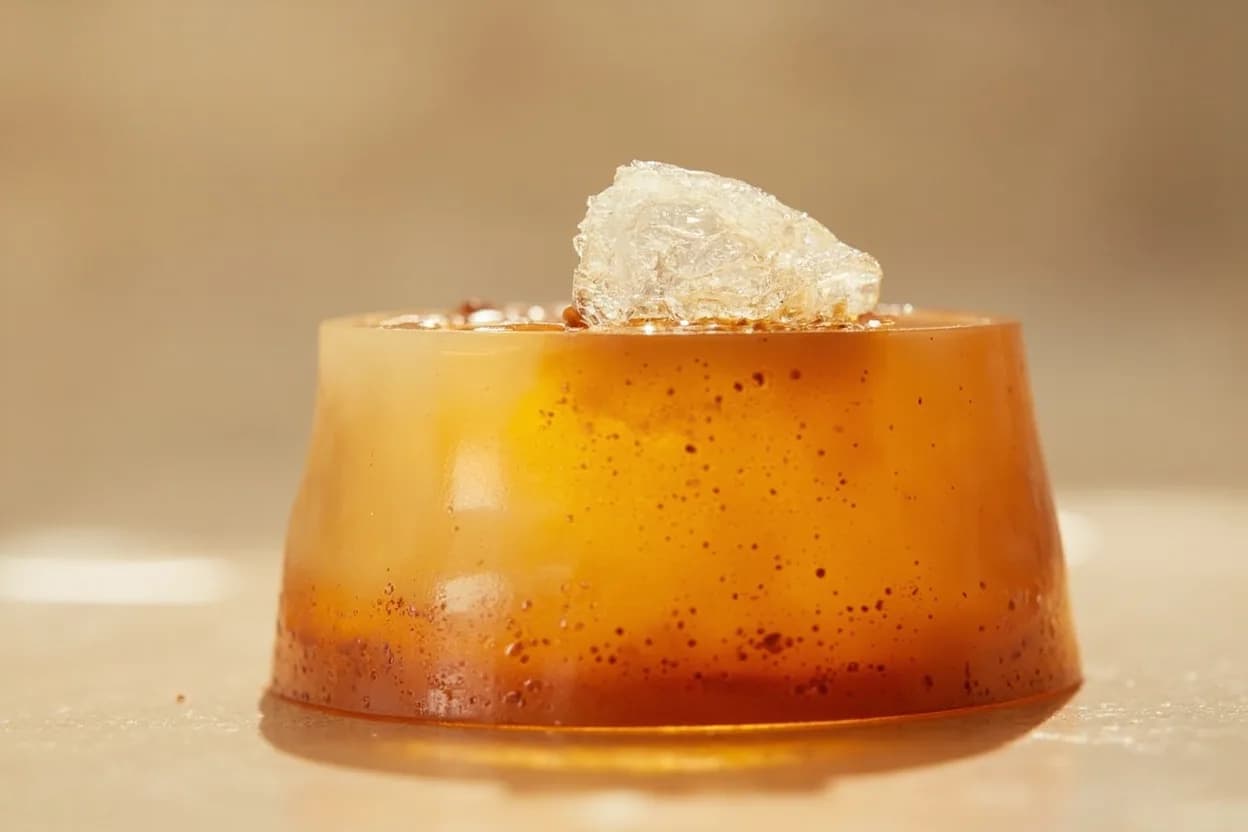
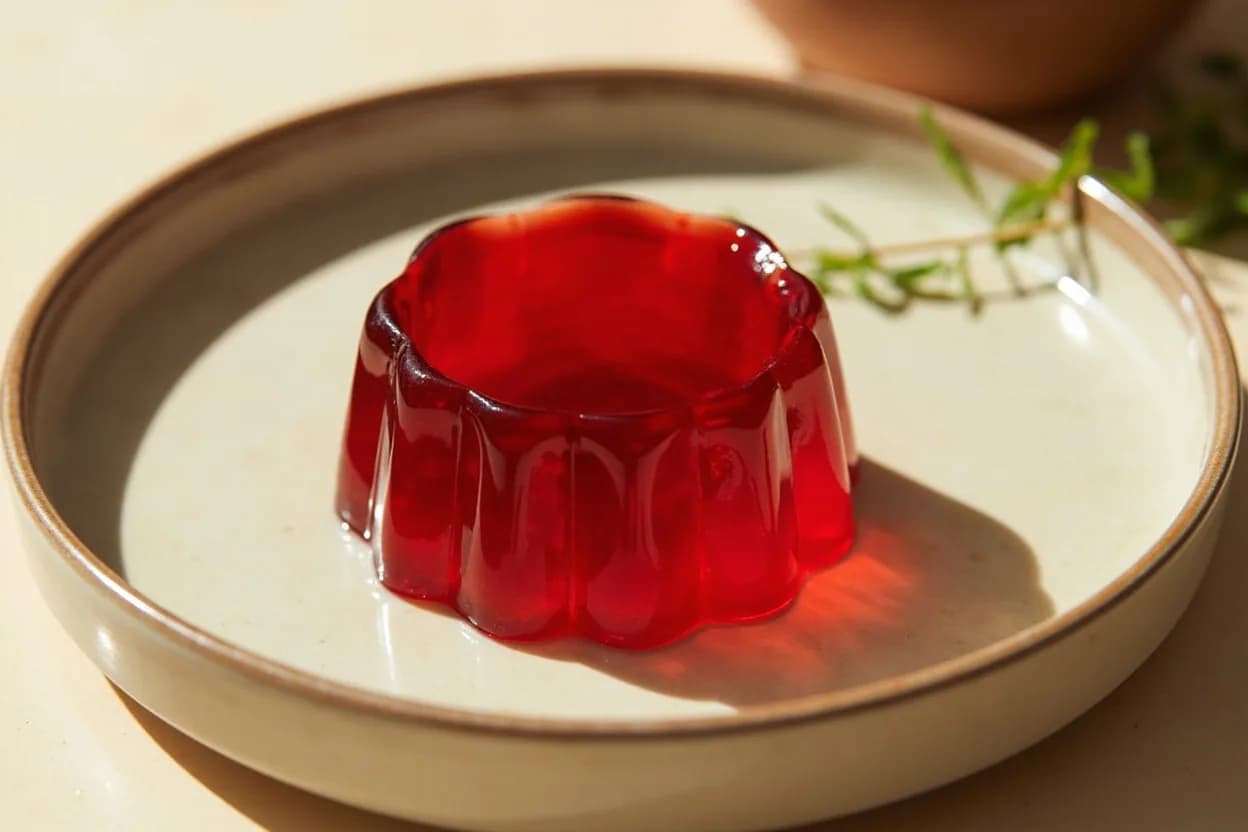
- Surface loses its glossy liquid sheen and becomes matte and slightly opaque as the gel sets
- A light finger press on the surface meets firm, elastic resistance rather than rippling
- Gel pulls cleanly away from the sides of a mold when tilted
- Cut surfaces show a clean, glassy fracture with no syneresis (weeping) in a properly set gel
- In the mouth, agar gels feel firm and slightly brittle, dissolving less smoothly than gelatin
How to check
- Tilt the container — a set agar gel does not flow or slosh
- Press the surface lightly with a clean fingertip; it should spring back without sticking
- Use an instant-read thermometer while cooling: once the mixture drops below 40°C without setting, the agar concentration may be insufficient
- For precise texture work, test a small spoonful on a chilled plate — it should set within 1–2 minutes
The science behind it
- Gelatin Set Temperature
Gelatin sets and melts well below agar's range (15–35°C), making agar preferable for warm-climate service or room-temperature presentations
Over-concentrated or over-agitated agar gels can expel liquid (weep); correct agar ratio and gentle pouring minimize this
- Hydrocolloid Concentration
Agar percentage relative to total liquid is the primary lever for gel firmness
- Carrageenan Gel Set
Another algae-derived hydrocolloid with similar vegan applications but different texture and ionic sensitivity
- Spherification
Modernist technique that sometimes uses agar for warm-temperature spheres that would melt under gelatin-based methods
Appears in
References
- 1.Modernist Cuisine, Volume 4 — Nathan Myhrvold, Chris Young & Maxime Bilet (The Cooking Lab, 2011)
- 2.On Food and Cooking — Harold McGee (Scribner, revised 2004)
- 3.Hydrocolloids: Practical Guides for the Food Industry — Imeson (ed.), Woodhead Publishing, 2010
- 4.The Fat Duck Cookbook — Heston Blumenthal (Bloomsbury, 2008)
Confidence: high
Notes
Agar vs. Gelatin: the critical distinction
Because agar sets roughly 10–15°C above typical gelatin's gel point but melts at a temperature 50°C higher, the two hydrocolloids are not interchangeable. Agar's high melt point means it can be used in warm desserts, layered with hot sauces, or served in tropical climates without collapsing. The substitution ratio is roughly 1 g agar for every 6–8 g gelatin by weight, though the texture will always be firmer and more brittle.
Fluid gels and molecular applications
When an agar gel is blended or sheared while still warm (before full network formation completes), the broken network produces a fluid gel — a smooth, pourable but texture-carrying material that behaves like a thickened sauce at rest. This technique, popularized by Ferran Adrià and Heston Blumenthal, exploits agar's high setting temperature to create hot sauces with body.