Fish & Seafood Doneness
Ankimo (Monkfish Liver) Set Point
Also: あん肝, ankimo doneness, monkfish liver temperature, steamed monkfish liver
Ankimo reaches its signature custard-like creaminess when steamed to an internal 60–65°C — fully cooked yet unctuous, never granular or grainy.
Ankimo, the steamed liver of the monkfish (Lophius spp.), is considered the foie gras of the sea in Japanese cuisine. Its remarkable richness comes from the liver's exceptionally high fat content (up to 50% lipid by wet weight). Doneness is defined by the transformation of hepatic proteins from raw and slippery to a just-set, firm-yet-yielding custard texture, achieved when the internal temperature reaches approximately 60–65°C (140–149°F). Below this point the liver is under-set, wet, and potentially unsafe; above 70°C the fats begin to express excessively and the texture becomes grainy, chalky, and dry.
In photos

What happens
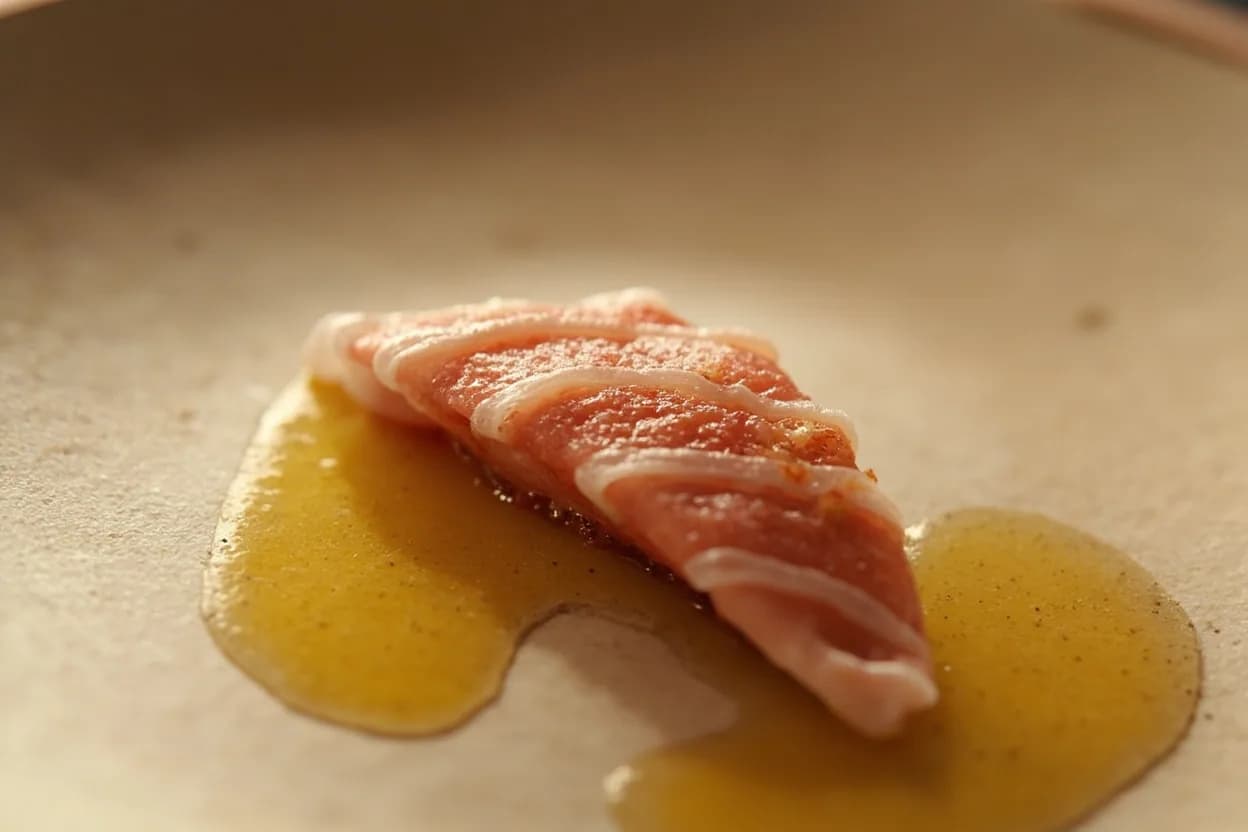
Monkfish liver proteins — primarily collagen-poor hepatic albumins and lipoproteins — begin denaturing between 55°C and 65°C. At the target range, proteins form a continuous network that holds the emulsified fat in suspension, yielding a smooth, creamy texture with no visible fat expulsion. The high lipid content (similar in composition to fatty tuna toro) means the eating temperature feels almost molten on the tongue. Above 70°C, protein networks contract excessively, squeezing out fat that pools as greasy beads, and texture becomes mealy. The liver must be thoroughly cleaned of bile ducts and blood vessels before cooking, as these impart bitterness even at proper doneness.
What to look for
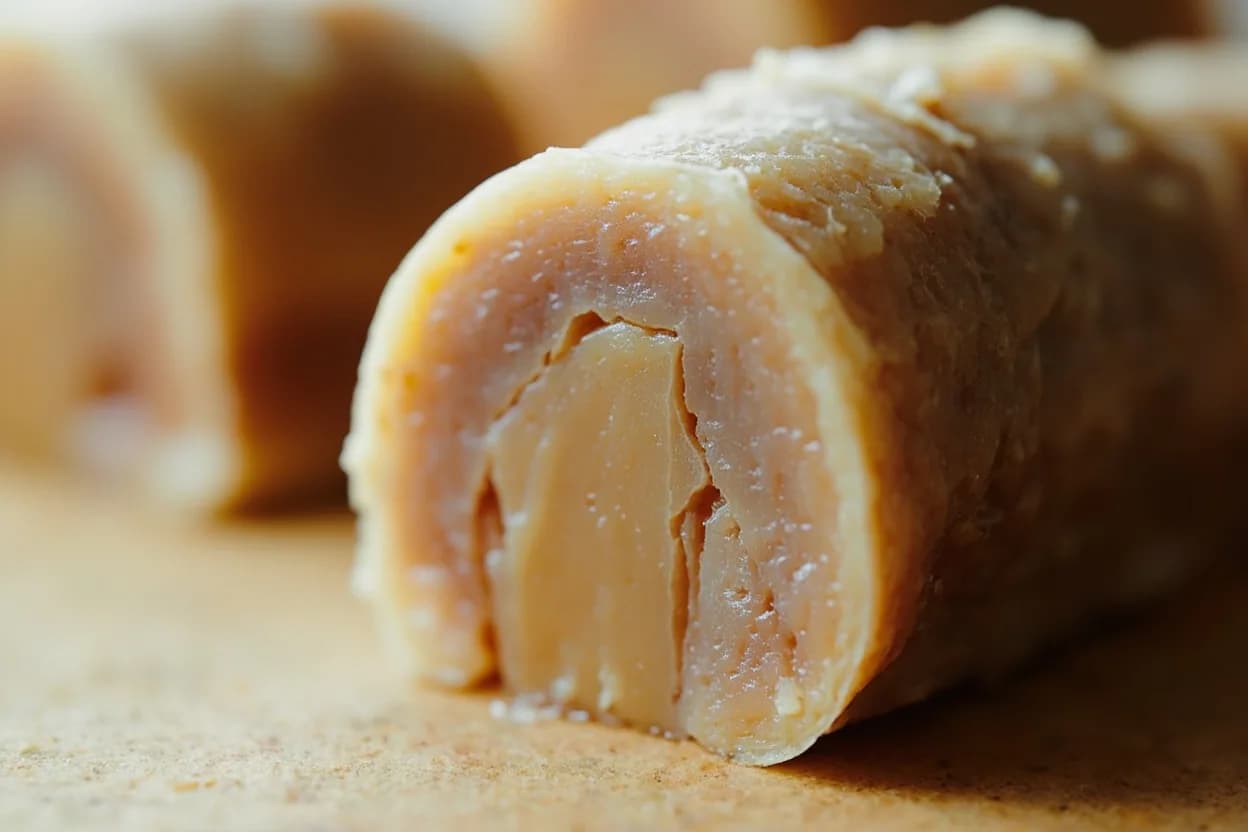
- The exterior of a rolled ankimo log firms to a pale beige-grey and holds its cylindrical shape cleanly when sliced
- Cut surface is smooth and homogeneous — no wet or translucent patches at the center
- Texture yields under gentle pressure like a firm pâté or just-set crème brûlée, not rubbery or springy
- Aroma is mild, oceanic, and faintly sweet — no raw offal smell; a pronounced iodine smell indicates undercooking or poor cleaning
- Slices do not crumble on cutting — they hold a clean edge with a slight sheen from the internal fat
How to check
- Instant-read thermometer inserted at the center of the log (through the end) — target 60–65°C
- Skewer test: a thin metal skewer inserted to the center for 5 seconds should feel warm (not cold) when touched to the wrist
- Press test: a firm but yielding resistance under fingertip pressure through the steamer cloth — similar to the resistance of a just-set terrine
- Time-temperature estimate: a 300g ankimo log in a bamboo steamer over boiling water takes approximately 25–30 minutes; verify with thermometer on first attempt
Food safety
Carryover & resting
Carryover cooking is notable in rolled ankimo. Remove from the steamer when the core reads 60–62°C; residual heat in the outer layers will carry the center to approximately 63–65°C while the log rests. Do not steam to the upper end of the range in the steamer itself.
The science behind it
- Foie gras doneness
Ankimo shares with foie gras an extreme fat content that compresses the safe doneness window — both demand precision to avoid fat expulsion and textural breakdown
- Fish liver fat composition
Monkfish liver fat is rich in omega-3 polyunsaturated fatty acids, which contribute to its distinctive flavor and sensitivity to heat
- Ponzu sauce pairing
Ankimo is classically served with ponzu (citrus-soy) and momiji oroshi (daikon with chili) to cut richness — the temperature at service matters, as warm ankimo melts more readily than chilled
- Torchon technique
Like foie gras torchon, ankimo is often rolled tightly in cheesecloth or plastic wrap to achieve a uniform cylinder before steaming
- Sake brine (sake-shio)
Ankimo livers are typically brined in sake and salt for 30–60 minutes before cooking to remove blood, tighten the texture, and moderate off-flavors
Appears in
References
- 1.The Japanese Grill — Tadashi Ono & Harris Salat (Ten Speed Press, 2011)
- 2.Nobu: The Cookbook — Nobuyuki Matsuhisa (Kodansha, 2001)
- 3.Japanese Soul Cooking — Tadashi Ono & Harris Salat (Ten Speed Press, 2013)
- 4.On Food and Cooking — Harold McGee (Scribner, 2004)
Confidence: high
Notes
Cleaning is the critical prerequisite
Success with ankimo depends more on cleaning than on cooking temperature. The liver must be rinsed under cold running water, then all bile ducts (green or yellow-tinted vessels), blood clots, and connective membrane removed with tweezers. A 30-minute soak in lightly salted sake draws out remaining blood. Even a tiny remnant of bile duct destroyed by heat will turn an entire log intensely bitter.
Chilled vs. warm service
Steamed ankimo is cooled in its wrapping, then sliced cold and served at 4–10°C for firm, clean-cutting slices with maximum flavor concentration. Some preparations warm it briefly before service, which emphasizes the molten, foie-gras-like quality but makes clean slicing impossible. Kaiseki typically serves it cold.