Beef Doneness
Beef: Medium
Also: demi-anglais, medium cooked, 145°F, pink center
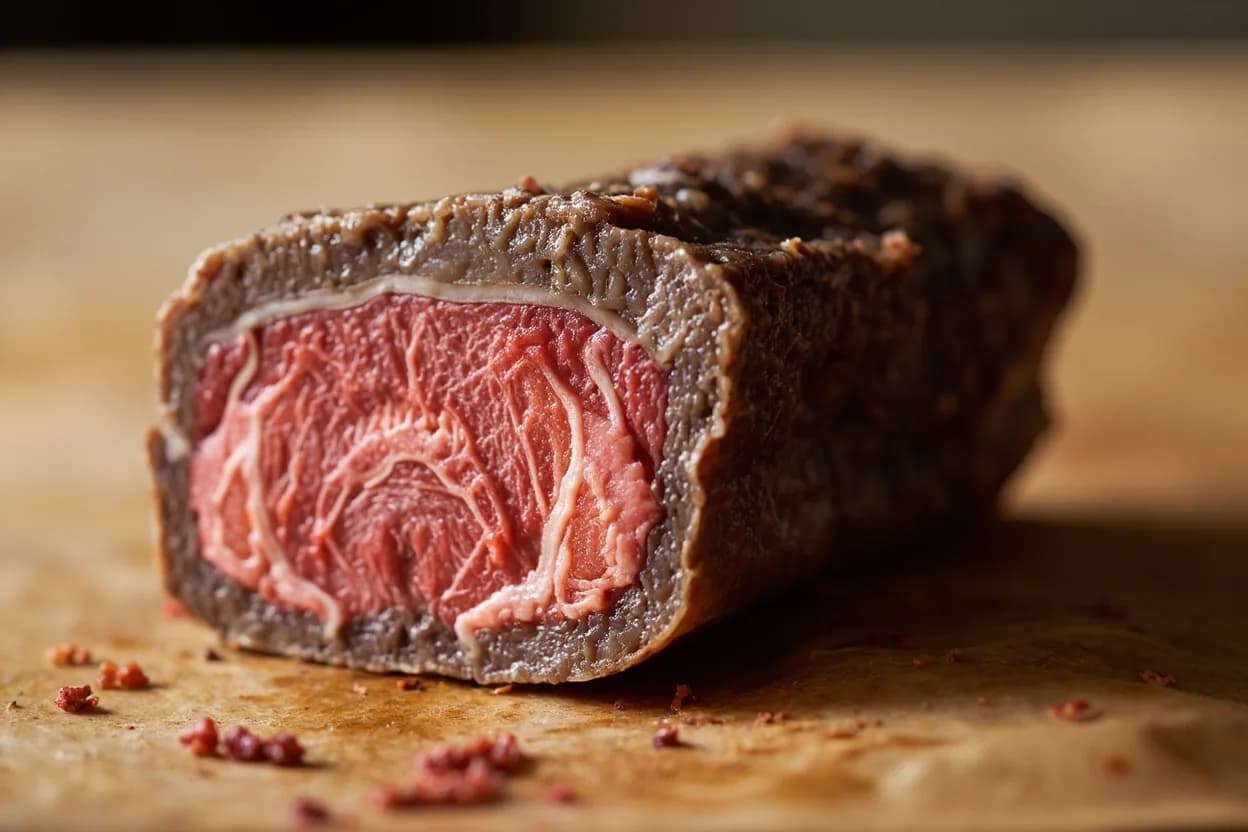
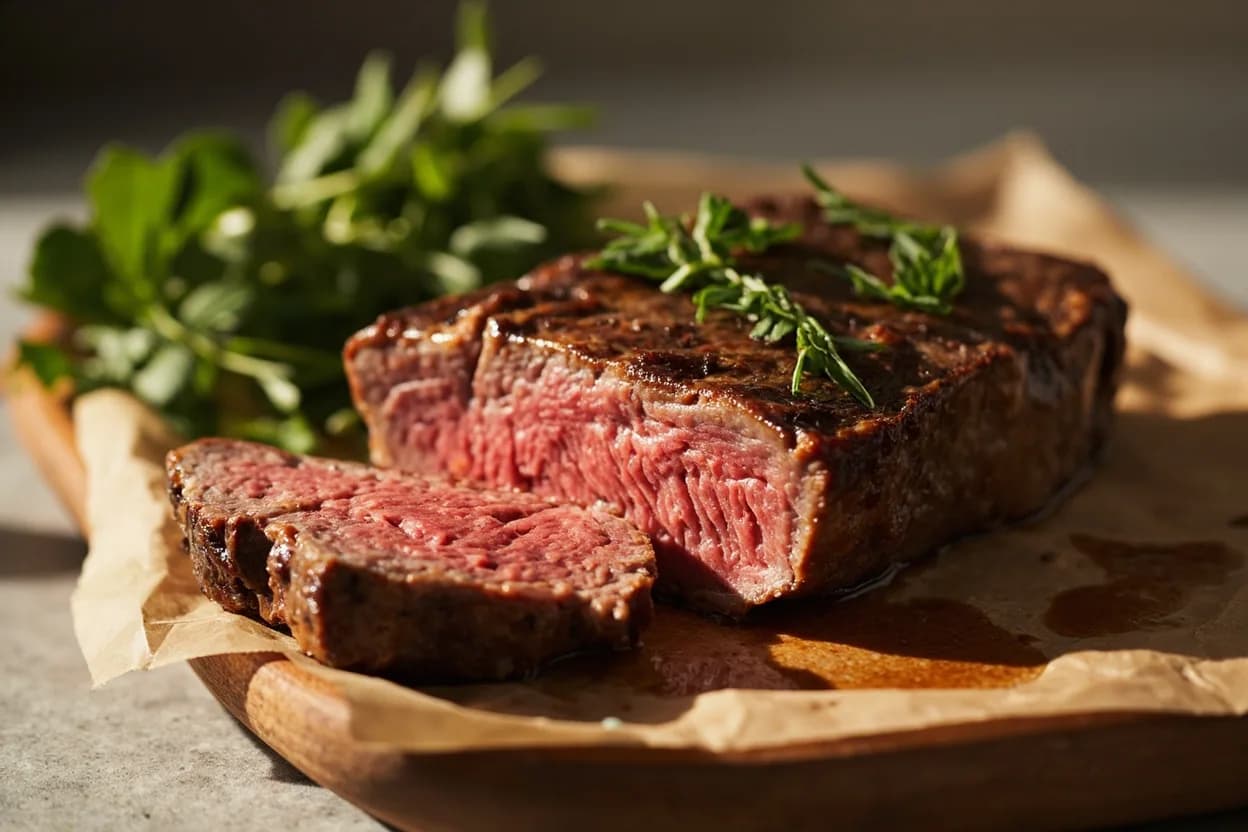
A fully warm pink center fading to grey-brown at the edges — the USDA-recommended doneness for whole-muscle beef and a popular choice for those who want some color without visible red.
Medium doneness, reached at 63°C (145°F), produces a steak with a pink center that transitions to grey-brown toward the exterior. The USDA designates 63°C with a 3-minute rest as the minimum safe internal temperature for whole-muscle beef, making medium the first doneness stage that fully meets federal food-safety guidelines. The texture is firmer than medium-rare: actin denaturation has begun and most intramuscular fat has rendered. The steak is still juicy but noticeably less so than at medium-rare. Medium is the most commonly ordered doneness in many casual steakhouse environments.
In photos

What happens
By 63°C, myosin denaturation is long complete and actin is beginning to denature — the combination causing meaningful fiber contraction and a firmer, less yielding bite. The pink color of the center persists because some myoglobin remains in its partially denatured but still pink form, though the edges convert fully to grey-brown denatured globin hemochrome. Most intramuscular fat has now rendered, so the flavor profile is rich from fat dissolution but the lubricating moisture has largely been expelled from the muscle fibers — moisture loss is typically 15–20%. Connective tissue collagen still has not dissolved (that requires much longer times above 70°C), so tougher cuts remain chewy.
What to look for
- Pink center surrounded by a pronounced grey-brown band
- Thoroughly warm and uniform in temperature when cut
- Noticeably firmer under thumb — springs back readily
- Juices run mostly clear with a faint pink tinge when rested
- Fat visibly rendered; any visible marbling has largely liquefied
- Texture cohesive and springy, less slippery than medium-rare
How to check
- Instant-read thermometer to center: 63°C (145°F); USDA requires 3-minute rest after reaching this temperature
- Press test: firmness resembles the fleshy base of the hand when thumb and middle finger are touched — distinct spring-back, noticeably firmer than medium-rare
- Cut and inspect: pink center (not red) with a wide grey-brown perimeter band; no cool or red core
- Visual timing: grey band from each surface meets but does not eliminate the central pink zone
Food safety
Carryover & resting
Pull steaks from heat at 60–61°C and rest 5 minutes; carryover of 2–3°C will bring them to 63°C. For large roasts (standing rib roast, beef tenderloin), pull at 58–59°C as carryover can reach 5–7°C. Resting also allows juices to redistribute — medium steaks benefit from a full rest more than rarer ones because the fibers have expelled more moisture.
The science behind it
- Medium-Rare
One stage below; center is pinker and juicier at 57°C with less actin denaturation
- Medium-Well
One stage above; center reaches 68°C with only a trace of pink remaining
- Actin denaturation
Begins in earnest above 65°C; at medium it is just initiating, contributing to the firmer texture
- USDA safe minimum temperature
63°C/145°F with 3-minute rest is the official food-safety threshold for whole-muscle beef
- Fat rendering
Substantially complete at medium; dissolved fat enriches flavor but moisture has been expelled
Appears in
References
- 1.USDA Food Safety and Inspection Service — Safe Minimum Internal Temperature Chart
- 2.The Food Lab — J. Kenji López-Alt
- 3.On Food and Cooking — Harold McGee
- 4.Modernist Cuisine: The Art and Science of Cooking — Myhrvold, Young, Bilet
Confidence: high
Notes
The USDA threshold
The USDA revised its recommendation for whole-muscle beef from 71°C (160°F) down to 63°C (145°F) with a 3-minute rest in 2011, aligning with food-science understanding of pasteurization kinetics. The rest period is as important as the peak temperature: holding beef at 63°C for 3 minutes achieves the same pathogen reduction as a brief exposure to higher temperatures.
When medium is the right call
Medium is often the better choice for leaner, less marbled cuts — sirloins from grass-fed cattle, for instance — where the lower fat content means the textural premium of medium-rare is less pronounced. Medium also works well for dishes where the beef is sauced heavily, making the fine distinctions in center color and juiciness less perceptible.