Technique-Specific Doneness
Braising Collagen-to-Gelatin Conversion Temperature
Also: collagen breakdown temperature, gelatin conversion in braising, connective tissue melting point, braising doneness for tough cuts
Collagen-rich cuts require a sustained internal temperature of 80–95°C for hours to hydrolyze collagen into gelatin and achieve fork-tender texture.
Collagen — the primary structural protein in connective tissue, cartilage, and the silverskin surrounding muscle groups — does not simply melt when heated. It undergoes a two-stage transformation: first, triple-helix collagen strands denature and contract (gelatinization onset near 60–65°C), then sustained heat hydrolyzes the peptide bonds, converting collagen to soluble gelatin (80–95°C over 2–8 hours). This conversion is what transforms a tough, fibrous braising cut like beef short rib, osso buco, or pork shoulder from chewy to yielding. The dissolved gelatin enriches the braising liquid with body and glossiness. Time and temperature are inversely linked: 90–95°C converts collagen more rapidly (2–3 hours), while a gentler 80°C (176°F) may require 6–8 hours to achieve the same result — but with more moisture retained in the meat.
In photos


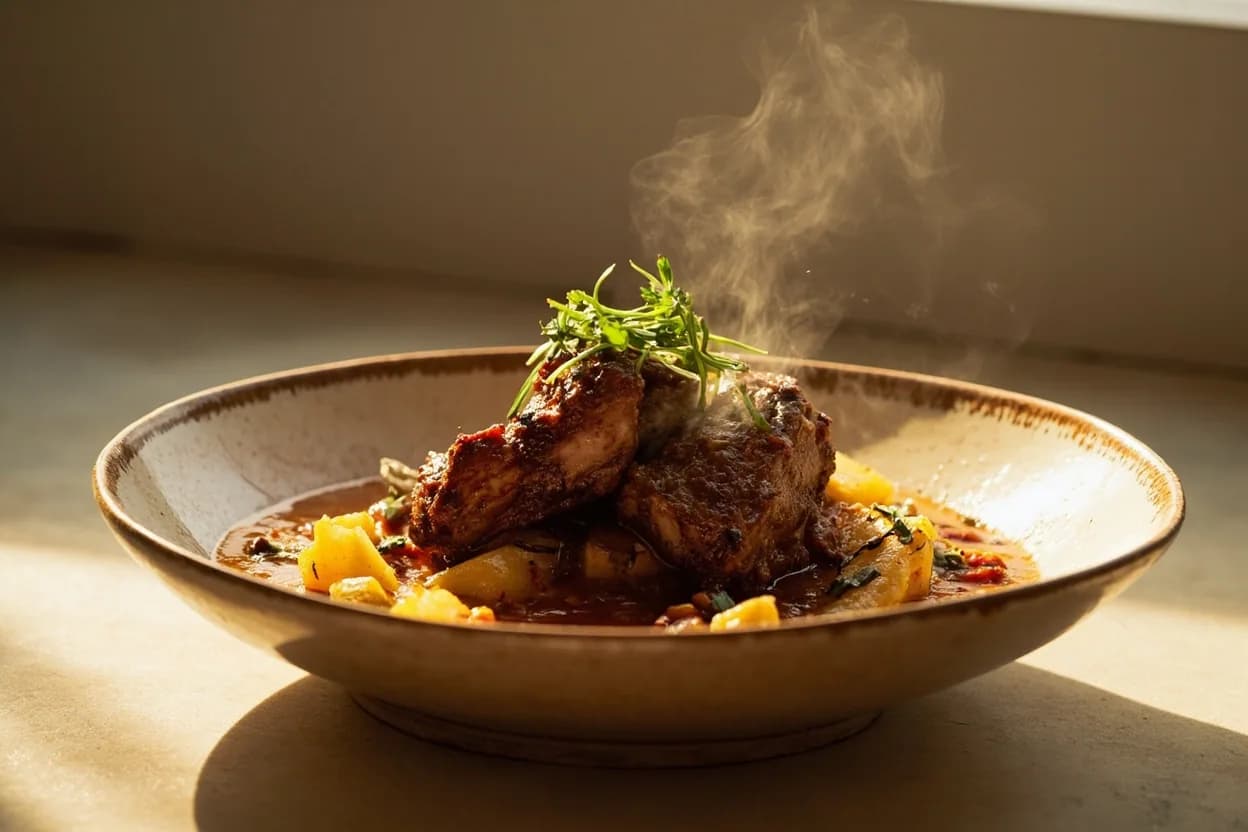
What happens
Collagen's triple-helix structure begins to unwind around 60°C, but the peptide backbone does not break. Sustained heat above 70°C, combined with liquid (braising medium provides water molecules), catalyzes hydrolysis of peptide bonds, converting the fibrous protein into randomly coiled gelatin strands. These disperse into the cooking liquid, creating body and coating the palate. Simultaneously, fat within marbled cuts renders and lubricates the muscle fibers, contributing to the characteristic unctuous mouthfeel of well-braised meat. Muscle fibers themselves have already contracted and expressed moisture at 65–70°C — the tenderness of braised meat is not moisture-dependent but collagen-conversion dependent. The apparent "juiciness" of a properly braised short rib comes primarily from dissolved gelatin coating the palate, not residual moisture in the muscle fiber.
What to look for
- Meat yields to a fork or chopstick pressed in gently — it should part with no resistance, but not fall apart on lifting
- Braising liquid has noticeably thickened and coats a spoon; a spoonful will gel when chilled (strong gelatin set)
- Meat surface looks slightly glistening and yielding rather than firm and springy
- Bone-in cuts (osso buco, short rib) show visible bone pullback as collagen in the periosteum converts
- Aroma deepens and sweetens — the Maillard-derived sear notes meld with the cooking liquid and a rich meaty sweetness develops
How to check
- Insert a skewer, cake tester, or chopstick into the thickest part of the meat — it should slide in with no resistance
- A fork test: if the meat shreds easily when two forks pull apart, collagen conversion is complete
- For bone-in cuts, press the meat near the bone — complete conversion feels uniformly tender, not dense near the bone
- Chill a tablespoon of braising liquid — if it gels at refrigerator temperature, sufficient gelatin has been released
- Internal thermometer is less useful than texture: at 80–95°C, doneness is time-dependent not temperature-dependent once the range is reached
Carryover & resting
Braised meats do not carry over cook in the same way as roasted meats — they are at equilibrium with the braising liquid. Resting in the liquid (off heat, lid on, 15–30 minutes) allows the meat to reabsorb some expelled liquid as pressure equalizes. For maximum tenderness and juiciness, do not pull the meat from the liquid until just before serving.
The science behind it
- Collagen content by cut
Cuts from heavily worked muscles (chuck, shank, shoulder, oxtail, short rib) have the most collagen and benefit most from braising; loin and tenderloin have almost none
- Gelatin as sauce body agent
Dissolved gelatin gives braising sauces and stocks their body and glossy coating quality; reduced braising liquid is a natural jus
- Maillard reaction in braising
Pre-sear builds flavor compounds via Maillard browning that dissolve into the braising liquid over the long cook
- Sous vide collagen conversion
Can convert collagen at lower temperatures (72–80°C) over 24–48 hours, producing textures impossible in a conventional braise
- pH effect on collagen hydrolysis
Acidic braising media (wine, tomatoes, citrus) accelerate collagen hydrolysis by cleaving peptide bonds more readily
Appears in
References
- 1.On Food and Cooking — Harold McGee (Scribner, 2004)
- 2.Modernist Cuisine — Nathan Myhrvold, Chris Young & Maxime Bilet (The Cooking Lab, 2011)
- 3.The Food Lab — J. Kenji López-Alt (W. W. Norton & Company, 2015)
- 4.Meat Science — R. A. Lawrie & D. A. Ledward (Woodhead Publishing, 7th ed., 2006)
Confidence: high
Notes
Low-and-Slow vs. High-and-Fast
A conventional oven braise at 160–175°C (325–350°F) will bring the braising liquid to a simmer (90–95°C), converting collagen in 2–3 hours for most cuts. A lower oven setting (140°C / 275°F) keeps the liquid at a bare quiver (80–85°C) and takes 4–6 hours, but the longer time at lower temperature tends to preserve more moisture in the muscle tissue and produces a more cohesive, sliceable texture — desirable for short rib preparations where you want to serve a single intact portion rather than a pulled or shredded result.
Why Braising Liquid Matters
Water is essential for collagen hydrolysis — dry roasting, even at 200°C, will not convert collagen to gelatin efficiently because there are insufficient water molecules to complete the hydrolysis reaction. This is why a sealed Dutch oven or braiser, which traps steam and maintains a moist environment throughout the cook, produces more reliably tender results than an uncovered pot or a roasting pan with only a shallow pool of liquid.