Poultry Doneness
Chicken Thighs vs. Breast Doneness Targets
Also: thigh vs breast temperature, dark meat vs white meat doneness, chicken cut-specific temps
Thighs benefit from 80–85°C to melt collagen and become succulent; breasts are best at 65–71°C where they remain moist and tender before actin-driven toughening sets in.
Chicken thighs and breasts are structurally and compositionally different muscles that respond to heat in distinct ways, each with its own optimal doneness window. The breast (pectoralis major) is a fast-twitch muscle with low collagen and fat, which means it reaches peak juiciness early — around 65°C — and quickly becomes dry and chalky above 72°C as actin denatures and moisture is expelled. The thigh (biceps femoris and adjacent muscles) is a slow-twitch muscle rich in collagen, intramuscular fat, and myoglobin, which requires higher temperatures — 80–85°C — to convert collagen into mouth-coating gelatin and render the fat, producing the 'falling-off-the-bone' succulence that defines properly cooked dark meat.
In photos

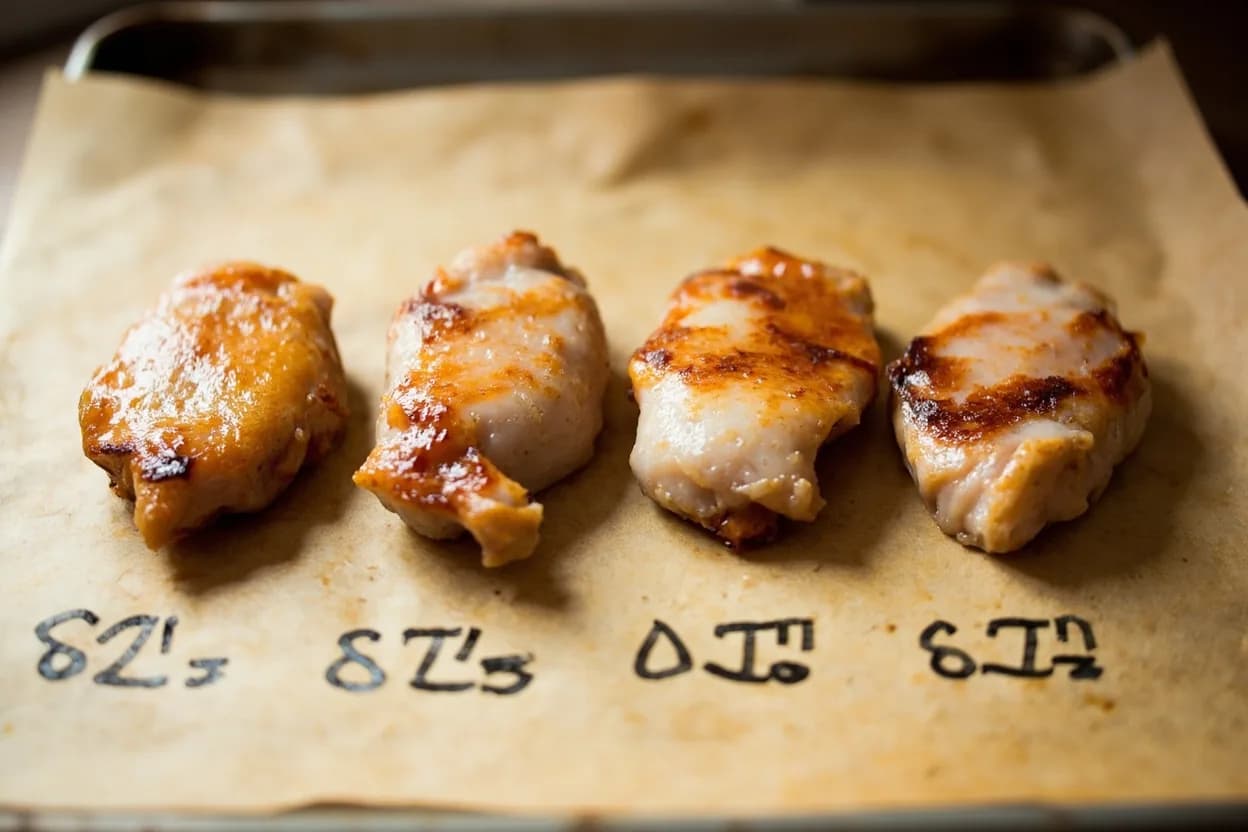
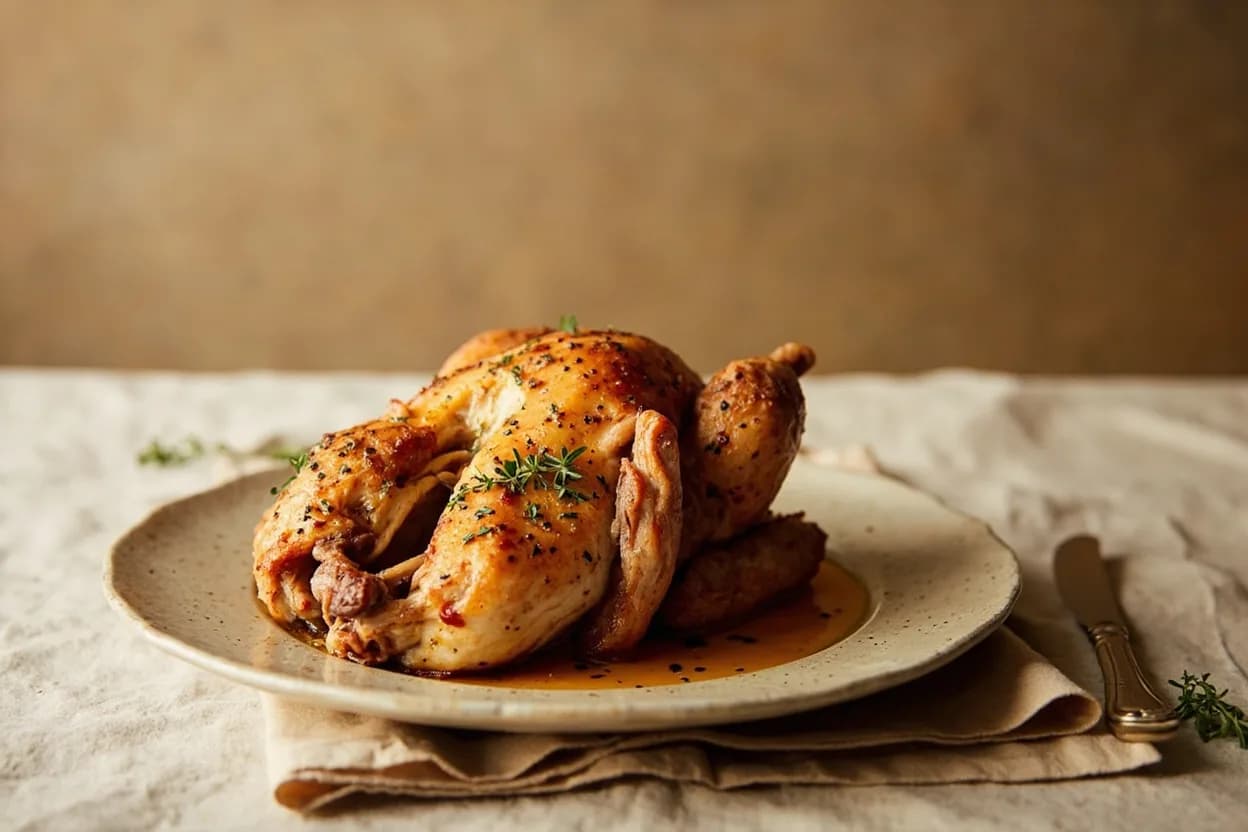
What happens
In chicken breast, myosin denatures around 50°C (firming begins) and actin denatures at 65–68°C (dramatic moisture loss and toughening). Between 65–71°C the breast is fully safe, fully set, and still retains significant juiciness — above 74°C it becomes progressively drier. In chicken thighs, the same protein denaturation occurs, but the higher collagen content (Type I and III collagen in connective tissue sheaths) must reach 72–80°C to begin dissolving into gelatin. This gelatin coats muscle fibers and, combined with rendered intramuscular fat and the richer myoglobin content (which provides more flavor), creates the characteristic succulent, slightly gelatinous quality of well-cooked dark meat. Below 75°C, thigh collagen remains chewy and the connective tissue is gristly rather than silky.
What to look for
- Breast at 65–71°C: flesh is opaque white-ivory throughout, still plump and springy with no raw translucency; juices run clear
- Breast overcooked (>74°C): visibly shrunk, dry and stringy when pulled apart, cotton-wool texture
- Thigh at 80–85°C: flesh pulls cleanly from the bone with minimal resistance; juices are golden-clear; the meat has a slightly gelatinous, silky quality between fibers
- Thigh undercooked (<75°C): meat near the bone is pinkish and slightly rubbery; connective tissue is chewy rather than dissolved
- Dark meat can appear slightly pink even at safe temperatures due to myoglobin — smell and texture are more reliable cues
How to check
- For breasts: probe the thickest point (the center of the plump side, not the thin tapered end) — remove at 65°C if resting, or hold to 68–71°C if serving immediately
- For thighs: probe between the bone and the meat at the thickest part — target 80–83°C for boneless, 82–85°C for bone-in where bone insulates and lowers the reading
- Poke test for thighs: pierce with a skewer; juices should run golden-clear with no pink tinge
- Tug test for thighs: meat should release from the bone with light resistance, not cling firmly
- When cooking whole pieces on a sheet pan or grill, place thighs and breasts with different cook-completion timing in mind (thighs take 8–12 minutes longer)
Food safety
Carryover & resting
Breast carryover: 2–4°C over a 5-minute rest — pull at 62–65°C and rest uncovered if targeting 65–68°C final temp. Thigh carryover: 3–5°C — pull at 79–80°C. Bone-in thighs hold heat longer and may carry over slightly more. Resting also allows juice redistribution in both cuts.
The science behind it
The high-temp dissolution of thigh connective tissue that creates silky, rich dark meat
- Actin Denaturation
The 65–68°C threshold that causes breast meat moisture loss — the key reason breast and thigh temps diverge
- Myoglobin Content
Higher in thigh (dark meat), giving richer flavor and ability to appear pink even when fully cooked
- Pasteurization Time-Temperature Curve
Lower temps held longer can achieve the same safety as a higher instantaneous kill — relevant for sous vide breast
- Spatchcocking
Butterflying a whole bird to equalize cooking of breast and thigh by flattening the bird
Appears in
References
- 1.The Food Lab — J. Kenji López-Alt
- 2.On Food and Cooking — Harold McGee
- 3.Modernist Cuisine — Myhrvold et al.
- 4.USDA FSIS: Poultry Preparation: Temperature and Cooking
Confidence: high
Notes
The whole-bird compromise
When roasting a whole chicken, the breast and thigh are thermally mismatched. By the time the thigh reaches 80–85°C, the breast has long exceeded 74°C and is heading toward dryness. Classic solutions include: trussing to bring the thigh closer to the breast and equalize cooking; starting the bird breast-side down to shield the breast from early heat; using high initial heat to crisp the skin then reducing to let the thigh catch up; or ice-packing the breast cavity before roasting to pre-cool the breast and delay its head start. Spatchcocking (butterflying) is the most effective — removing the backbone and pressing the bird flat reduces the thigh-to-breast distance, allowing both to finish within 5–10°C of each other.
Why thighs forgive overcooked
A chicken thigh cooked to 90°C is still enjoyable; a breast at 90°C is inedible cardboard. The difference is fat and gelatin. Thigh fat renders and bathes the muscle fibers, while dissolved collagen-gelatin coats them, providing lubrication that masks the moisture loss from denatured proteins. This is why braised and stewed chicken almost always uses thighs — the extended cooking at 85–95°C in braising liquid actually improves thigh texture by completing collagen dissolution, while it would destroy a breast.