Beverage Temperatures
Coffee Roast Stages: First & Second Crack
Also: first crack coffee, second crack coffee, coffee roasting cracks, light roast first crack, dark roast second crack, development phase
Two audible cracking events during roasting that mark the entry into light roast (first crack, ~196–204°C) and dark roast (second crack, ~224–230°C), with flavour development occurring in the window between them.
Coffee roasting progresses through a series of physical and chemical transformations that culminate in two audible cracking events. First crack (196–204°C / 385–400°F) is caused by the steam and CO₂ pressure inside the bean exceeding cell-wall tensile strength — the bean physically expands and the outer chaff skin fractures, producing a rapid popcorn-like cracking sound. This marks the entry to drinkable (light) roast. Second crack (224–230°C / 435–446°F) is caused by the brittle, now-caramelised cellular structure fracturing under thermal stress, producing a quieter, more rapid crackling. This marks the entry to dark roast. Development time — the minutes between first crack onset and the end of the roast — is the master variable for flavour profile.
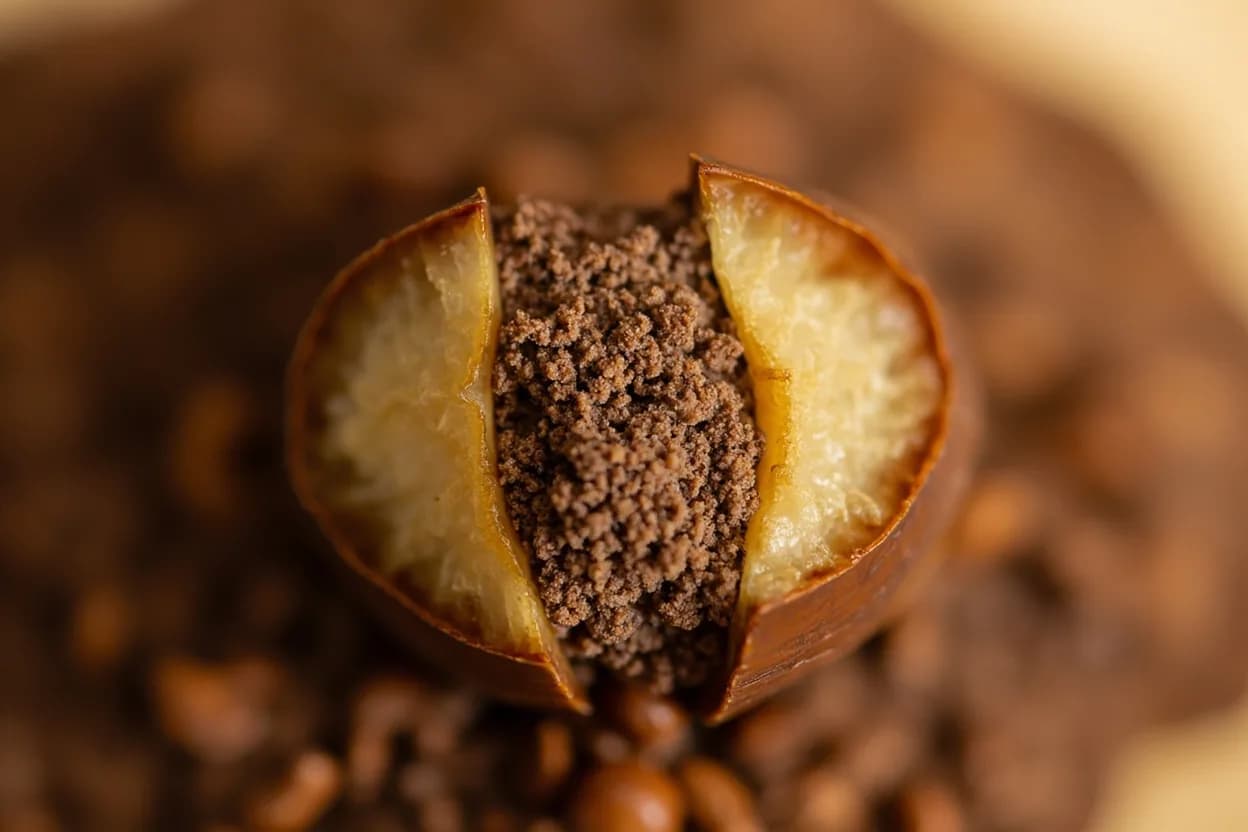
In photos

What happens
During first crack, endothermic bean drying gives way to exothermic pyrolysis. Sucrose undergoes caramelisation; Maillard reactions between amino acids and reducing sugars generate hundreds of aromatic compounds (pyrazines, furans, ketones). Cell walls rupture, releasing CO₂. The bean roughly doubles in volume as density falls. Between the cracks, organic acids degrade progressively (chlorogenic acids break down, reducing perceived acidity), body develops, and roast character deepens. At second crack, oils migrate to the surface, the cellular matrix carbonises, and bitter compounds (pyridines, quinolines) increase. Beyond second crack, the roast rapidly approaches burning and the cup profile collapses to a uniformly dark, charred character.
What to look for
- First crack: distinct rapid popping sounds resembling popcorn, one pop at a time; bean colour shifts from yellow to light tan/cinnamon
- Development phase: sound quietens; bean colour develops from cinnamon through medium brown; sweetness and roast aroma become detectable
- City roast (just after first crack): light brown, matt surface, no surface oils; bright acidity, floral/fruit notes
- Full City roast (first crack fully settled): medium-brown, still dry surface; balanced acidity and body
- Second crack onset: rapid, finer crackling sound, somewhat like crinkling cellophane; colour is dark brown, oils beginning to emerge
- French/Italian roast (into/beyond second crack): very dark, glossy oily surface; bittersweet, smoky, low acidity
How to check
- Listen carefully during the roast — first crack is unmistakably loud and rhythmic; second crack is quieter and more rapid
- Use a drum roaster with a bean-probe thermometer to log temperature; first crack onset is audible but probe temperature confirms it
- Sample beans via a trier (roaster sampling spoon) during development to assess colour with a colour tile or Agtron meter
- For home drum roasters, a cooking thermometer in the roasting chamber correlates approximately to these crack temperatures, though bean-probe temps are more accurate
- Timing development: from first crack onset to drop, 20–25% development time ratio (DTR) is a common specialty target
The science behind it
Non-enzymatic browning between amino acids and reducing sugars; responsible for roasty, complex flavour development between the cracks
- Caramelisation
Sucrose pyrolysis beginning around 170°C; contributes sweetness and body, precedes first crack
- Development time ratio (DTR)
Percentage of total roast time spent after first crack; 20–25% DTR is a specialty benchmark for balanced development
- Agtron number
Spectrophotometric colour measurement of ground coffee; light roast ≈ 75–85, medium ≈ 55–65, dark ≈ 35–45
- CO₂ degassing
Roasted beans off-gas CO₂ for days to weeks; high-CO₂ fresh-roasted beans bloom vigorously during brewing
- Chlorogenic acid degradation
Major coffee acid; breaks down progressively through roasting, reducing perceived sourness and bitterness from this source
Appears in
References
- 1.The Coffee Roaster's Companion — Scott Rao
- 2.The World Atlas of Coffee — James Hoffmann
- 3.Craft Coffee: A Manual — Jessica Easto
- 4.Modulating the Flavor Profile of Coffee — Specialty Coffee Association Research
Confidence: high
Notes
Carryover after drop
Like meat, a roasting bean carries significant thermal inertia. If dropped into a cooling tray, the bean temperature continues to rise 2–5°C before cooling begins. Roasters targeting a specific crack stage often drop slightly before the bean-probe reading reaches the nominal temperature, relying on carryover to complete development.
Variable crack temperatures
Exact crack temperatures vary meaningfully with bean density, moisture content, and roaster design. Dense, high-altitude beans (e.g. Ethiopian Yirgacheffe) may first crack at 202–205°C; lower-density washed Centrals may crack at 196–198°C. Published ranges are indicative; a skilled roaster calibrates to their own machine and green bean lot.