Legume Doneness
Dal Pressure Cook Doneness & Full Starch Breakdown
Also: dal pressure cooker doneness, pressure cooked dal, pulse pressure doneness, instant pot dal, toor dal done, chana dal pressure cooked
Whole and split pulses cooked under pressure until completely soft throughout, verified by a chopstick or spoon-mash test, with texture calibrated to the dish — soupy, creamy, or thick paste.
Pressure cooking dal elevates the boiling point of water to approximately 120°C (250°F) at 15 psi (1 bar gauge), allowing temperatures that are physically unachievable in open-pot boiling. At these temperatures, cell-wall pectin and starch gelatinize far faster, and even dense whole pulses (toor/pigeon pea, chana dal/split chickpea, urad dal, whole masoor) reach full starch breakdown in 8–25 minutes under pressure versus 30–90 minutes at a rolling open boil. Correct doneness is assessed after pressure release: each pulse should be uniformly soft throughout with no hard center, mashable under minimal pressure of a spoon or chopstick against the pot wall, and fully gelatinized — the cooking liquid should appear creamy, opaque, or thickened depending on variety. The texture target varies: soupy-creamy for restaurant-style dal tadka (toor), thick and nearly paste-like for dal makhani (urad), cohesive but slightly textured for sambar.
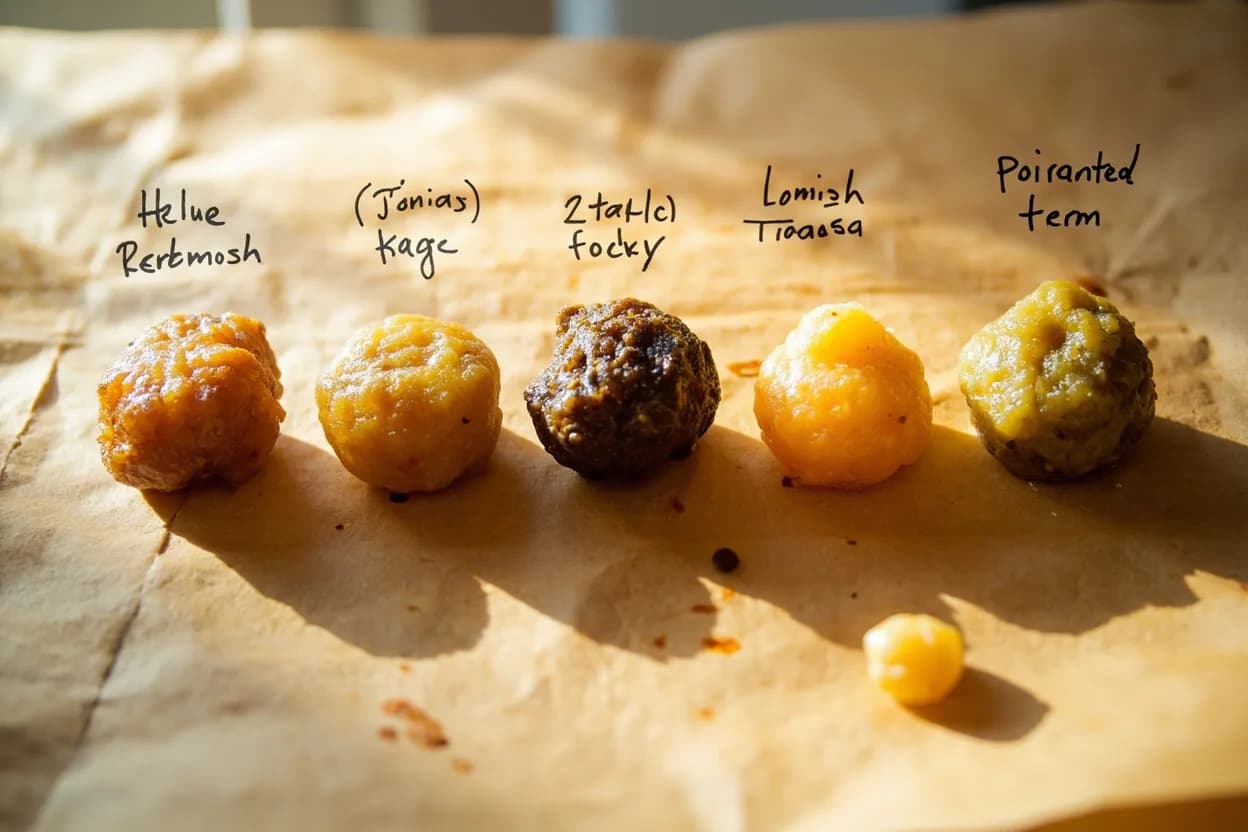
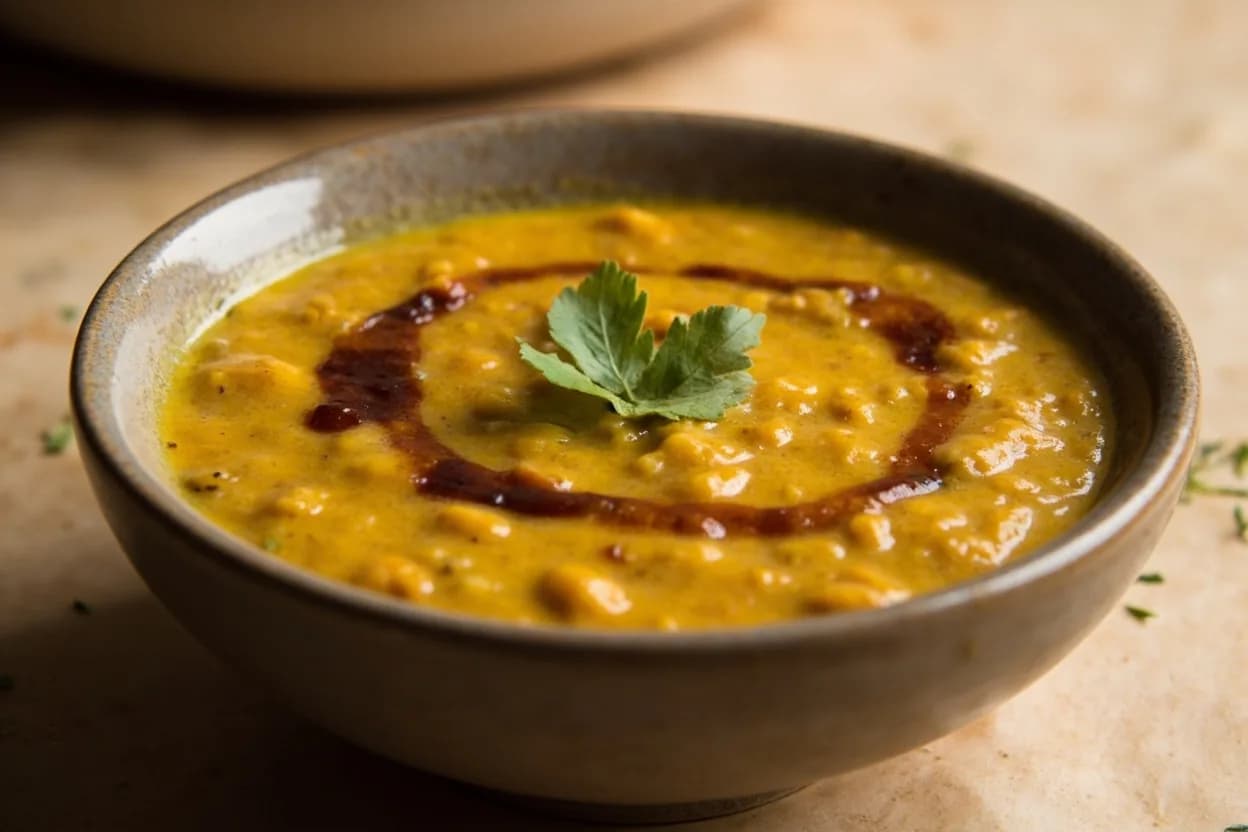
In photos

What happens
At pressure-cooker temperatures (115–121°C), the hydrolysis of pectin in cell walls accelerates dramatically — pectin that would take 30–45 minutes to dissolve at 100°C dissolves in 8–12 minutes. Simultaneously, starch gelatinization completes rapidly and uniformly: amylose chains leach from burst cells into the cooking liquid, thickening it. Protein denaturation is complete and irreversible. The anti-nutritional factors (trypsin inhibitors, lectins, phytates, raffinose-family oligosaccharides) that cause digestive discomfort with improperly cooked legumes are fully neutralized. Urad dal, with its thick seed coat, requires longer pressure time than thin-skinned toor or dehulled chana dal. A natural pressure release (NPR) allows residual steam to continue softening the pulse through carryover, which is critical for whole urad and chana dal.
What to look for
- Chopstick or spoon mash test: a pulse pressed against the pot wall or between fingers crushes to smooth paste with thumb pressure alone — no firm core, no gritty resistance
- Cooking liquid appears creamy, opaque, or thick rather than thin and watery (except for toor and masoor, which stay more liquid at the right ratio)
- Whole pulses have visibly swollen and many have split along their suture — uneven splitting is normal; unsplit grains should still mash easily
- Urad dal at doneness: skin has darkened to deep charcoal and flesh is uniformly white, soft, and almost sticky-gelatinous
- Toor dal at doneness: liquid turns opaque gold and a stirred spoonful shows no discrete grain edges — a creamy, slightly chunky suspension
- No beany, starchy, or raw legume taste on the palate
How to check
- Chopstick mash (primary): press a single pulse against the side of the pot with a chopstick or wooden spoon — it should collapse to smooth paste without resistance at any point
- Two-finger squeeze: remove a pulse, let it cool 10 seconds, and press between thumb and forefinger — it should cream completely without a hard center
- Stir and observe: stir vigorously; the mixture should look uniform and creamy, not separated with hard grains floating in thin liquid
- Taste: chew 2–3 mashed pulses slowly — no raw, starchy, or beany note at any point during chewing
- If even one pulse remains firm at center after the mash test, return to pressure for 3–5 more minutes
Food safety
Carryover & resting
Natural pressure release provides 10–20 minutes of carryover cooking at declining pressure. For whole chana dal and urad, this carryover is essential — opening the pressure cooker immediately via quick release will produce a pulse that seems almost done but firms up as it cools. Factor NPR into your timing: 20 minutes under pressure + 15 minutes NPR is more reliable than 30 minutes + QPR.
The science behind it
- Toor Dal (Pigeon Pea)
Most common pressure-cooked dal in Indian cooking; small, thin-skinned, dehulled — reaches doneness in 8–10 minutes at pressure
- Urad Dal (Black Gram)
Whole black urad requires 25–30 min at pressure + NPR for full breakdown; the base of dal makhani, where the gelatinized starch creates its signature body
- Chana Dal (Split Chickpea)
Split but not dehulled; reaches doneness in 15–20 min at pressure; holds its shape better than toor, yielding a chunkier texture
- Tarka / Tadka
Bloomed-spice infusion poured over cooked dal at serving; requires the dal to already be at full doneness before tarka is applied
- Sambar
South Indian lentil-vegetable stew using toor dal; dal must be fully broken down before vegetables are added, so pressure-cooking the dal first is standard
- Pressure Cooker vs. Instant Pot
Instant Pot reaches ~11.6 psi (0.8 bar gauge), slightly lower than a stovetop cooker at 15 psi — add 2–3 extra minutes to standard pressure times
Appears in
References
- 1.Indian-ish — Priya Krishna (Houghton Mifflin Harcourt, 2019)
- 2.The Pressure Cooker Cookbook — Lorna Sass (Morrow, 1989)
- 3.On Food and Cooking — Harold McGee (Scribner, 2004)
- 4.Prashad Cookbook — Kaushy Patel (Saltyard Books, 2012)
- 5.Modernist Cuisine — Nathan Myhrvold et al. (The Cooking Lab, 2011)
Confidence: high
Notes
Pressure times by pulse type
Dehulled split pulses (red masoor, yellow moong, toor) cook fastest: 8–12 minutes at high pressure, NPR optional. Split pulses with hull (chana dal, split urad): 15–20 minutes, NPR recommended. Whole unhulled pulses (whole urad, whole green moong, whole masoor): 25–35 minutes, NPR essential. Pre-soaking whole pulses for 4–8 hours reduces pressure time by 30–40% and improves digestibility by initiating phytate breakdown. Never skip soaking for whole urad if you want the deep, gelatinous texture characteristic of dal makhani.
The fat matters for texture perception
Fully broken-down dal that is then cooked down on the stovetop with cream, butter, or coconut milk undergoes a secondary thickening: fat droplets emulsify into the starch-water matrix, creating a richer mouthfeel. Dal makhani relies on this two-stage process — pressure cook to full breakdown, then slow simmer for 30–60 minutes in cream and butter. The end texture should coat a spoon and flow slowly when poured; if it pours like water, cook down further.