Frying Temperatures
Deep-Fry Oil for Doughnuts, Beignets & Churros
Also: doughnut frying temperature, beignet oil temperature, churro frying heat, enriched dough fry temperature
Enriched doughs — doughnuts, beignets, churros — fry optimally at 175–185°C (350–365°F): the window where the exterior browns before the interior overcooks, and the dough puffs fully before its crust locks.
Doughnuts, beignets, and churros belong to the category of leavened or aerated enriched-dough fries: they contain fat (butter or oil), sugar, and eggs alongside flour, which lowers moisture content relative to plain doughs and gives them a tender, cake-like interior. The optimum frying temperature is 175–185°C (350–365°F). Below this zone the oil penetrates the dough before surface crust forms, resulting in heavy, greasy pastries. Above it, the exterior colors and sets before the interior has fully expanded and cooked, producing pale raw centers despite dark exteriors.
In photos

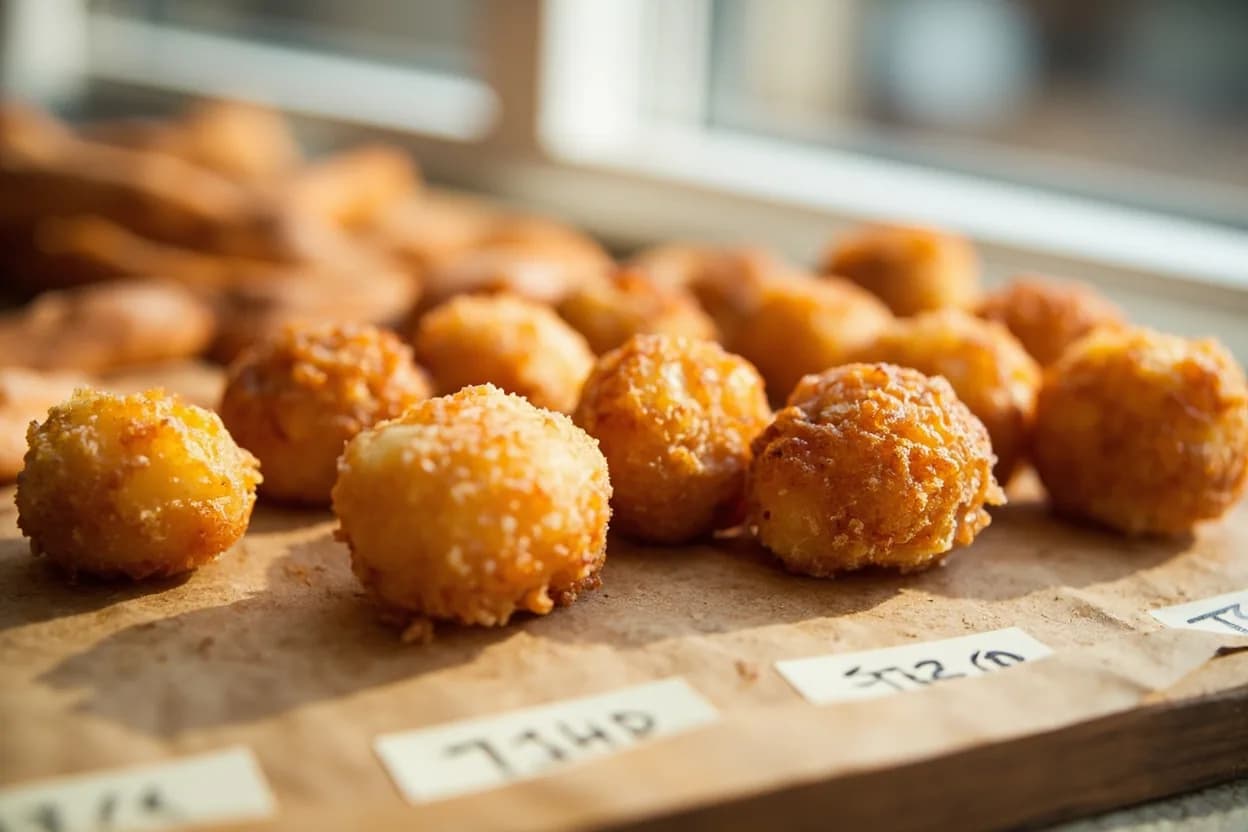
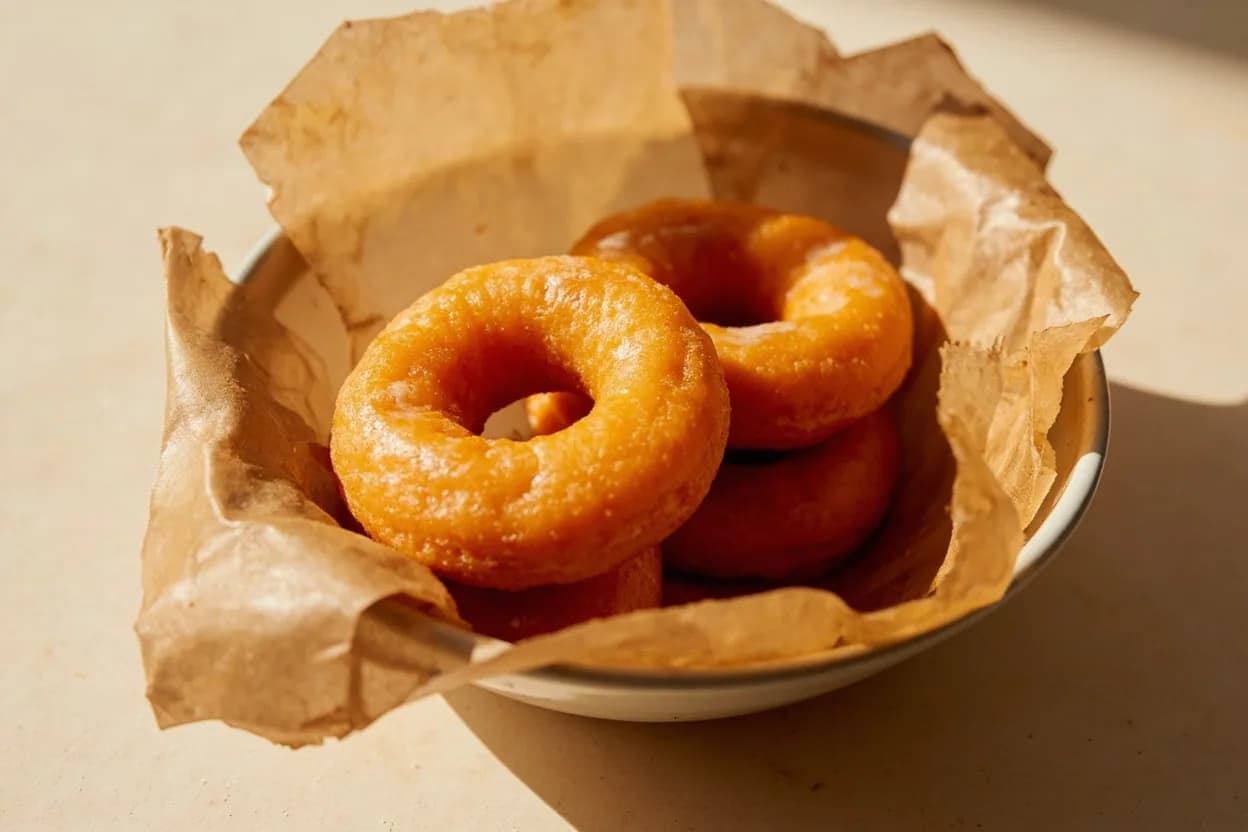
What happens
When enriched dough enters oil at 175–185°C, several events occur rapidly in sequence. Surface moisture evaporates and begins Maillard browning of sugars and proteins, quickly forming a crust that is thin enough to allow continued interior expansion. The heat activates remaining yeast gas (in yeast-raised doughnuts) or expands steam pockets (in choux-based churros), so the pastry puffs to its full volume. Interior starch gelatinizes and egg proteins set at 71–74°C, creating a tender, cooked crumb. At this temperature the full fry cycle (color development + interior cook-through) coincides for most shapes within 2–3 minutes per side. Timing and flipping are critical — both sides must receive even contact with hot oil for uniform color and internal doneness.
What to look for
- Doughnuts float immediately on entry — a sign of proper temperature and sufficient gas expansion
- Color progression: pale yellow → golden amber over 2–3 minutes per side; do not rush to deep brown
- A golden ring (halo) around the equator of a ring doughnut indicates even oil coverage and correct temperature
- At too-low temperature: doughnut or beignet sinks or barely floats, soaks oil and emerges greasy and heavy
- At too-high temperature: exterior darkens in under 1 minute while interior center is still raw dough
How to check
- Use a clip-on deep-fry thermometer or digital probe — maintain 175–185°C throughout the session
- Test with one piece before full batch: it should float, bubble steadily, and reach medium-golden color in about 90 seconds per side
- Check internal doneness with an instant-read thermometer: interior of a yeast doughnut should reach 88–93°C (190–200°F)
- Tear or cut one test piece open: interior should be fully dry, tender, and cooked through — not gummy or doughy at the center
Food safety
Carryover & resting
Freshly fried doughnuts and churros continue to cook from residual heat for 1–2 minutes after removal. Drain on a wire rack over a sheet pan rather than paper towels alone, which trap steam and soften the underside. For churros, serve immediately — the crust softens within minutes. Doughnuts tolerate 15–20 minutes of resting before glazing.
The science behind it
Browning of sugars and proteins on the dough surface; accelerated by the sugar content of enriched doughs, which is why churros and beignets brown faster than plain-dough items
- Leavening in Frying
Yeast gas in raised doughnuts and steam in choux must expand before the exterior crust sets; temperature governs whether this expansion is complete before crust lock-up
- Enriched Dough
Doughs containing fat, eggs, and sugar behave differently from lean doughs in oil because their lower water content reduces steam production and accelerates crust formation
- Double-Frying
Not used for enriched doughs — a single fry in the correct window is correct; double-frying would over-color the sugary exterior
- Choux Pastry
Churros are made from a piped choux or choux-adjacent paste; the high egg content creates a steam-leavened expansion in the first seconds of frying
Appears in
References
- 1.The Bread Baker's Apprentice — Peter Reinhart (Ten Speed Press, 2001)
- 2.Bouchon Bakery — Thomas Keller & Sebastien Rouxel (Artisan, 2012)
- 3.The Professional Pastry Chef — Bo Friberg (Wiley, 4th ed., 2002)
- 4.The Food Lab — J. Kenji López-Alt (W. W. Norton, 2015)
Confidence: high
Notes
Why enriched doughs have a narrower frying window than lean doughs
Sugar and fat in enriched doughs lower the Maillard threshold — surface browning begins earlier and accelerates faster than with lean doughs. A yeast-raised doughnut can go from perfectly golden to over-browned in under 30 seconds at 190°C, whereas a plain fritter might tolerate that temperature for twice as long. This means the temperature window is not just a guideline but a structural requirement: hold 175–185°C and flip precisely on color cue.
Churros: choux vs. yeasted
Classic Spanish churros are made from a very simple paste of flour, water, salt, and sometimes a little oil — not full choux pastry but choux-adjacent in its high-hydration, no-fat simplicity. Mexican churros often add eggs and butter to approach choux richness. Both types fry at 175–185°C but the choux-enriched version browns faster due to egg proteins and benefits from the lower end of the range (175–178°C). The star-shaped extrusion from a churrera creates ridges that maximize crust surface area and crunch.