Aromatic & Fat Doneness
Doubanjiang Fry-Off Stage (Oil Separation)
Also: doubanjiang cooked off, doubanjiang fry stage, 郫县豆瓣炒香, toban djan bloom, bean paste fry-off
The doneness stage when Sichuan fermented broad-bean-and-chili paste is fried in hot oil until fat visibly separates, the paste darkens to deep brick-red, and its raw fermented edge and excess salt mellow into a rich, savory, aromatic base.
Doubanjiang (豆瓣酱, Pixian-style fermented broad bean and chili paste) requires a dedicated fry-off stage before other ingredients are added. The paste — which has been fermented for months to years and contains substantial residual moisture, salt, and raw fermented compounds — must be stir-fried in a generous amount of hot oil until its water evaporates, the oil separates visibly, and the color deepens from red-orange to a deep brick-red or mahogany. This fry-off removes the raw, astringent edge of the paste, concentrates its umami and capsaicin compounds into the oil, and builds the foundational flavor base for mapo tofu, twice-cooked pork (hui guo rou), dan dan noodles, and dozens of other Sichuan preparations. It is analogous to the bhunnao stage in Indian cooking but applied to a fermented paste rather than a fresh masala.
In photos
What happens
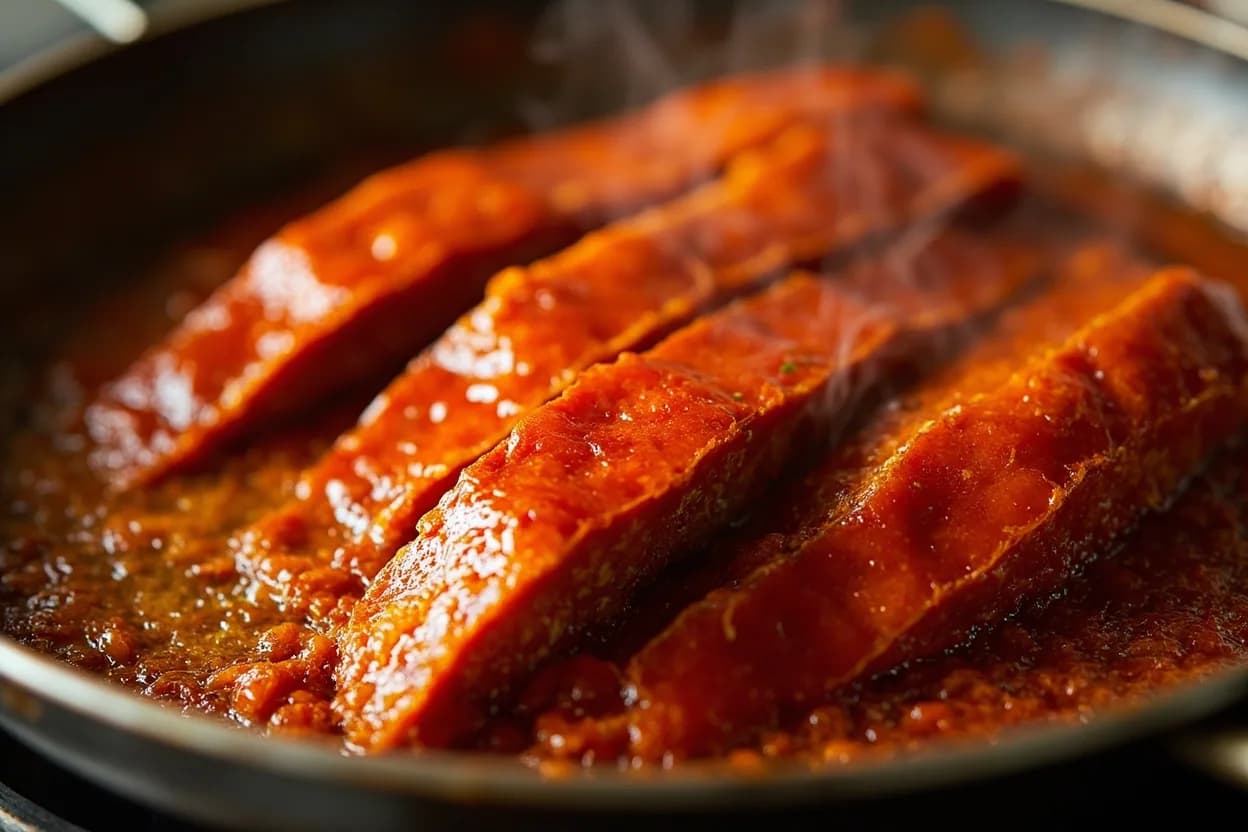
Pixian doubanjiang contains approximately 50–65% moisture, significant sodium chloride, fermented organic acids (lactic, acetic), amino acids from the fermented beans, and a complex of capsaicin esters from the dried chilies. When added to oil at 160–180°C, the moisture immediately volatilizes and the paste sputters and bubbles vigorously — the kitchen fills with pungent, spicy steam. As moisture expels, the paste temperature rises above 100°C and Maillard reactions between the amino acids and residual sugars begin darkening the paste. Capsaicin and fat-soluble carotenoids (responsible for Sichuan's characteristic crimson-red oil) leach into the surrounding oil, turning it a vivid red-orange. The oil — initially absorbed and emulsified into the paste — releases and pools visibly as free water approaches zero. At this point the paste has transformed from raw-fermented to deeply savory, less salty on the palate, and the oil has become an intensely flavored, Sichuan-characteristic red-oil base.
What to look for
- Bright red-orange oil pools visibly at the edges of the paste mass and around the pan
- Vigorous sputtering from evaporating moisture subsides as frying becomes dry and sizzling
- Color shifts from the paste's original red-orange to a deeper, darker brick-red or mahogany
- Aroma transforms from sharp, pungent fermented smell to a rich, roasted, savory, spicy fragrance
- The paste becomes slightly drier and more granular in texture, no longer slippery and wet
- The kitchen air takes on a distinctive reddish-spicy haze from volatilized capsaicin — ensure ventilation
How to check
- Tilt the wok or pan; freely pooling red oil at the lower edge (not the paste itself, but clear red fat) indicates fry-off is complete
- Drag a spatula through the paste — it should move as a drier, cohesive mass, not as a wet slurry that flows back
- Taste a tiny amount (carefully, it is extremely spicy and hot): the raw, sour fermented edge should be mostly resolved into deep savory umami; salt should feel mellowed rather than sharp
- Color check: the Pixian paste's characteristic bright red should have shifted to a darker, richer tone — not quite black, but significantly deepened
- Typical fry-off time in a hot wok: 2–4 minutes on medium to medium-high heat with continuous stirring to prevent scorching
Food safety
The science behind it
- Bhuna / bhunnao stage
The analogous oil-separation endpoint in Indian masala cooking — same principle (moisture out, oil separates, depth develops) applied to a different base
- Sichuan red oil (hong you)
The colored, capsaicin-infused oil produced during the fry-off is the characteristic red oil of Sichuan cuisine
- Pixian doubanjiang
The canonical Sichuan fermented paste from Pi County, Chengdu — the highest-quality version for fry-off; labeled 郫县豆瓣
- Ma la (numbing-spicy)
The defining Sichuan flavor profile (numbing from Sichuan pepper + heat from chili); the fry-off stage is where both compounds concentrate into the cooking oil
Responsible for the darkening of the paste during fry-off as amino acids and sugars react above 100°C once moisture is expelled
The high heat of wok cooking intensifies and accelerates the fry-off; a flat-bottomed pan on domestic heat achieves the same result but more slowly
Appears in
References
- 1.Land of Fish and Rice — Fuchsia Dunlop (W.W. Norton, 2016)
- 2.The Food of Sichuan — Fuchsia Dunlop (W.W. Norton, 2019)
- 3.Every Grain of Rice — Fuchsia Dunlop (Bloomsbury, 2012)
- 4.On Food and Cooking — Harold McGee (Scribner, 2004)
- 5.Chinese Food Made Easy — Ching-He Huang (HarperCollins, 2008)
Confidence: high
Notes
Pixian versus other doubanjiang
Not all doubanjiang is Pixian. Mass-produced varieties (Lee Kum Kee, generic supermarket brands) are younger, less complex, and saltier — they still require a fry-off, but the resulting oil will be less nuanced. Authentic Pixian doubanjiang (郫县豆瓣, aged 3 months to 3 years) produces a richer, more complex red oil with deeper fermented notes. It is the non-negotiable choice for authentic mapo tofu and hui guo rou.
Oil quantity and the red-oil payoff
Sichuan chefs typically use more oil than might seem necessary — 3–5 tablespoons per 2 tablespoons of paste — because the fry-off's purpose is to extract all the fat-soluble color and flavor compounds into the oil, which then carries those flavors throughout the dish. The red-tinted, flavor-saturated oil that results is the actual flavor vehicle, not just a cooking medium. Dishes cooked with too little oil never achieve the characteristic 红油 (red oil) finish.
Finely chopping the paste
Restaurant practice is to mince or briefly pulse Pixian doubanjiang before adding it to the wok — finer particle size means faster moisture expulsion, more even Maillard browning, and a smoother finished sauce. Whole or coarsely chopped paste takes longer to fry off and can scorch on the outside before the interior moisture fully expels.