Egg Doneness
Egg: Soft Scramble vs. Firm Set
Also: scrambled egg doneness, oeufs brouillés, baveuse, soft curds vs. dry scramble
Soft scramble forms glossy, barely-set curds at 65–70°C; firm set at 75–80°C yields fully cooked, drier eggs — a few degrees separate silk from rubber.
Scrambled eggs exist on a continuum between a barely-coagulated, flowing custard and a fully set, dry mass. The transition is driven by the sequential denaturation of egg proteins: ovalbumin, ovotransferrin, and conalbumin begin setting at different temperatures, allowing the cook to interrupt coagulation at any point by removing heat and stirring. Soft scramble (oeufs brouillés in French tradition) targets 65–70°C (149–158°F), producing small, glossy, creamy curds still held in a fluid matrix. Firm set (the American diner style) reaches 75–80°C (167–176°F), where all proteins have fully coagulated and liquid has mostly been expelled from the curd network. Above 80°C, eggs become rubbery and weep as the protein network contracts and expels water.
In photos
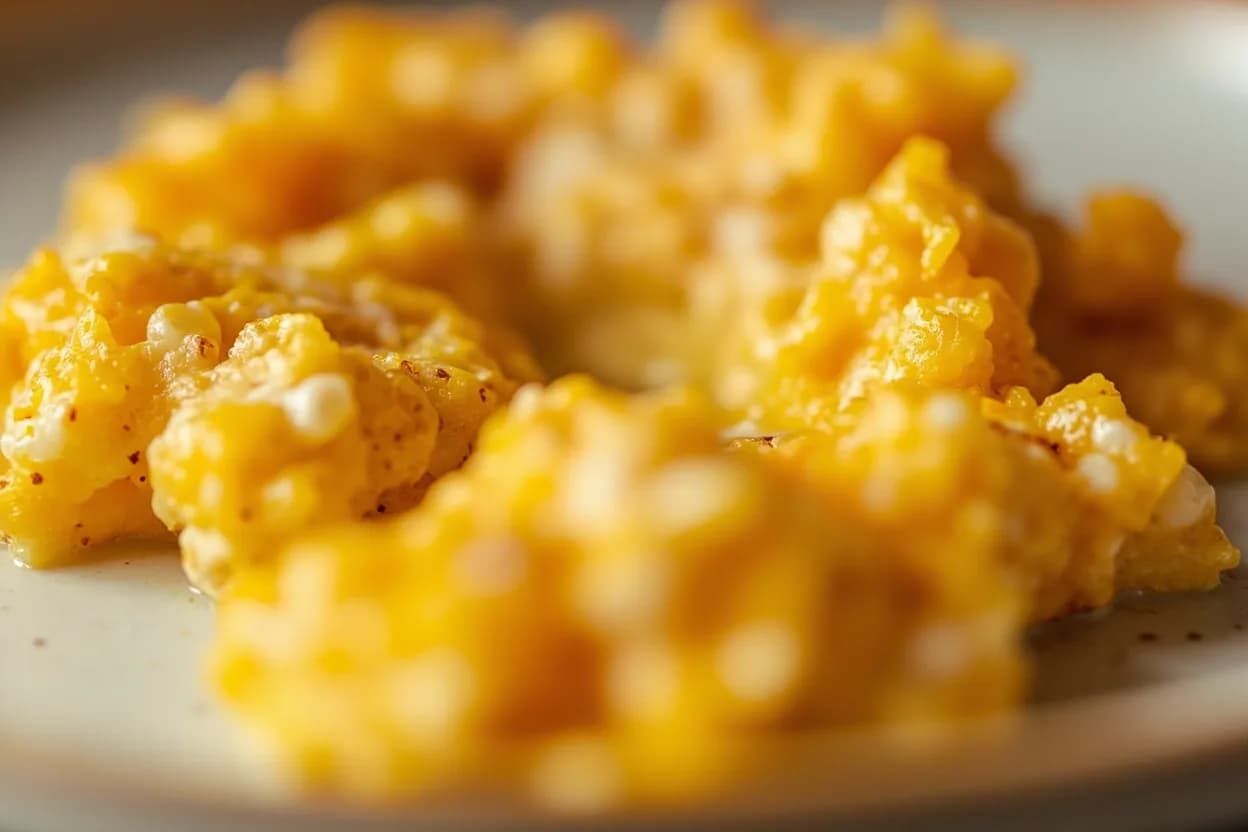
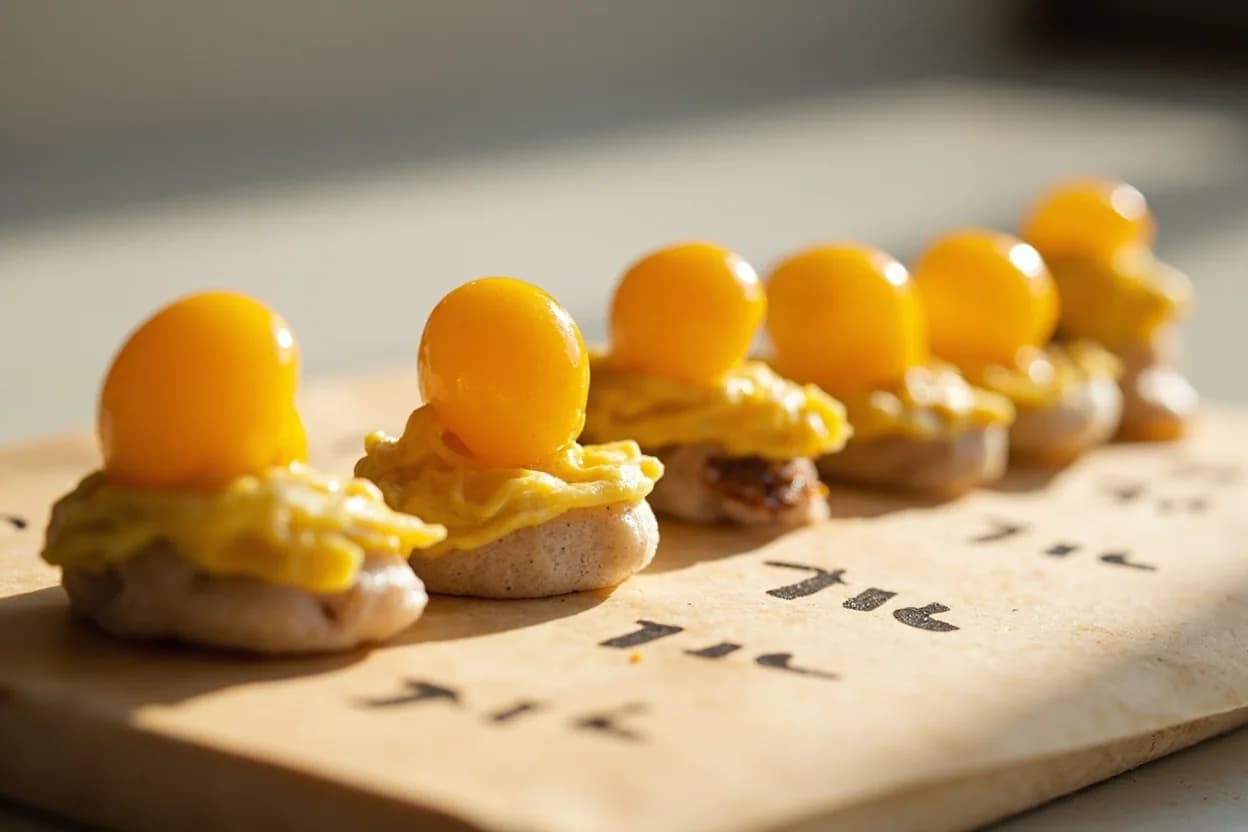
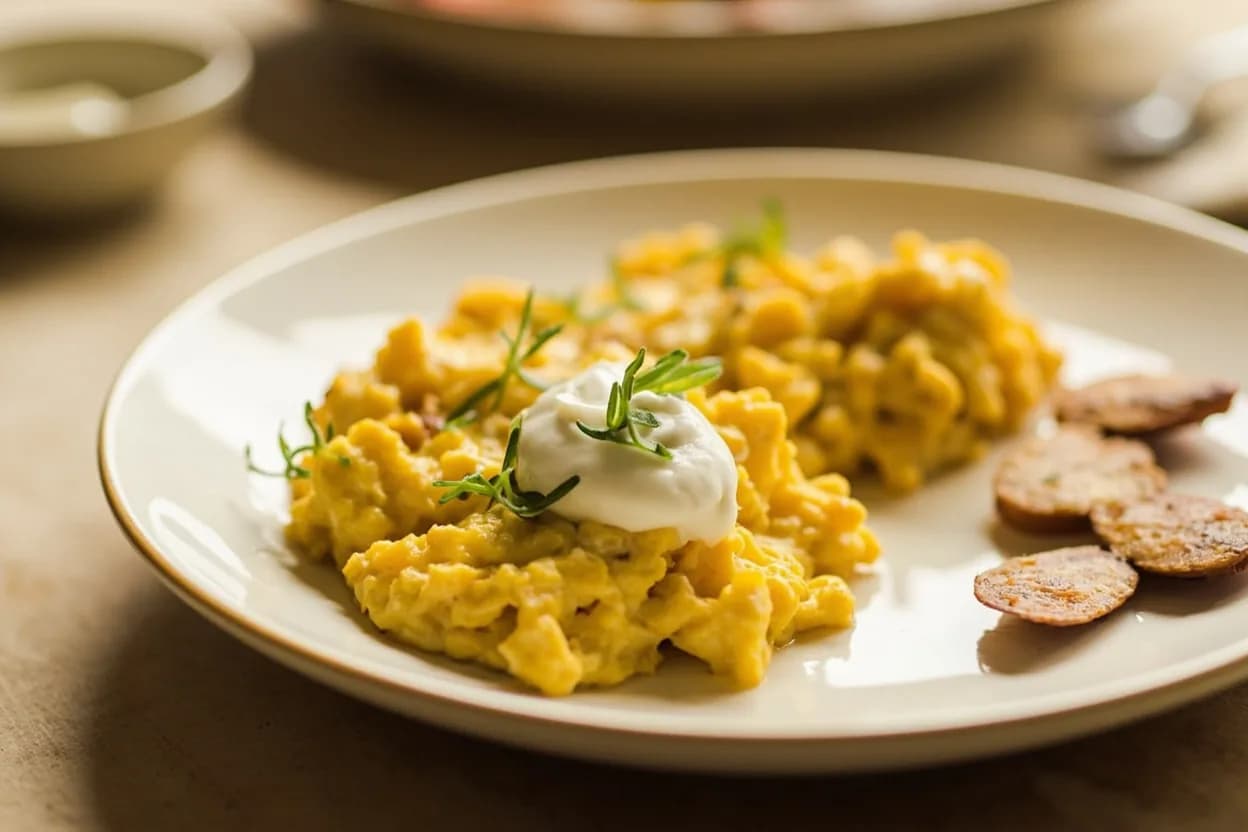
What happens
Whole beaten eggs contain a mixture of proteins with distinct denaturation temperatures: conalbumin/ovotransferrin begins setting at ~61°C; ovomucoid at ~70°C; ovalbumin (the most abundant, ~54% of egg white protein) at ~80°C. Yolk proteins, dominated by low-density lipoproteins, begin to thicken at ~65°C. In soft scramble, heat is applied gently and removed repeatedly (bain-marie technique) or over very low direct heat, allowing the cook to catch the eggs just as conalbumin and yolk proteins set — yielding small, soft curds suspended in still-liquid egg. Residual heat (carryover) continues cooking the curds off the heat. At 75–80°C (firm set), ovalbumin fully coagulates, expelling the moisture that was bound in the protein network. The curds become larger, drier, and more cohesive. Added fat (butter, cream) disrupts protein network formation, keeping curds tender and glossy at both stages; salt added before cooking can slightly accelerate denaturation and promote a finer curd.
What to look for
- Soft scramble: small, distinct curds coated in a glossy, barely-set liquid matrix — eggs run slightly when tilted on the plate
- Soft scramble: a sheen of butter is visible between curds; no dry or crumbly patches
- Firm set: larger, matte curds that hold their shape and do not weep when the plate is tilted
- Overcooking indicator: liquid pooling under the eggs is expelled moisture, a sign proteins have over-contracted above 80°C
- Proper soft scramble releases cleanly from a silicone spatula with no sticking; overcooked eggs stick and tear
How to check
- Temperature (professional): use an instant-read thermometer stirred through the eggs; remove from heat at 63–65°C for soft scramble, allowing carryover to reach 67–70°C on the plate
- Visual cue (soft scramble): eggs should still look slightly underdone in the pan — translucent patches are acceptable; they will set fully from residual heat
- Tilt test: tilt the pan — soft scramble flows slowly like a thick custard; firm set moves as a solid mass
- Spatula drag: drag a silicone spatula through the eggs; soft scramble leaves a track that slowly fills back in; firm set leaves a clean, dry channel
- Time as proxy: over medium-low heat in a buttered pan, constant stirring for 3–4 minutes yields soft scramble; 6–8 minutes yields firm set — but pan temperature varies widely, so visual/tactile cues are more reliable
Food safety
Carryover & resting
Carryover cooking is significant for scrambled eggs. Remove from heat 2–3°C before the target: soft scramble pulled at 63°C will reach 66–68°C from residual pan heat alone. Transferring immediately to a cold bowl or adding cold cream/butter arrests carryover. This is the fundamental technique of the French bain-marie method, where the bowl is alternately placed over and removed from simmering water.
The science behind it
- Bain-marie egg cookery
Indirect, controlled heat via a double boiler is the classical French method for oeufs brouillés — the water bath limits maximum temperature and slows protein denaturation for maximum control
- Ovalbumin denaturation
The dominant egg white protein sets at ~80°C, making it the protein responsible for the rubbery texture of overcooked eggs
- Fat as protein network disruptor
Butter and cream intercalate between protein chains, physically separating them and preventing tight network formation — the mechanism behind creamy scrambled egg texture
- Omelette baveuse
The French ideal for an omelette is also baveuse (slightly runny, glossy interior) — the same 65–70°C target as soft scramble, achieved by folding and plating before the interior is fully set
- Salt timing debate
Adding salt before beating draws moisture through osmosis and can subtly tighten the protein network, promoting a finer curd in soft scramble; salting after cooking avoids this effect for those preferring larger curds
Appears in
References
- 1.On Food and Cooking — Harold McGee (Scribner, 2004)
- 2.The Food Lab — J. Kenji López-Alt (Norton, 2015)
- 3.Modernist Cuisine at Home — Myhrvold & Bilet (The Cooking Lab, 2012)
- 4.Larousse Gastronomique (Clarkson Potter, 2001)
- 5.Ratio: The Simple Codes Behind the Craft of Everyday Cooking — Michael Ruhlman (Scribner, 2009)
Confidence: high
Notes
The French bain-marie method
Escoffier's oeufs brouillés are made entirely in a double boiler, stirring constantly with a wooden spoon. The bowl is moved on and off the heat to keep the eggs below 70°C throughout the entire process — which can take 20 minutes for a single portion. The result is extraordinarily small, creamy, uniform curds with no separation of liquid. Finishing with cold butter and crème fraîche simultaneously enriches the dish and arrests carryover cooking.
High-heat scrambles
Chinese egg stir-fries (番茄炒蛋, fried rice) use very high heat — a screaming wok at 250°C+ — to set eggs in seconds. The result is a firm, slightly smoky set with a characteristic 'wok hei' char on the outer curd. This is a deliberate firm-set technique executed so rapidly that the eggs do not become rubbery — they are cooked and off the heat before any protein over-contraction can occur.
Pasteurized eggs for soft scramble service
Modern kitchens serving consistently soft-scrambled eggs at 65–70°C use pasteurized shell eggs or liquid pasteurized egg products. Liquid pasteurized whole egg (pasteurized at approximately 60°C for several minutes at commercial scale) provides Salmonella safety while retaining all functional cooking properties — curd formation, emulsification, and flavor are indistinguishable from shell eggs in practical kitchen use.