Egg Doneness
Egg Yolk Ribbon Stage
Also: au ruban, ribbon stage, pale and thick stage, blanchir, whipped yolks
Yolks and sugar beaten until pale, tripled in volume, and thick enough to fall from the whisk in a slow, flat, dissolving ribbon.
The ribbon stage is a critical structural milestone in baking and pastry where egg yolks (or whole eggs) are beaten with sugar until the mixture turns pale yellow, roughly triples in volume from incorporated air, and reaches a consistency where a stream lifted from the whisk falls back onto the surface in a flat, slow ribbon that holds its shape for several seconds before dissolving. This is not a temperature doneness point but rather a physical state achieved by mechanical aeration. The French term 'au ruban' (to the ribbon) precisely describes the characteristic pour pattern. It is a fundamental stage for génoise sponge, sabayon (zabaione), ladyfingers, charlotte batter, and many egg-thickened custard bases.
In photos
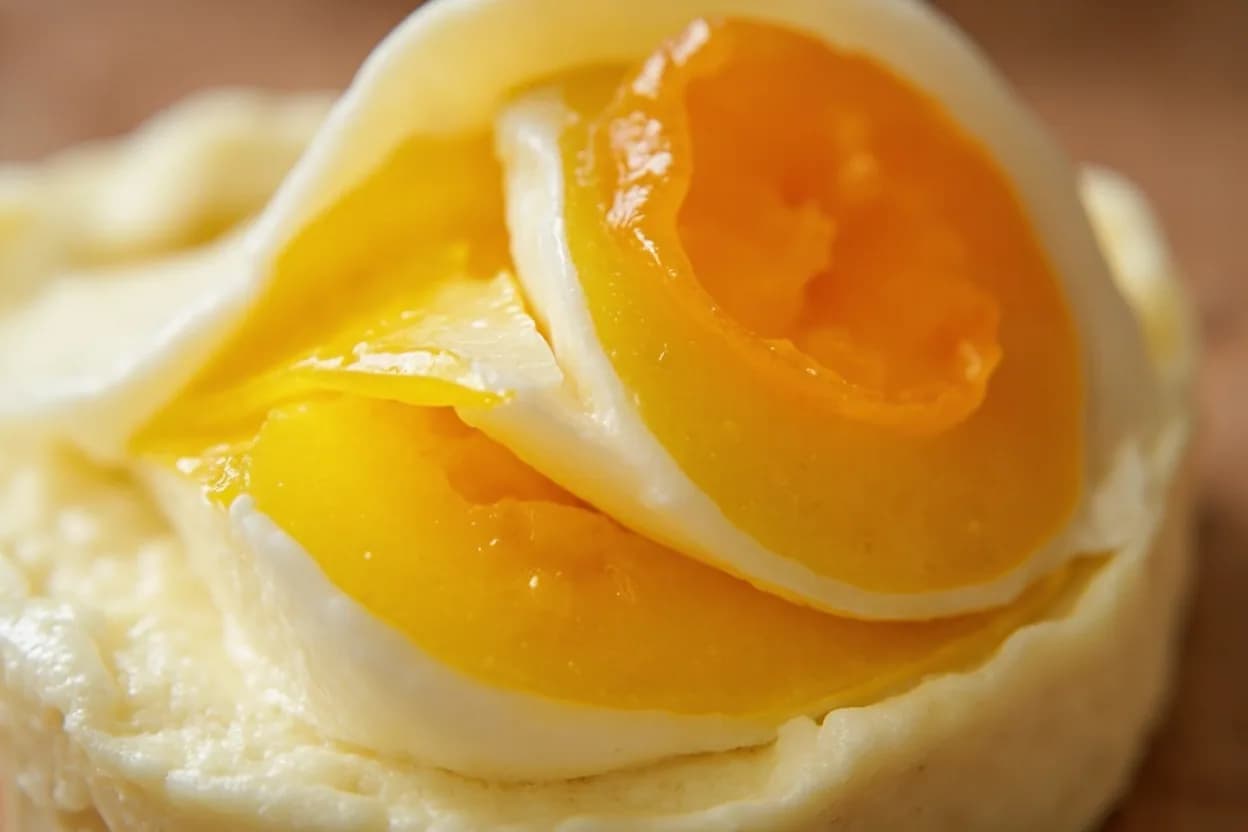
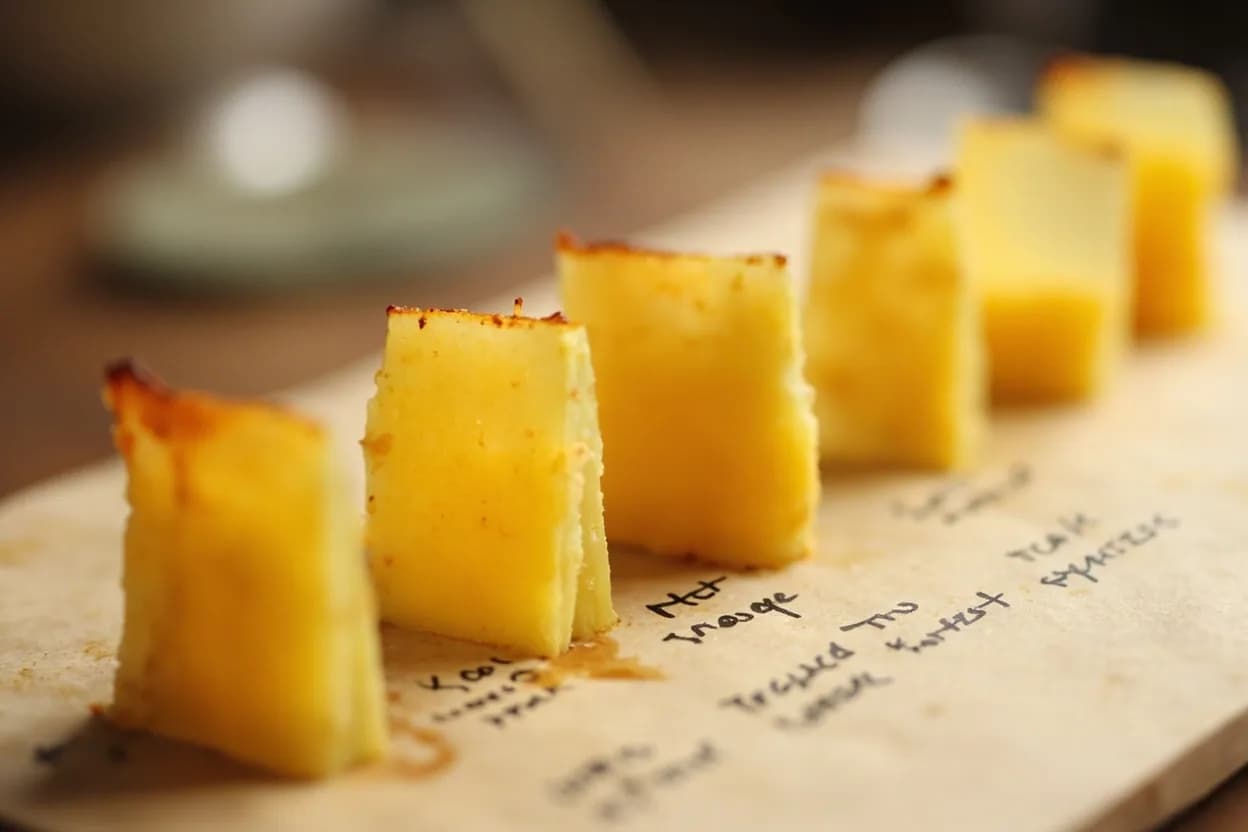

What happens
Beating egg yolks with sugar simultaneously dissolves the sugar crystals and denatures surface proteins partially, reducing their surface tension and allowing them to stabilise a foam. The resulting foam is stabilised by the high viscosity of the egg-sugar syrup — the dissolved sucrose raises the mixture's viscosity substantially, trapping air bubbles and preventing rapid collapse. The pale colour results from the dilution of yolk carotenoids by the incorporated air phase. Volume increase of 3–5× is typical. For sabayon, gentle heat (double boiler at 60–65°C) simultaneously aerates and slightly cooks the yolks, producing a more stable foam and a custard-like consistency.
What to look for
- Mixture turns pale lemon-yellow or almost white, a strong contrast to the raw orange yolk
- Volume increases dramatically — 3 to 5 times original volume
- Texture feels light and mousse-like when lifted on a spatula
- Ribbon test: a thick, flat stream falls from the whisk and lies on the surface in folds for 3–5 seconds before sinking — neither disappears instantly nor stays raised as a stiff peak
- Surface of the mixture looks matte and holds a faint trail from the whisk
How to check
- Lift the whisk or beater and let the batter fall back: it should flow in a wide, flat ribbon that dissolves in 3–5 seconds
- Run a finger along the surface — it should hold a defined trail momentarily
- Tilt the bowl — the mixture should flow slowly, like thick honey or softly whipped cream
- Check colour: pale yellow indicates sufficient aeration; deep yellow means more beating is needed
- For timed recipes, electric mixer on medium-high typically reaches ribbon stage in 4–6 minutes for 4 yolks + 100 g sugar
The science behind it
- Sabayon / Zabaione
Ribbon stage achieved over a double boiler, with heat providing additional protein stabilisation alongside mechanical aeration
- Génoise Sponge
The ribbon stage of whole eggs (not just yolks) with sugar is the essential foundation — the foam captures the only leavening
Both involve egg thickening, but nappe is heat-coagulation; ribbon is mechanical aeration — different mechanisms, often confused
- Meringue: Soft Peak Stage
Analogous foam stabilisation but using egg whites rather than yolks; sugar concentration and mechanism differ
Appears in
References
- 1.Patisserie: Mastering the Fundamentals of French Pastry — Christophe Felder
- 2.The Professional Pastry Chef — Bo Friberg
- 3.On Food and Cooking — Harold McGee
- 4.Larousse Gastronomique
Confidence: high
Notes
Why the ribbon must dissolve
An underbeaten batter produces a ribbon that sinks instantly — insufficient air for a stable foam, and the subsequent flour fold will deflate the structure quickly, yielding a dense crumb in génoise. An overbeaten mixture is drier and grainier, and the foam is over-stabilised, making it resistant to folding in flour without deflation. The dissolving ribbon — holding 3–5 seconds then sinking — indicates the sweet spot where the foam is voluminous but still fold-friendly.
Sabayon vs. cold ribbon stage
In sabayon, the ribbon stage is achieved over a double boiler at 60–65°C, which simultaneously aerates the foam and gently cooks the yolks to a stable thickened consistency. This produces a more heat-stable foam than the cold ribbon stage used in génoise. The hot sabayon can be served warm as a sauce or cooled and folded into whipped cream for tiramisu filling — the cooked proteins provide structure the cold version lacks.