Bread & Dough Doneness
Enriched Bread Internal Temperature
Also: brioche doneness temperature, milk bread temperature, challah internal temp, enriched dough baked through
Enriched breads — brioche, challah, milk bread, pan dulce — are done at 88–93°C (190–200°F); fat and eggs lower the starch gelatinization threshold, so they set at a lower temperature than lean loaves.
Enriched breads contain significant amounts of fat (butter, oil), eggs, dairy, and sugar added to the base flour-water-yeast matrix. These ingredients profoundly alter the starch gelatinization and protein denaturation temperatures, meaning the crumb sets at a lower internal temperature (88–93°C / 190–200°F) than lean artisan bread. Pulling at the lean-bread target of 96–99°C will produce an over-dried, crumbly enriched crumb. The fat coats starch granules and impedes water absorption, lowering the effective gelatinization point; egg proteins contribute additional structure that sets earlier.
In photos
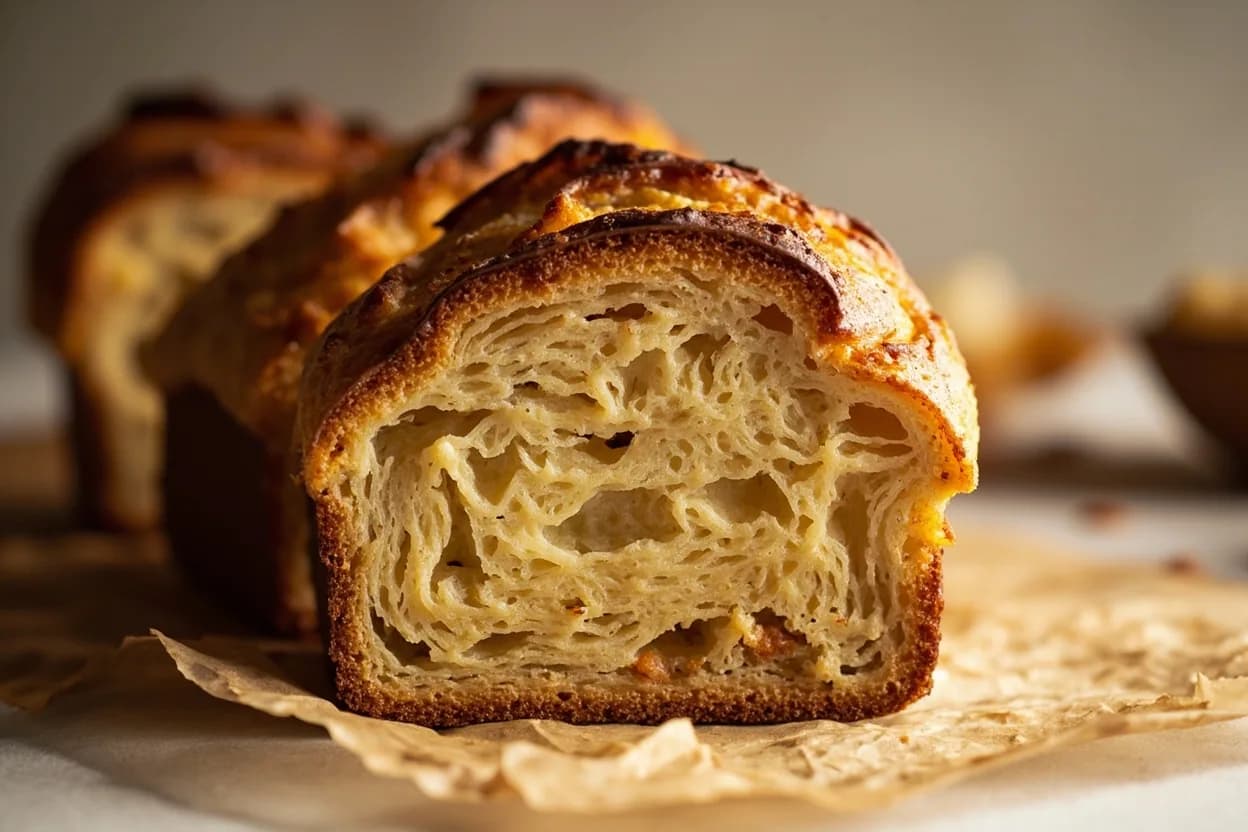

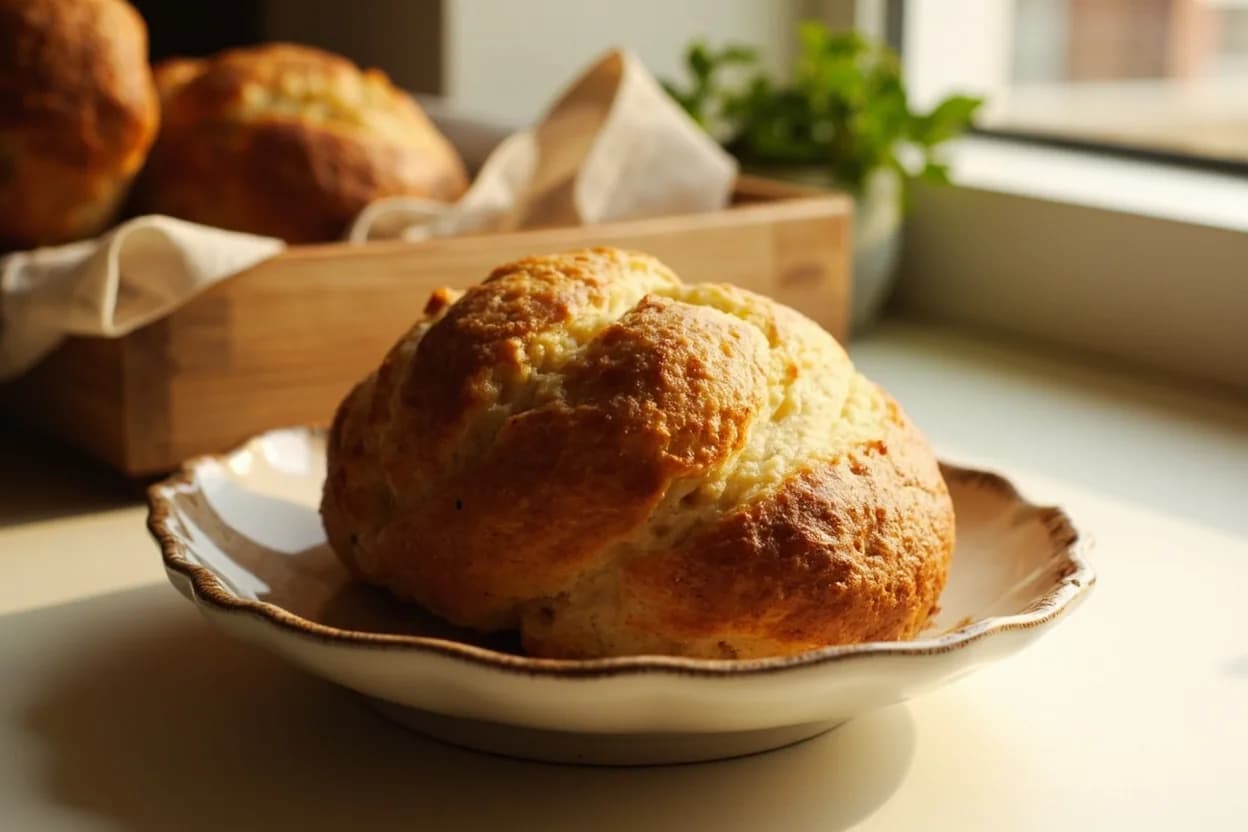
What happens
Fat molecules intercalate between starch granules during mixing, partially coating them and reducing their water-uptake capacity. This means gelatinization is complete at lower temperatures than in a lean dough. Simultaneously, egg proteins (ovalbumin, ovomucin) denature and coagulate beginning around 70°C, providing a secondary structural network that stiffens the crumb well before starch gelatinization would be complete in a lean dough. Sugar raises the Maillard/caramelization activity on the crust at lower temperatures, producing the characteristic deep-golden color of challah and brioche; this visual cue can mislead bakers into thinking the crumb is done when the interior is still wet.
What to look for
- Crust is deep mahogany-gold with no dull or pale patches on the sides or bottom
- Loaf springs back immediately and fully when the top is gently pressed — no residual indent
- Pull away from the pan sides is clean and complete for tin-baked loaves
- Bottom sounds slightly less hollow than a lean loaf due to the denser, moister crumb — compare against the same loaf unbaked
- A skewer inserted in the center comes out clean with no wet dough attached, though a small amount of sticky crumb is acceptable
How to check
- Insert an instant-read thermometer into the thickest part of the loaf, avoiding the base crust
- For brioche à tête, probe through the side of the main body below the topknot
- For challah braids, probe at the geometric center of the thickest strand intersection
- For pan-baked milk bread (shokupan), probe through the side into the center of the pull-apart block
- Check two spots in large loaves — enriched doughs can have uneven heat penetration due to fat pockets
Carryover & resting
Enriched breads continue to firm slightly after removal from the oven as egg proteins continue to set and butter solidifies. Allow to cool in the pan for 10–15 minutes before turning out, then cool on a rack for at least 30 minutes before slicing. Cutting too early releases steam and causes the butter-enriched crumb to compress and become gluey.
The science behind it
- Egg protein coagulation
Ovalbumin and ovomucin denature starting around 70°C, providing structural support in enriched crumbs before starch fully gelatinizes
Fat coating on starch granules lowers the effective gelatinization temperature, reducing the target vs. lean bread
- Sugar and Maillard reaction
High sugar content accelerates crust browning; visual color can suggest doneness while the crumb is still under-temperature
- Tangzhong/yudane
Pre-gelatinized starch pastes used in Japanese milk bread; they shift the entire gelatinization curve and extend shelf life
- Laminated enriched dough
Croissants and pain au chocolat have a different doneness threshold due to layered butter and steam leavening
Appears in
References
- 1.The Bread Baker's Apprentice — Peter Reinhart
- 2.Modernist Bread — Myhrvold & Migoya
- 3.How Baking Works — Paula Figoni
- 4.Advanced Bread and Pastry — Michel Suas
- 5.The Art of French Pastry — Jacquy Pfeiffer
Confidence: high
Notes
Why fat lowers the target temperature
In a lean dough, the only barriers to starch gelatinization are the gluten network and water availability. In an enriched dough, fat molecules compete with starch for water — they coat granule surfaces and reduce effective hydration. Because gelatinization is a hydration-driven process, less available water means the reaction is complete at a lower temperature. The same principle explains why pie dough (very high fat) has a much lower structural-set temperature than pasta dough.
The misleading crust
Sugar-rich enriched doughs brown aggressively — often requiring an oven tent of foil to prevent over-browning before the crumb is done. Bakers who judge by crust color alone frequently pull enriched loaves 5–10°C short of the target, resulting in a wet, dense interior that collapses on slicing. Always confirm with a thermometer.