Egg Doneness
Egg: Soft-Poached vs. Hard-Poached
Also: poached egg doneness, soft poach, hard poach, eggs benedict doneness
Soft-poached yields a set white with a liquid, flowing yolk; hard-poached sets both white and yolk completely solid.
Poaching suspends a shelled egg in water held just below a simmer (roughly 82–90°C / 180–194°F at the water surface), so the egg cooks by gentle convection rather than direct contact. Doneness is determined by the internal temperature the yolk reaches. Soft-poached targets a yolk between 63–65°C (145–149°F), leaving it runny and saucy; hard-poached allows the yolk to exceed 77°C (170°F) until fully coagulated. The white proteins (primarily ovomucin and ovalbumin) set at around 63–65°C, so both styles have a set white, but the yolk state diverges sharply with time.
In photos

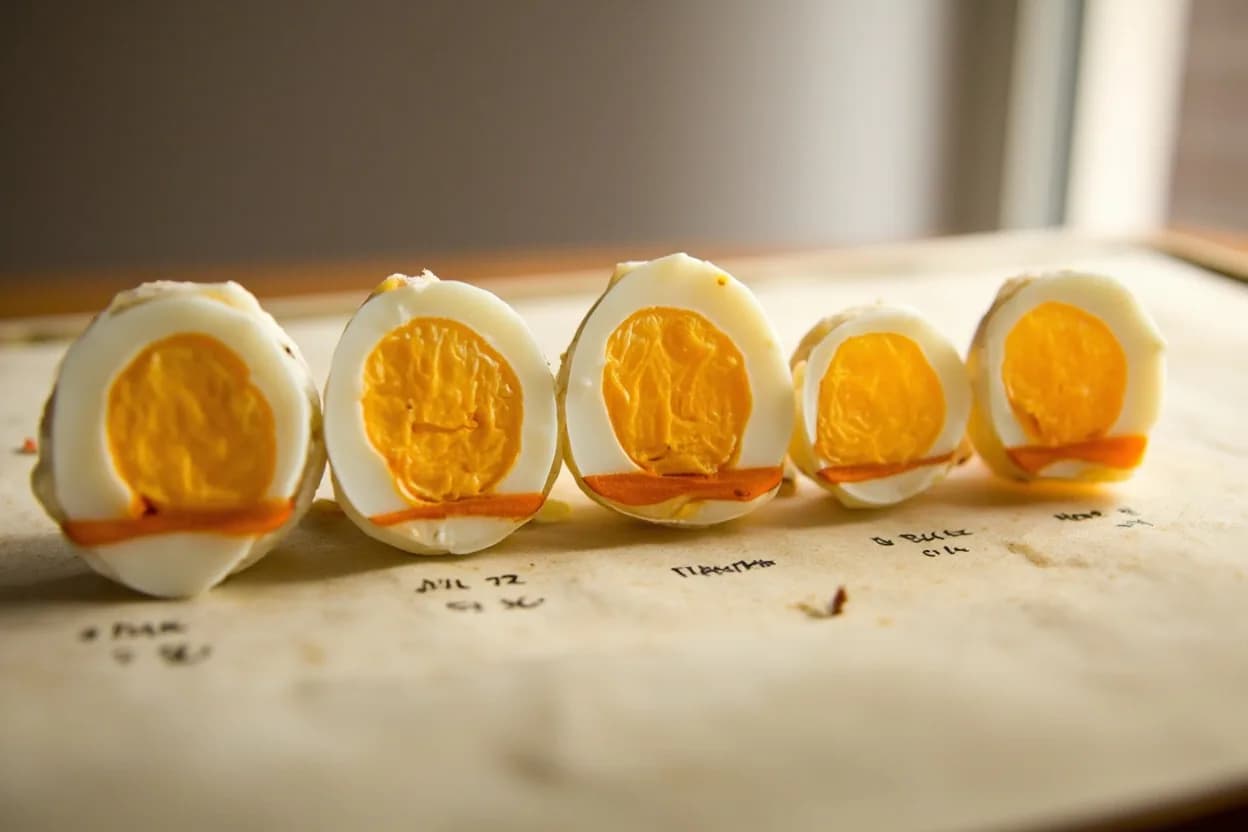
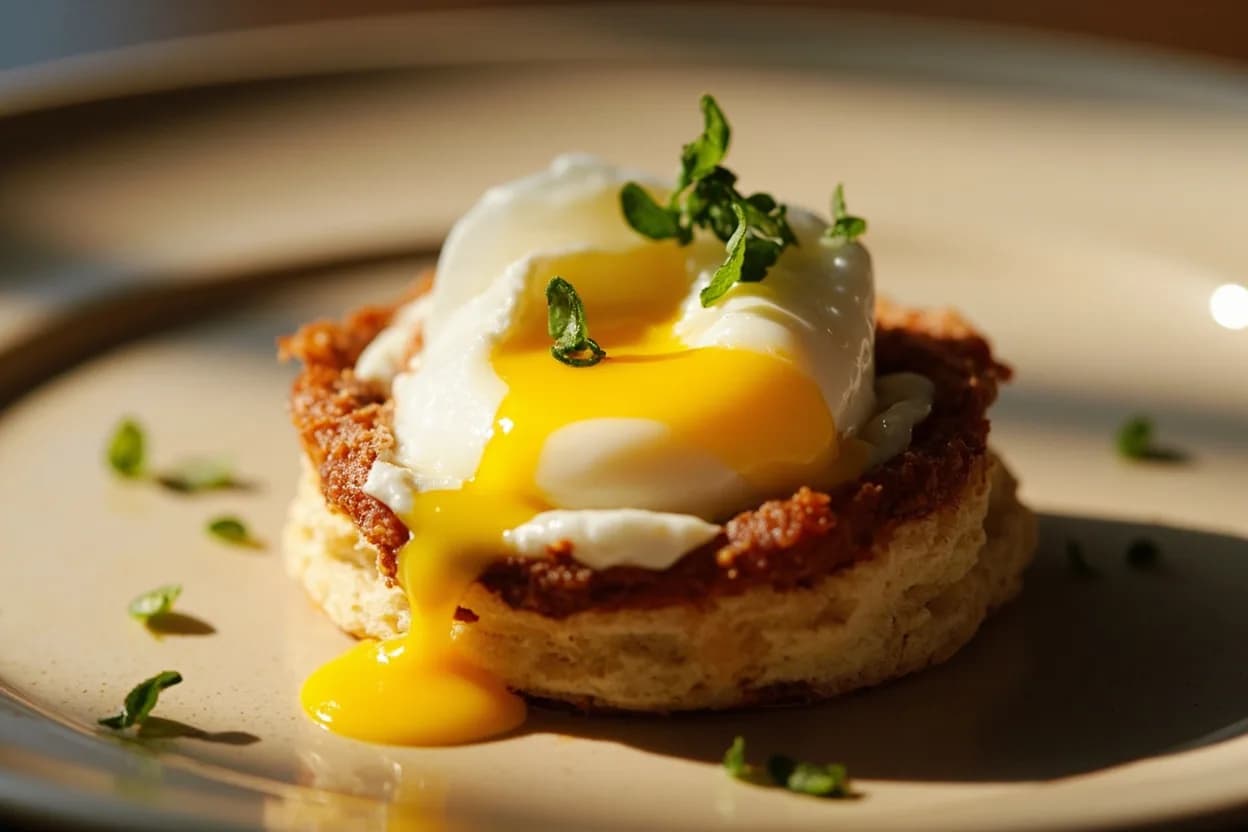
What happens
Egg white proteins begin denaturing at 63°C and are fully set by 70°C. Yolk proteins (low-density lipoproteins, phosvitin) remain fluid at 63–65°C, producing the characteristic molten centre. As yolk temperature climbs past 70°C the lipoproteins gel noticeably; above 77°C the yolk loses all fluidity and sets chalky-firm. The poaching water temperature, egg starting temperature, and cook time all interact to determine final yolk state.
What to look for
- Soft-poached: white is opaque and barely resistant to a finger-press; yolk visibly jiggles when the egg is lifted
- Soft-poached: when cut, yolk flows freely and coats the plate
- Hard-poached: white is firm and slightly rubbery; no jiggle in the yolk
- Hard-poached: yolk is uniformly pale yellow and crumbles when cut
- Overcooked: yolk begins to turn grey-green at the surface from hydrogen sulfide reaction
How to check
- Lift egg with a slotted spoon and gently press the yolk through the white — fluid movement indicates soft-poach
- Time from water entry: ~3 min in 90°C water for soft-poach, ~5–6 min for hard-poach (large egg, fridge-cold)
- For precision, use a sous vide circulator at 63°C for 45–60 min to achieve a reproducible soft-set yolk, then briefly expose in simmering water to finish the white
- Instant-read thermometer inserted into yolk if the egg is large enough; target 63–65°C for soft
Food safety
Carryover & resting
Carry-over is minimal for poached eggs — the water bath dissipates heat rapidly once the egg is removed. Serve immediately or transfer to an ice-water bath to halt cooking, then reheat in hot (not simmering) water for 30–60 seconds before plating.
The science behind it
- Soft-Boiled Egg: Jammy Stage
Same yolk temperature target (63–65°C) achieved via boiling rather than poaching
Both exploit the temperature window where egg proteins thicken without fully coagulating
- Sous Vide Egg
Circulator poaching at a fixed temperature eliminates timing guesswork for consistent soft-poach
- Hollandaise Sauce
Classically served over soft-poached eggs; both depend on emulsified, partially cooked yolk proteins
Appears in
References
- 1.On Food and Cooking — Harold McGee
- 2.The Food Lab — J. Kenji López-Alt
- 3.Modernist Cuisine — Myhrvold, Young, Bilet
- 4.USDA Food Safety and Inspection Service: Shell Eggs from Farm to Table
Confidence: high
Notes
Vinegar and vortex
Adding a splash of white vinegar to the poaching water lowers the pH, accelerating white protein coagulation so the white wraps tightly around the yolk rather than spreading into feathery wisps. A gentle vortex (stirring the water before dropping the egg) serves the same purpose mechanically. Neither technique affects yolk doneness.
Restaurant hold technique
Professional kitchens poach eggs in batches, transfer them to ice water, trim ragged edges with scissors, and refrigerate. Individual eggs are re-warmed to order in 65–70°C salted water for 45–60 seconds — the yolk never climbs past soft-poach temperature during the brief reheat.