Vegetable Doneness
Eggplant: Fully Collapsed & Charred (for Dip)
Also: flame-roasted eggplant, charred aubergine, smoky eggplant, baba ghanoush stage
Direct-flame or broiler heat chars the skin completely while steam pressure collapses the interior to silky, smoke-infused pulp — the essential doneness for baba ghanoush and mutabbal.
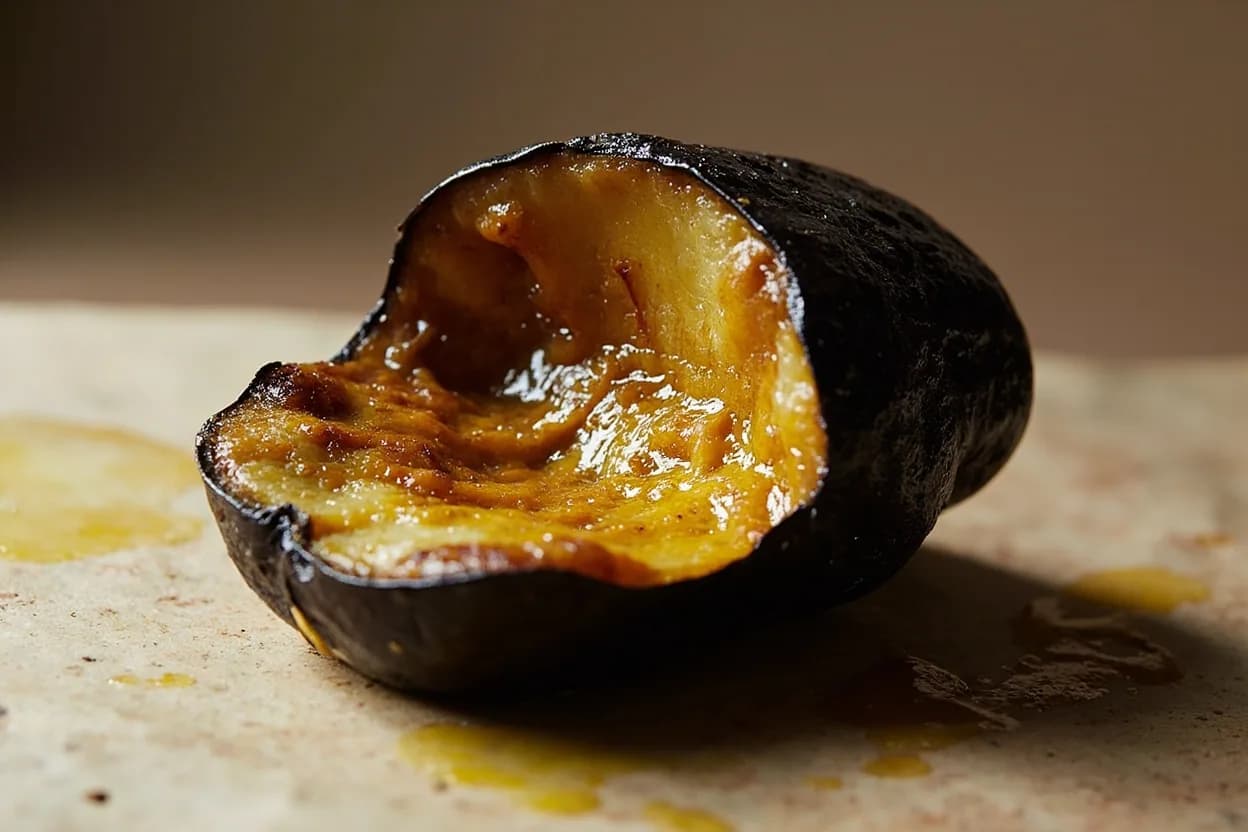
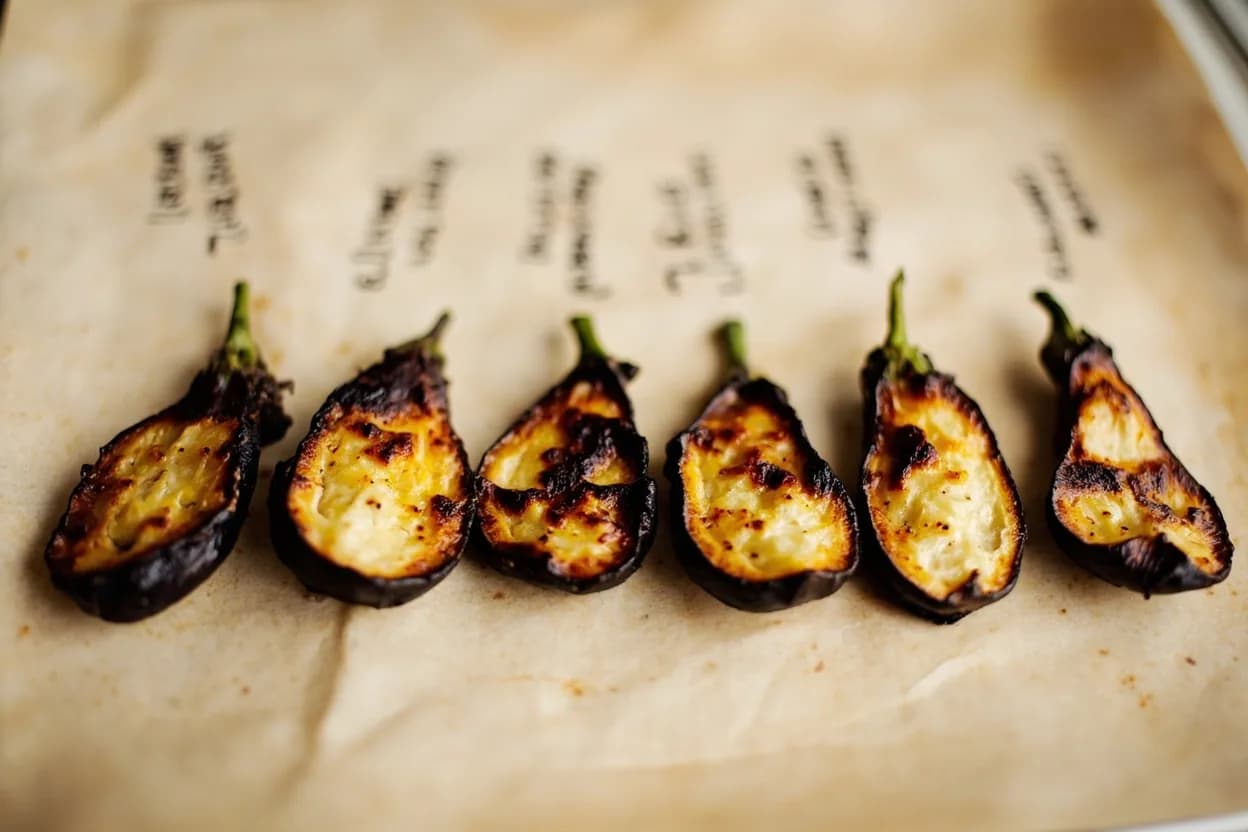
Roasting eggplant for dip requires pushing well past ordinary vegetable doneness to a state of total interior collapse. The entire skin must blacken and char — not merely soften — while the interior flesh steams in its own moisture and becomes fully soft, almost liquid in consistency. This is achieved by direct contact with a gas flame, live coals, or a very hot broiler. The char is not incidental: it creates the smoke compounds (guaiacol, syringol) that define the flavor of authentic baba ghanoush and mutabbal. The eggplant is done only when it has visibly deflated and the skin is entirely black, papery, and separating from the flesh.
In photos

What happens
Direct flame rapidly chars the outer skin through pyrolysis, creating a sealed carbonized shell that traps steam. Internal moisture converts to steam, building gentle pressure that ruptures and softens cell walls without the browning associated with dry roasting. The interior flesh undergoes extensive softening as pectin fully degrades and starch gelatinizes. Solasodine (the bitter compound in eggplant) volatilizes or is masked by competing smoke aromatics. The smoke compounds produced by burning skin (guaiacol and syringol from lignin combustion) migrate into the flesh, creating the characteristic smoky depth impossible to replicate with oven roasting alone. Total cooking time on a gas burner: 15–25 minutes depending on eggplant size.
What to look for
- Skin is entirely matte black and papery — no shiny or soft green/purple patches remaining
- Eggplant visibly deflates and collapses inward, sometimes leaning to one side
- Audible hissing and sputtering from escaping steam through cracks in charred skin
- A pronounced woody, campfire smoke aroma — not just toasted vegetable smell
- When pierced, flesh offers zero resistance and liquid runs out of the cavity
- Skin peels away in large papery sheets, not in small sticky fragments
How to check
- Deflation check: the eggplant should look visibly sunken and collapsed compared to its raw shape
- Skewer test: a skewer or thin knife inserted through charred skin should slide through flesh with no resistance at all
- Squeeze test (with tongs): gently press — should feel entirely soft with no firm core
- Skin audit: rotate on flame and check that all surfaces including the stem end are fully charred; partially charred eggplant yields harsh, bitter spots in the dip
- Steam test: pierce and hold over bowl — significant liquid should release, indicating full interior collapse
Carryover & resting
After removing from flame, place in a covered bowl or sealed bag for 10–15 minutes. Steam softens any remaining firm patches and makes the skin easier to peel. Do not skip this resting step — underrested eggplant has tough fibrous zones.
The science behind it
- Pyrolysis
High-temperature dry decomposition of the eggplant skin creates the smoke compounds that define the flavor
- Steam-in-skin cooking
The charred skin acts as a sealed vessel, trapping moisture and pressure-cooking the interior
- Smoke absorption
Guaiacol and syringol from burning lignin in eggplant skin migrate into flesh during and after cooking
- Pectin degradation
Full interior collapse requires complete pectin breakdown in cell walls at sustained temperatures above 85°C
- Mutabbal vs. baba ghanoush
Mutabbal (Levantine) uses tahini, garlic, and lemon; baba ghanoush (originally Lebanese) traditionally adds pomegranate molasses and omits tahini in some regions
Appears in
References
- 1.Jerusalem — Yotam Ottolenghi & Sami Tamimi (Ten Speed Press, 2012)
- 2.Plenty — Yotam Ottolenghi (Chronicle Books, 2011)
- 3.The Complete Middle Eastern Cookbook — Tess Mallos (Periplus, 2007)
- 4.On Food and Cooking — Harold McGee (Scribner, 2004)
Confidence: high
Notes
Gas burner vs. broiler vs. coals
A gas burner laid directly on the grate achieves the most authentic flavor — direct flame contact maximally chars skin and drives smoke into flesh. A broiler set to maximum with the eggplant as close as possible (5 cm / 2 inches) approximates this but produces slightly less smoke depth. Live wood or charcoal delivers the most complex smoke character. Avoid an electric burner: it produces uneven contact and minimal char. Never use the oven at normal temperatures (180–200°C) alone — the interior will soften before the skin blackens.
Draining is essential
After peeling, the collapsed flesh holds significant bitter liquid. Drain in a colander for at least 15–20 minutes before seasoning. Skipping draining produces a watery, bitter dip. Some cooks salt and drain for up to 30 minutes. Press lightly to express excess liquid but do not squeeze aggressively — this breaks the fibrous texture that gives a good baba ghanoush its body.