Technique-Specific Doneness
Feuilletage (Croissant Lamination) Rest Temperatures
Also: laminated dough temperature, croissant butter temperature, détrempe temperature, beurrage temperature, lamination rest window
Dough and butter block must both be at 12–14°C and equally pliable before each lamination fold to build clean, unbroken layers.
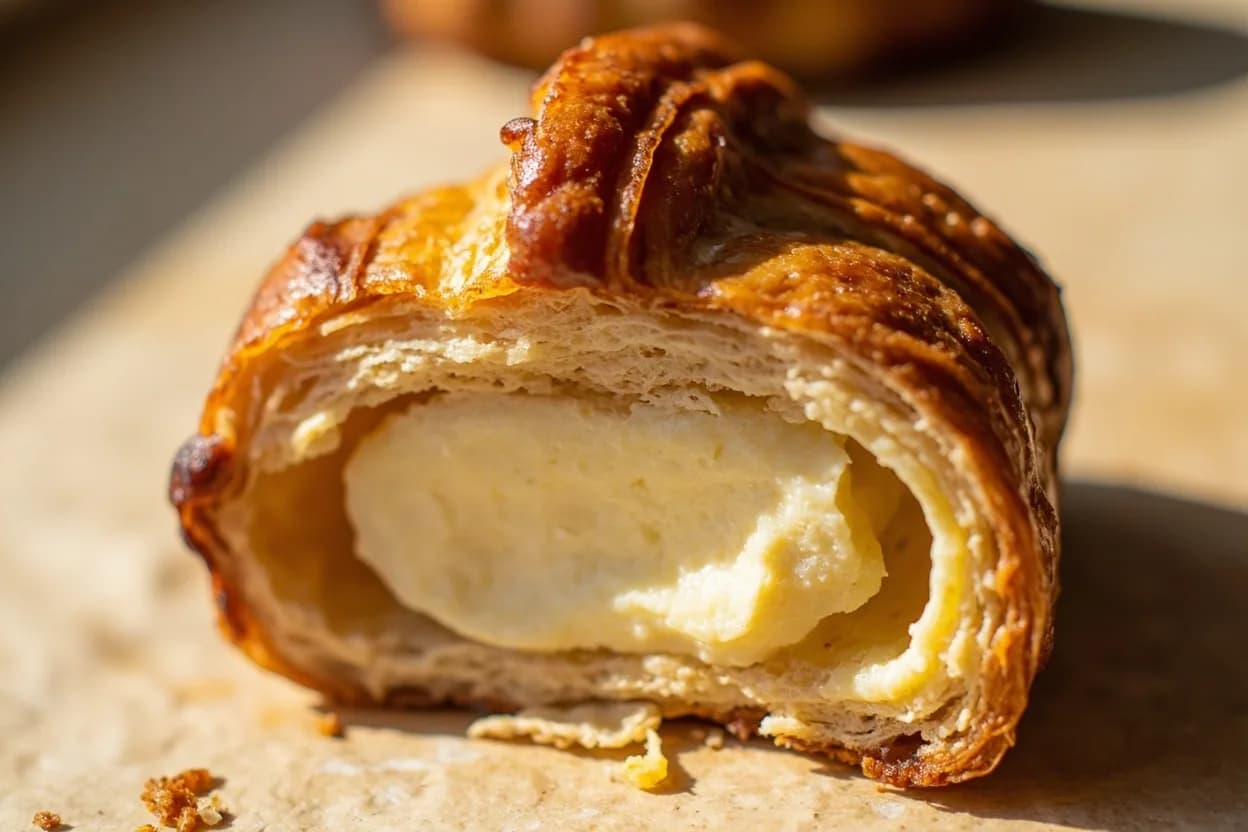
Feuilletage — the lamination technique that gives croissants and pains au chocolat their honeycomb crumb and shattering crust — depends on precise temperature management rather than cooking doneness. Both the détrempe (base dough) and beurrage (butter block) must be simultaneously at 12–14°C (54–57°F): cold enough to remain solid and distinct as layers, but warm enough to bend without cracking or smearing. If either element deviates significantly, the lamination fails — butter shatters through dough layers at colder temperatures, or merges into them at warmer ones. After each double or single fold (tour), the dough must rest refrigerated for 20–30 minutes minimum to relax gluten and re-chill the butter before the next turn.
In photos

What happens
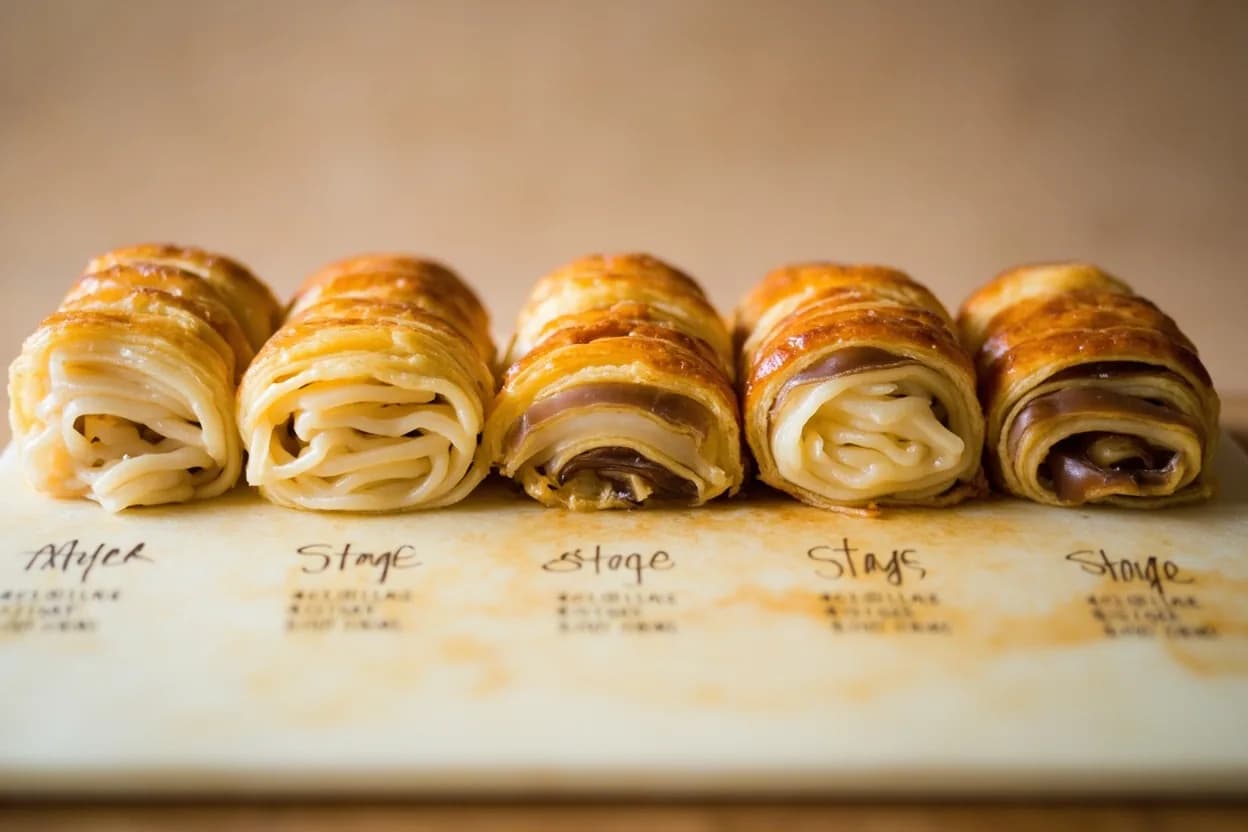
Croissant dough develops 27 distinct butter layers from three double folds (or 4 single folds). At 12–14°C, butter fat crystallizes into a semi-plastic state — it bends under a rolling pin without snapping or liquefying. Below 8°C, butter becomes brittle and punches through dough layers when rolled, creating holes and uneven distribution. Above 16°C, butter softens past its plastic range, absorbs into the dough rather than staying as a discrete layer, and the result bakes as a brioche-like crumb rather than an open honeycomb. Resting between folds also relaxes gluten developed during rolling, preventing elastic snap-back that tears layers and allows even extension.
What to look for
- Butter block should flex and bend like stiff modeling clay — no cracking, no sticking to fingers
- Dough surface should be cold to the touch but yield smoothly under a rolling pin with no tearing
- During rolling, butter should remain as a visible, even sheet — no smearing or breakthrough spots
- Properly rested dough rolls without elastic resistance; if it springs back aggressively, it needs more rest
- After the final fold, cut cross-section should show distinct alternating dough-butter striations
How to check
- Use an instant-read thermometer probed into the dough block and the butter block separately before each fold
- Press a finger into the butter block — it should leave a dent without the butter cracking or feeling greasy
- Roll a test corner of the dough; if the butter shatters visibly through the dough, it is too cold
- Watch for any translucent greasy patches on the dough surface — these indicate butter has begun to merge (too warm)
- Work in a kitchen kept at 18–20°C (64–68°F); warmer ambient temperatures require shorter rest intervals and faster work
The science behind it
- Gluten relaxation during rest
Refrigerator rest after each fold allows gluten networks to de-stress, preventing tearing during the next roll
- Butter fat crystallization
The plastic range of butter fat (12–16°C) is what allows it to deform as a sheet rather than melt or fracture
- Puff pastry (pâte feuilletée)
Uses the same lamination logic but no yeast; commercial puff pastry targets the same 12–14°C butter temperature
- Danish pastry dough
Enriched laminated dough sharing the same temperature discipline but with higher egg and sugar content
- Proof temperature for croissants
After shaping, croissants proof at 24–26°C (75–78°F) for 2–3 hours until visibly jiggly but not collapsed
Appears in
References
- 1.Bouchon Bakery — Thomas Keller & Sebastien Rouxel (Artisan, 2012)
- 2.The French Pastry School's Art of the Croissant — École Ferrandi Paris
- 3.Bread Science — Emily Buehler (Two Blue Books, 2006)
- 4.Advanced Bread and Pastry — Michel Suas (Delmar Cengage Learning, 2009)
Confidence: high
Notes
Butter Selection Matters
High-fat European-style butter (84%+ butterfat, often called beurre de tourage or dry butter) has a wider plastic range and lower moisture content than standard 80% butter. Lower moisture means it is less likely to steam and rupture layers during baking, and its higher fat-to-water ratio makes it more forgiving at the temperature margins. Brands like Beurre Poitou-Charentes AOP or Plugrá are preferred in professional production for this reason.
The Overnight Retard
Most professional boulangeries shape croissants and retard them overnight in a walk-in refrigerator (4°C / 39°F). This slows yeast activity to near-zero, extends flavor development through cold fermentation, and allows the baker to pull and proof trays to order each morning. The dough must be removed and proofed at room temperature (or in a warm proof box at 24°C / 75°F) for 2–3 hours before baking — the croissants should visibly jiggle when the tray is shaken.