Fish & Seafood Doneness
Fish: Flake Test (Visual Doneness)
Also: flake test, fork test, visual doneness for fish, flaking fish
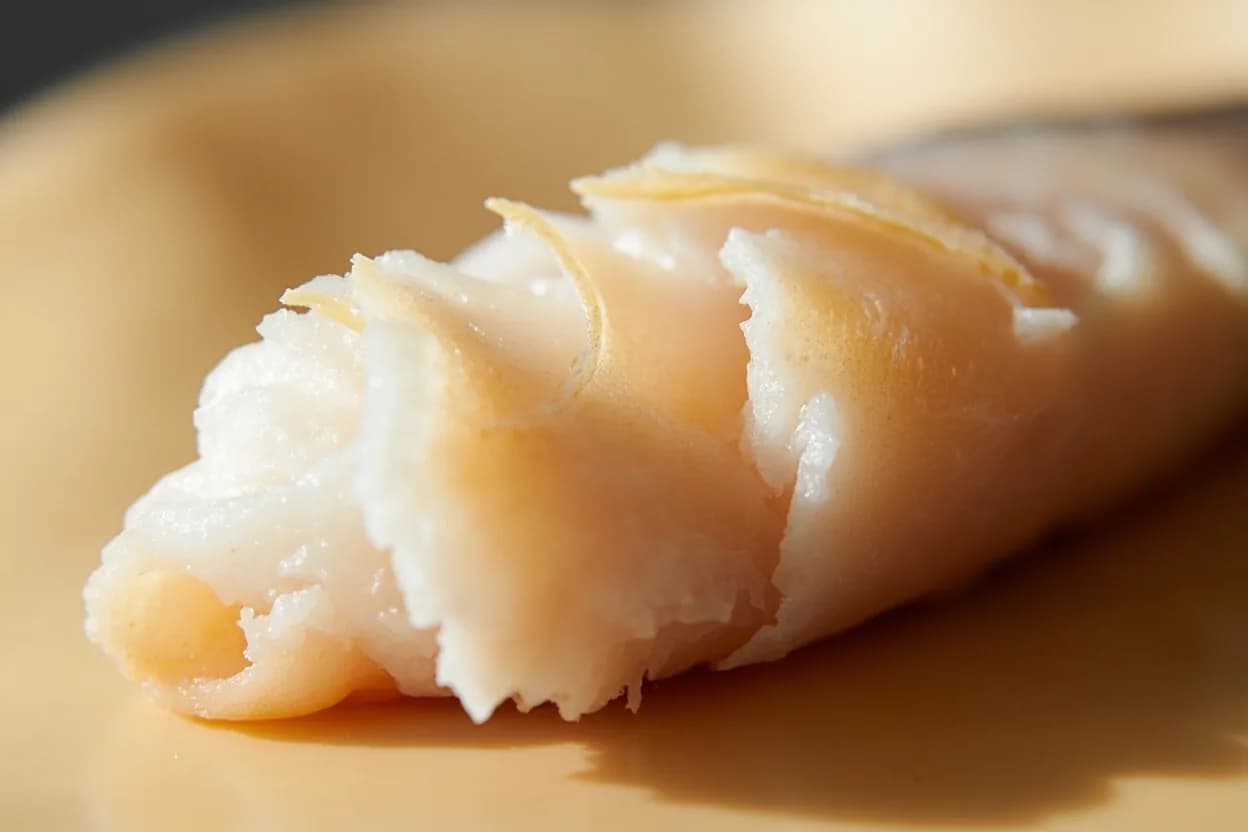
Fish is done when flesh separates cleanly into opaque, moist flakes along its natural myotome segments when gently pressed with a fork.
The flake test is a visual and tactile method for judging fish doneness without a thermometer. Fish muscle is arranged in short W-shaped bundles called myomeres, separated by thin sheets of collagen (myosepta). As internal temperature climbs above approximately 50°C (122°F), the collagen softens and those connective sheets dissolve, allowing the flesh to pull apart in clean, individual flakes. Properly done fish separates easily but remains moist; overcooked fish flakes apart without prompting and feels dry or chalky.
In photos

What happens
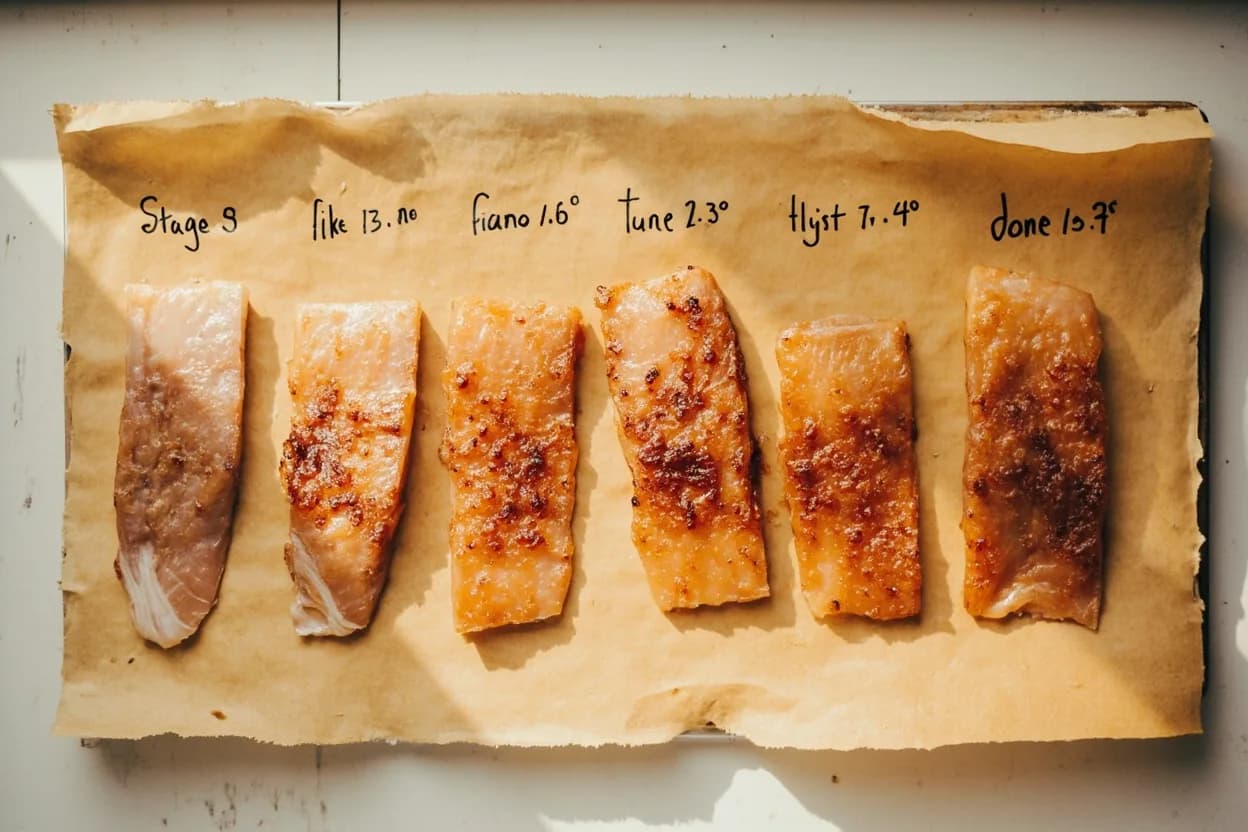
Heat denatures myosin proteins beginning around 40°C, causing initial firming. The myosepta collagen dissolves roughly between 50–55°C, releasing the myomere bundles so they slide apart when pressed. Actin proteins denature above 65–70°C, causing the dramatic moisture expulsion and rubbery, chalky texture associated with overcooked fish. The flake test targets the window after myosepta dissolution but before widespread actin denaturation.
What to look for
- Flesh shifts from translucent grey or pink to fully opaque white, cream, or pale gold
- Gentle pressure with a fork causes segments to separate cleanly and completely
- Flakes are moist with a slight sheen; no white albumin seeping excessively
- Flesh yields to light pressure rather than resisting or springing back
- Center of the thickest portion shows no glassy, translucent core when viewed side-on
- Aroma transitions from raw, briny, or fishy to sweet, cooked seafood
How to check
- Insert the tines of a fork at the thickest part and gently twist — if flesh separates in clean segments, it is done
- Use a thin knife or skewer inserted into the center for 2–3 seconds, then touch it to your lower lip — warmth indicates the interior has reached temperature
- Part the flesh at its thickest point with two forks and inspect the very center for any remaining translucency
- For whole fish, check at the backbone where flesh should release cleanly from the bone
Food safety
Carryover & resting
Fish carries over very little heat compared to dense proteins because of its low fat and connective tissue content. Remove from heat when the interior still looks slightly underdone, as residual heat will complete the cooking in 1–2 minutes off the burner or out of the oven.
The science behind it
- Myomere structure
The segmented W-shaped muscle bundles whose separation defines the flake
- Myosepta collagen
The connective tissue sheets that dissolve at ~50–55°C, enabling clean flaking
- Actin denaturation
Protein change above ~65°C that causes dryness and chalkiness in overcooked fish
- Albumin seep
The white protein (albumin) that leaches out of fish when cooked too fast or too long, a visual overcook cue
- Probe thermometer
The most reliable doneness check; flake test supplements but does not replace it for safety
Appears in
References
- 1.On Food and Cooking — Harold McGee
- 2.The Food Lab — J. Kenji López-Alt
- 3.FDA Fish and Fishery Products Hazards and Controls Guidance, 4th Edition
- 4.Modernist Cuisine: The Art and Science of Cooking — Nathan Myhrvold et al.
Confidence: high
Notes
Species variation
Different fish have different optimal flaking temperatures and textures. Salmon and tuna are often preferred at 50–54°C for a silkier, moister result. Firm white fish like cod, halibut, and sea bass are typically taken to 55–60°C. Fatty fish like mackerel tolerate slightly higher temperatures without drying out. Adjust the standard flake-test expectation by species.
When the flake test fails
Very thin fillets (under 1 cm) cook so quickly that by the time flaking is visible the fish may already be overcooked. For thin fish, time and visual color change are better guides. Similarly, sous vide fish held at precise low temperatures (e.g., 50°C) will not flake conventionally because the myosepta have only partially dissolved — in that context, tenderness and opacity are the correct cues.