Fish & Seafood Doneness
Fish: Translucent-to-Opaque Transition
Also: fish doneness, fish opacity test, fish flake test, fish internal temperature
Fish proteins denature at 57–63°C, turning flesh from translucent to white-opaque; the flake test confirms the collagen has softened and muscle segments separate cleanly.
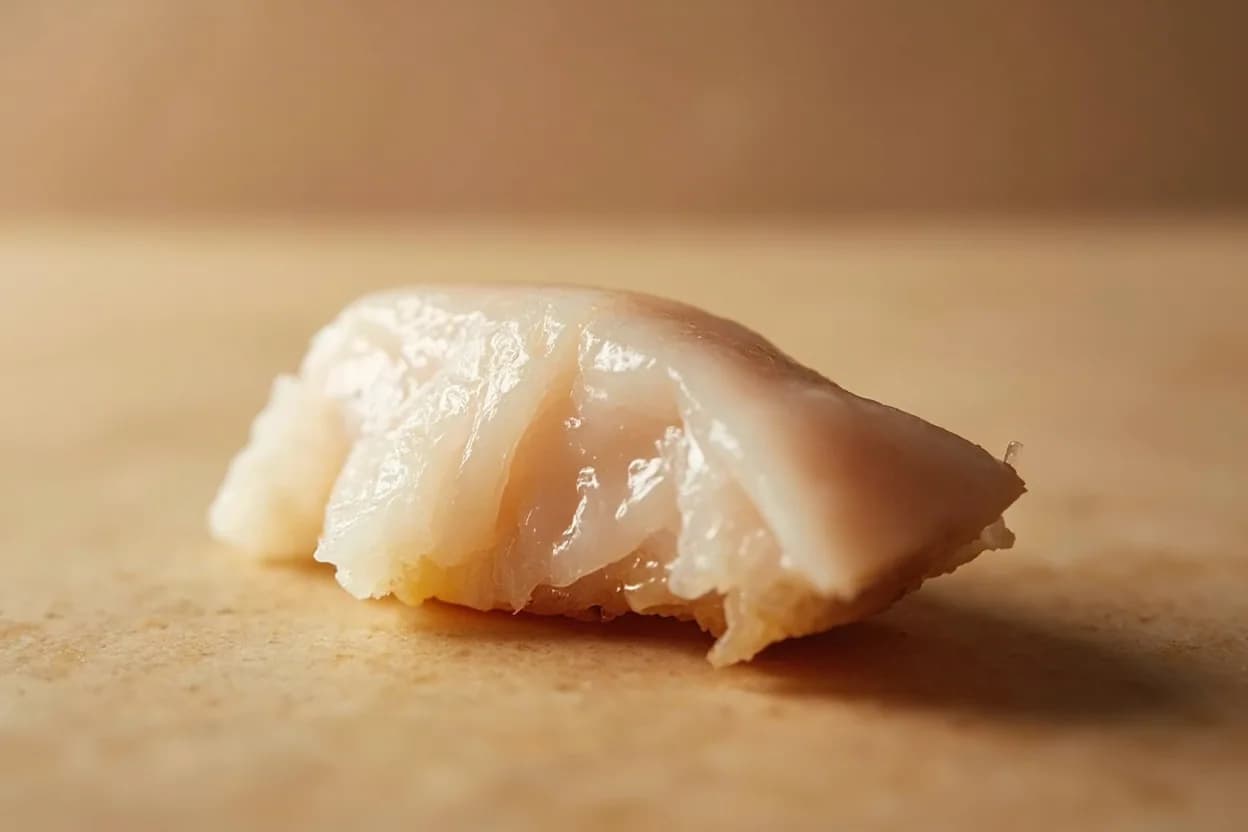
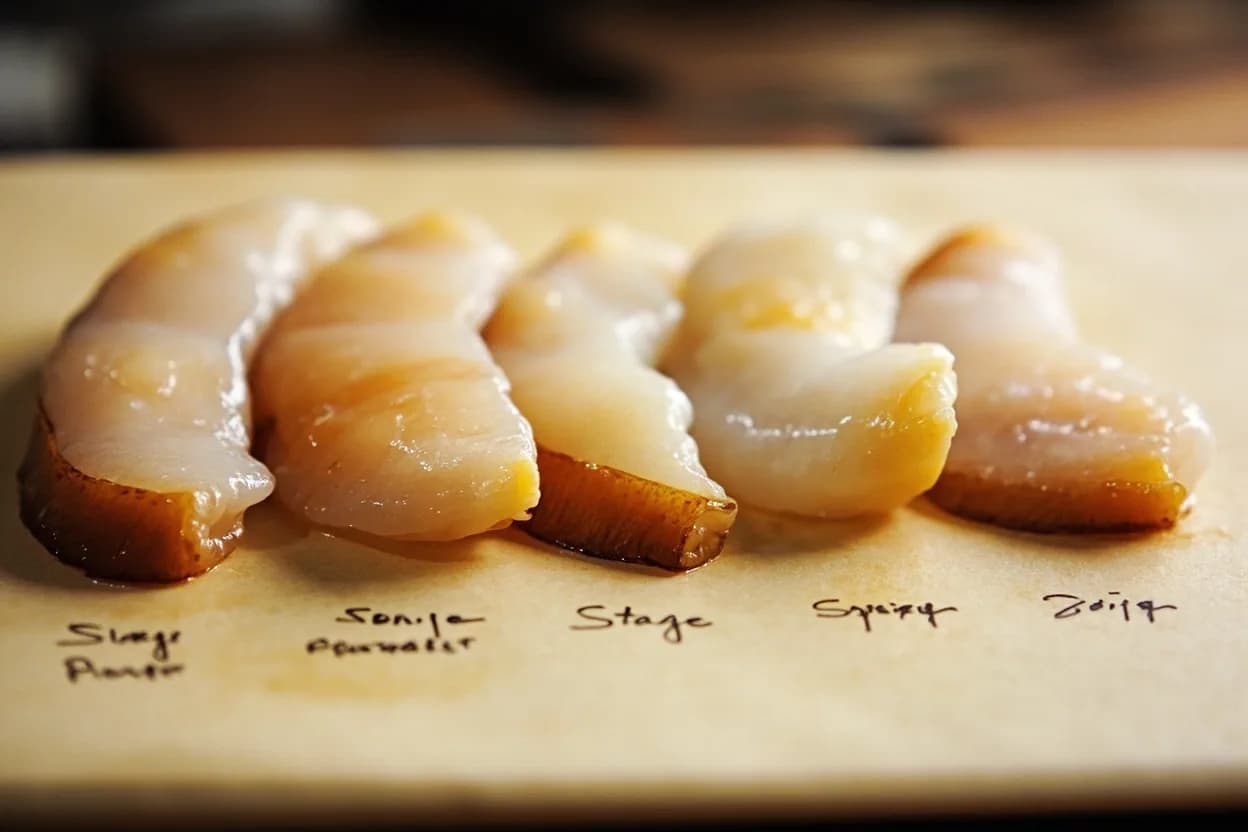
Fish flesh transitions from its raw translucent or glassy state to an opaque white (or pale pink for salmon) as internal temperature climbs through 57–63°C (135–145°F). This visible shift marks the denaturation of the primary structural proteins — myosin and actin — and the softening of the thin sheets of collagen (myocommata) that hold muscle segments (myomeres) together. The result is the characteristic flaking texture of cooked fish. USDA recommends 63°C (145°F) for fish; many cooks and chefs pull white fish at 57–60°C (135–140°F) for a more tender, moist result, relying on source quality and handling for safety.
In photos

What happens
Fish muscle is composed of short myomeres separated by collagen sheets (myocommata). When raw, the myomeres are densely packed and the collagen is firm, giving the flesh its translucent, glassy appearance — light passes through the closely aligned protein fibers. As temperature rises above 40°C, myosin begins to denature; by 50°C it has largely set, and the optical density of the muscle increases — the flesh turns opaque from the outside in. Actin denatures above 65–70°C, causing the muscle to seize tightly and expel moisture, which is why fish cooked beyond 65°C becomes dry and rubbery. The collagen in myocommata dissolves rapidly above 55°C (fish collagen is far less heat-stable than mammalian collagen), allowing the myomeres to separate easily — the flake. The final color depends on species: myoglobin-rich salmon holds a pink-orange hue; lean white fish becomes uniformly ivory-white.
What to look for
- The flesh changes from translucent or glassy to uniformly opaque white or pale pink when viewed from the side or tested with a knife tip
- A fork or the tip of a knife inserted at the thickest point meets minimal resistance and the myomeres begin to separate into distinct flakes
- The flesh surface loses its sheen and takes on a matte, slightly grainy appearance
- Steam rises gently from the surface — not aggressively bubbling, which indicates over-cooking
- For salmon: the flesh transitions from deep translucent orange to a paler, more opaque salmon-pink; a fashionable 'medium' pull leaves a translucent streak at the very center
How to check
- Insert a thin instant-read thermometer at the thickest point, angled horizontally — target 57–60°C (135–140°F) for moist-preferred; 63°C (145°F) for USDA-compliant
- Flake test: insert a fork or thin spatula and gently twist — myomeres should separate cleanly with slight resistance; they should not dissolve or stay fused
- Translucency check: use a thin knife tip to peek into the thickest part — opaque throughout means done or slightly over; a translucent core means more heat is needed
- Cake tester test for thick fillets: a metal skewer inserted for 5 seconds and removed should feel warm (not hot or cold) when pressed to the inside of your wrist — warm = 55–60°C
Food safety
Carryover & resting
Fish carry over very little — typically 1–3°C — due to thin fillets and low thermal mass. Remove from heat the moment the target temperature is reached, as the short carryover window means over-shooting is easy. Thick steaks (swordfish, halibut) carry over slightly more. Resting under foil for 1–2 minutes is sufficient.
The science behind it
- Myomere separation (flaking)
The structural hallmark of properly cooked fish; myocommata collagen dissolves above 55°C, releasing individual muscle segments
- Salmon medium doneness
Many chefs target 52–54°C for a translucent center in salmon, a preference-driven target below USDA minimum
- Poaching fish in butter (beurre monté)
Holding fish at 57–60°C in butter sauce achieves a silky, barely-set texture using the same protein denaturation window
- Fish collagen vs. mammalian collagen
Fish myocommata collagen melts above 55°C vs. 70–75°C for beef, explaining why fish overcooks so much faster than red meat
Appears in
References
- 1.On Food and Cooking: The Science and Lore of the Kitchen — Harold McGee
- 2.The Food Lab: Better Home Cooking Through Science — J. Kenji López-Alt
- 3.Fish & Shellfish — James Peterson
- 4.USDA FSIS Safe Minimum Internal Temperature Chart
- 5.Salt Fat Acid Heat — Samin Nosrat
Confidence: high
Notes
Species matters
Lean white fish (cod, halibut, sole) have almost no margin — they go from translucent to perfectly opaque to dry and stringy within 5–10°C. Fatty fish (salmon, black cod, mackerel) are far more forgiving because their intramuscular fat buffers moisture loss. Tuna is treated differently again: its myoglobin-rich dark muscle is often served rare (45–50°C center) like red meat steak, while white tuna (albacore) benefits from a higher pull point. Monkfish, despite being 'the poor man's lobster,' has denser collagen and can tolerate 65°C without the same moisture penalty as cod.
The restaurant trick for uniform cooking
Many restaurant kitchens temper fish fillets at room temperature for 20–30 minutes before cooking to reduce the temperature gradient from surface to center. This narrows the opaque-transitioning wave front, reducing the window in which the exterior is overcooked while the center is still translucent. Combined with a moderate pan heat and butter-basting finish, this produces edge-to-edge even doneness — the visual hallmark of a properly cooked fish fillet in fine dining.