Offal & Specialty Cuts
Foie Gras: Just-Set Center
Also: foie gras 54°C, foie gras barely set, foie gras au torchon center, mi-cuit center temperature
The narrow internal temperature — 54°C / 130°F — at which foie gras reaches a creamy, barely-cohesive center without triggering the fat bleed-out that destroys its texture.
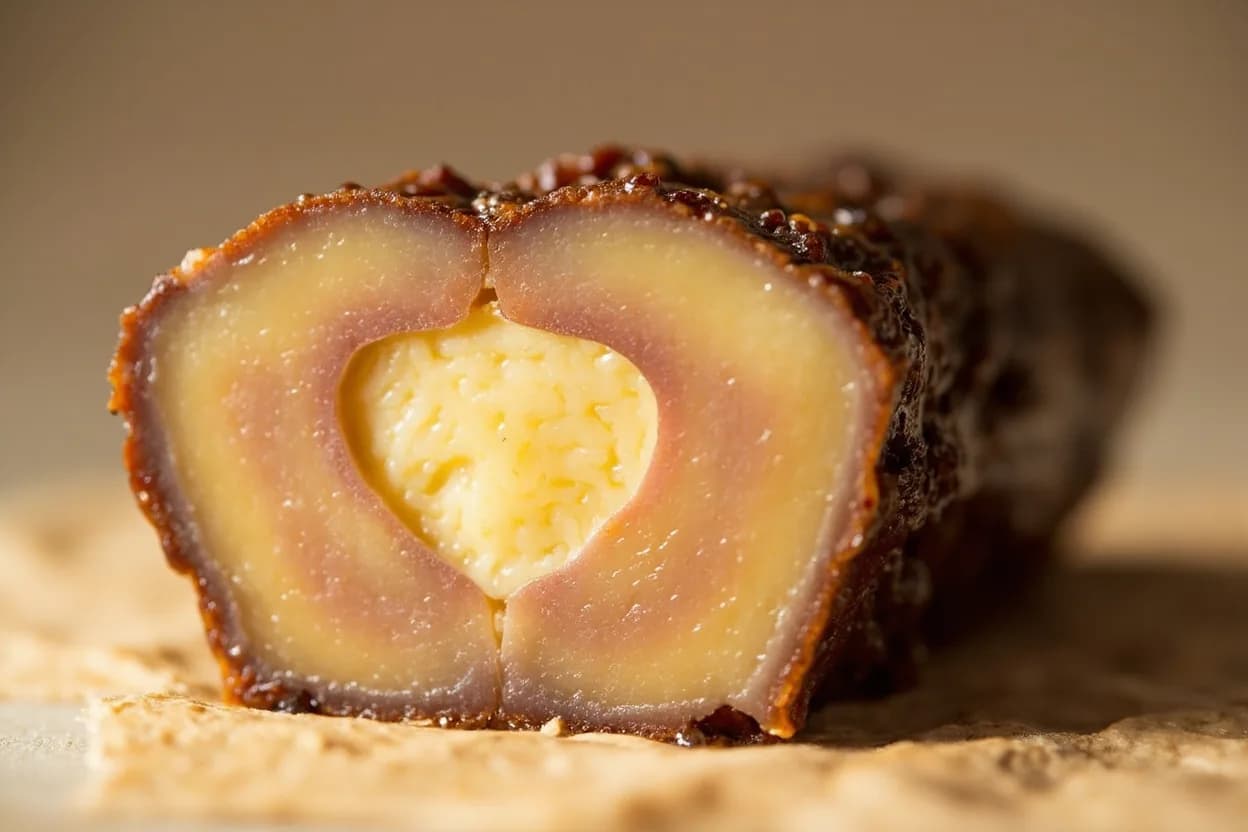
Foie gras is the fattened liver of duck or goose, composed of approximately 50% fat by weight — a ratio so extreme that temperature management during cooking is entirely different from any other offal. At 54°C (130°F) internal, the fat is fluid but the protein matrix has just begun to set, producing a center that is rich, creamy, and barely cohesive — neither raw (which reads as granular and iron-forward) nor overcooked (which causes catastrophic fat separation and a dry, grainy texture). This target applies to whole lobes cooked sous vide, au torchon, or terrine-style; seared escalopes are judged more by surface crust and center warmth than a strict internal reading.
In photos

What happens
Foie gras fat begins to render between 40–45°C; below 54°C the protein network has not set sufficiently to trap the liquefied fat, so premature cutting causes it to bleed out. At 54°C, key liver proteins (primarily albumin-type heat-labile proteins) reach their set point, forming a loose but coherent gel that holds the emulsified fat in suspension. Beyond 60°C, this network contracts aggressively, expelling fat as a separate pool and leaving a dry, crumbly residue. The window is only 6–8°C wide, which is why sous vide — with its precision and gentle heat — revolutionized foie gras cookery.
What to look for
- Surface of a terrine or torchon should yield to gentle finger pressure with a slight tremor, like a barely set panna cotta
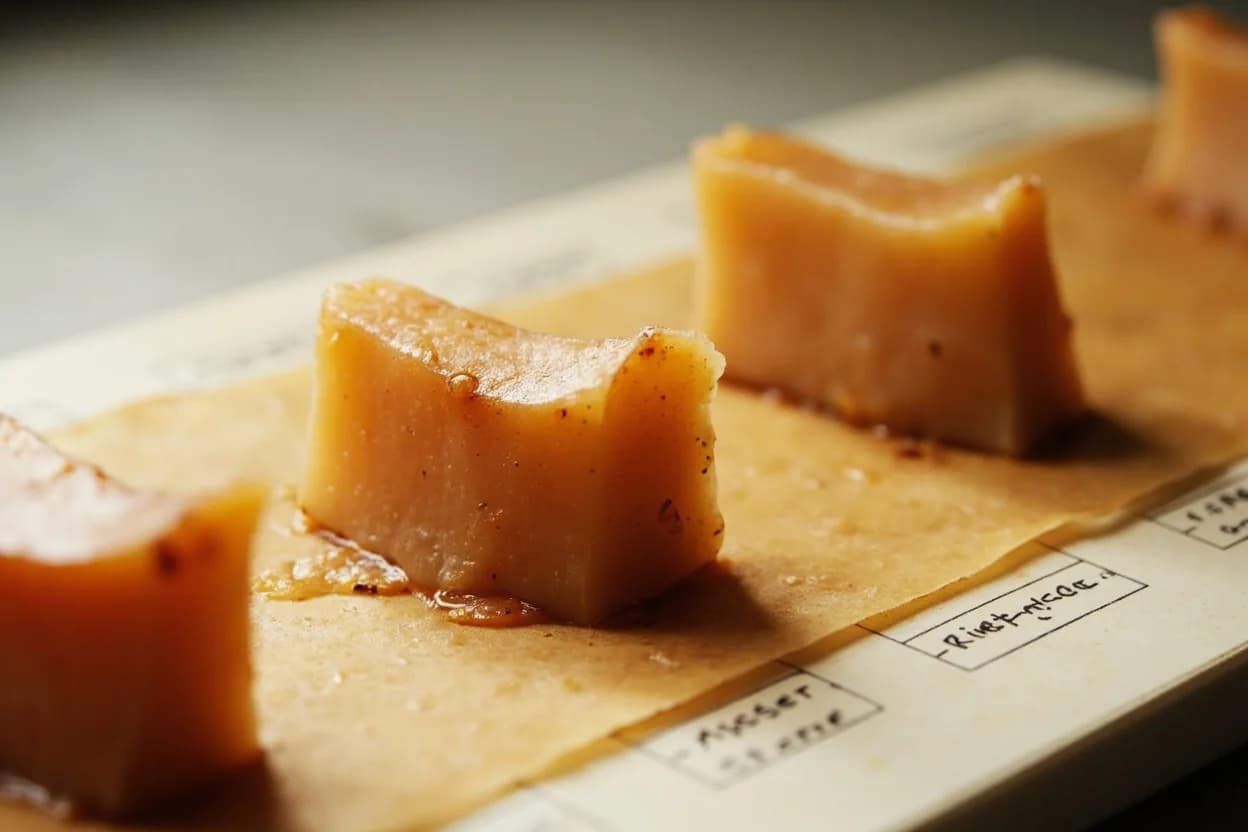
- Cut surface reveals a uniform pale golden-beige interior with no grey or pink gradient
- No visible pooling of rendered fat around the lobe — fat remains trapped in the flesh
- Aroma is rich, deeply savory, and buttery — not mineral or raw-liver forward
- A properly set foie gras slices cleanly with a warm knife without crumbling or smearing excessively
How to check
- Insert an instant-read thermometer into the geometric center of the thickest part of the lobe, avoiding fat pockets or veins
- For au torchon: probe through the wrapping at the end of the poaching time; target 54°C before resting in an ice bath
- For terrine: probe at 54°C center, then cool rapidly in a bain-marie over ice to halt cooking
- For seared escalopes: rely on a warm center touch (rather than thermometer) since the cooking time is under 90 seconds per side
- Sous vide at 57°C bath temperature for 30–45 minutes achieves 54°C center in a 300g lobe with controlled margin
Food safety
Carryover & resting
Foie gras continues cooking rapidly off heat due to its high fat content, which transfers heat efficiently. Remove from heat source 1–2°C before target; for terrine and torchon preparations, transfer to an ice bath immediately after reaching target temperature to arrest carryover.
The science behind it
- Fat rendering temperature
Foie gras fat begins to liquefy at 40–45°C, driving the narrow safe cooking window
- Sous vide precision cooking
Precise bath temperature control makes hitting the 54°C center consistently achievable
- Mi-cuit
Half-cooked foie gras technique that targets this just-set temperature for silky texture
- Torchon method
Classic French technique of rolling foie gras in cloth and poaching to this temperature
The narrow set-point of liver proteins defines the entire cooking window
Appears in
References
- 1.Under Pressure: Cooking Sous Vide — Thomas Keller (Artisan, 2008)
- 2.Modernist Cuisine: The Art and Science of Cooking — Nathan Myhrvold et al.
- 3.The French Laundry Cookbook — Thomas Keller (Artisan, 1999)
- 4.On Food and Cooking: The Science and Lore of the Kitchen — Harold McGee (Scribner, 2004)
- 5.Charcuterie: The Craft of Salting, Smoking, and Curing — Michael Ruhlman & Brian Polcyn (W. W. Norton, 2005)
Confidence: high
Notes
Why the window is so narrow
No other culinary fat subject has a target temperature range as compressed as foie gras. The difference between perfection and ruin is approximately 6°C. At 50°C it feels raw and granular on the palate; at 60°C it has lost much of its fat to the pan and tastes chalky. Experienced chefs who sear foie gras by feel develop an almost unconscious timing sense — usually 45–60 seconds per side in a smoking-hot dry pan — rather than relying on thermometers, because the cooking happens too quickly to probe effectively.
Sourcing and fat content variability
Not all foie gras behaves identically. Grade A lobes have higher fat content and are more unforgiving (the fat bleeds more aggressively if overcooked); Grade B lobes, with more connective tissue and slightly lower fat, have a slightly wider cooking window. Duck foie gras (from Moulard or Muscovy ducks) is fattier and slightly firmer-textured than goose foie gras; goose is considered more delicate and is more prone to melting if even slightly overcooked.