Cheese & Dairy Doneness
Fondue Service Temperature
Also: fondue holding temperature, cheese fondue maintenance, raclette service temp
The narrow window — 60 to 70°C — at which a cheese fondue stays smooth, fluid, and cohesive without curdling or seizing.
Fondue service temperature is the thermal range at which a prepared cheese-and-wine emulsion maintains its homogenous, dippable consistency at table. Below 55°C the fondue stiffens and may re-solidify; above 75°C prolonged heat drives off the alcohol and destabilises the emulsion, causing the proteins to clump and the fat to separate. The ideal range of 60–70°C (140–158°F) keeps the pot in a gentle, barely-simmering state — small lazy bubbles at the rim, never a rolling boil.
In photos

What happens
Cheese fondue is a colloidal emulsion: fat globules dispersed in an aqueous phase of wine and melted protein. Tartaric and malic acids in dry white wine (or lemon juice) lower pH, which keeps caseins negatively charged and mutually repulsive — preventing them from clumping. Ethanol further disrupts protein-protein interactions. At 60–70°C these mechanisms work efficiently; the fat and protein stay uniformly suspended. Above 75°C, prolonged heat denatures casein bonds irreversibly — the proteins aggregate and the emulsion 'breaks', producing a stringy, grainy mass swimming in a pool of yellow fat. Below 55°C, the fat re-crystallises and the fondue hardens.
What to look for
- Gentle lazy bubbles rising only at the edges — not a full rolling boil
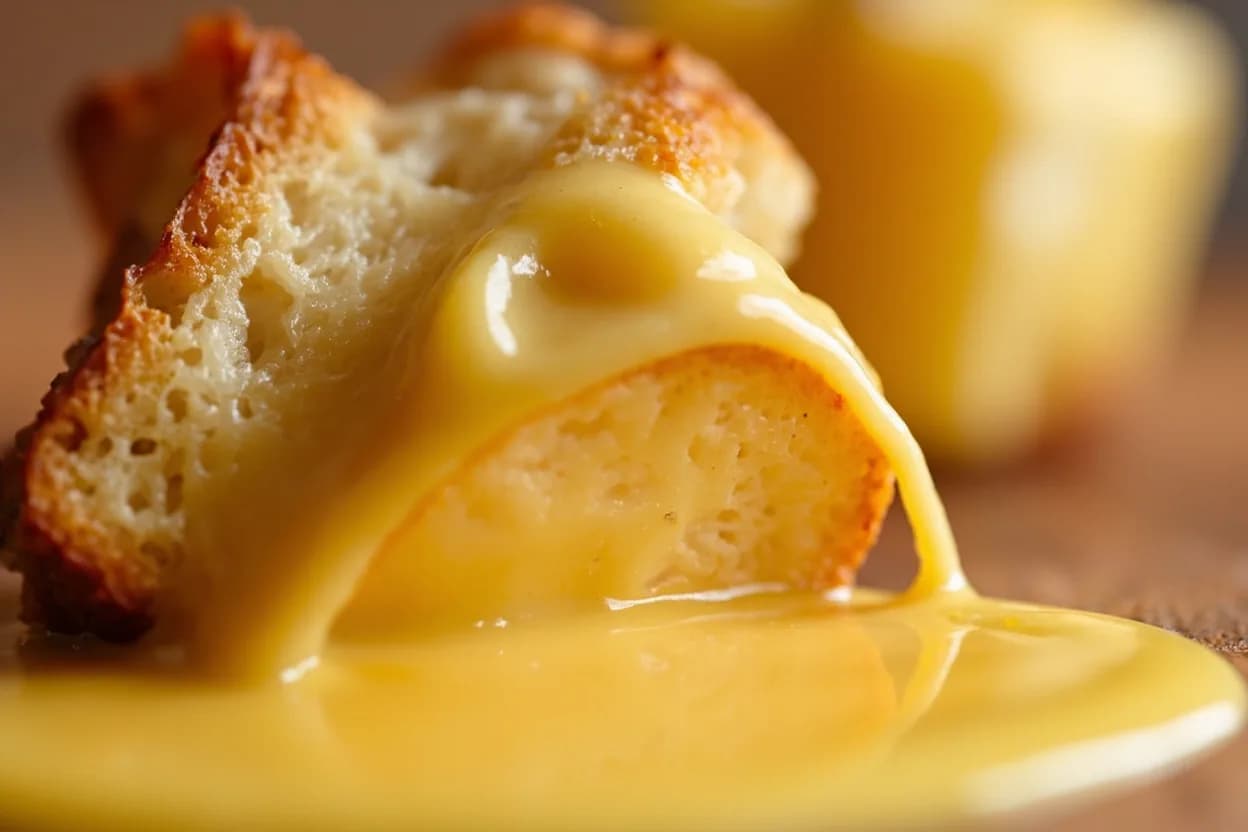
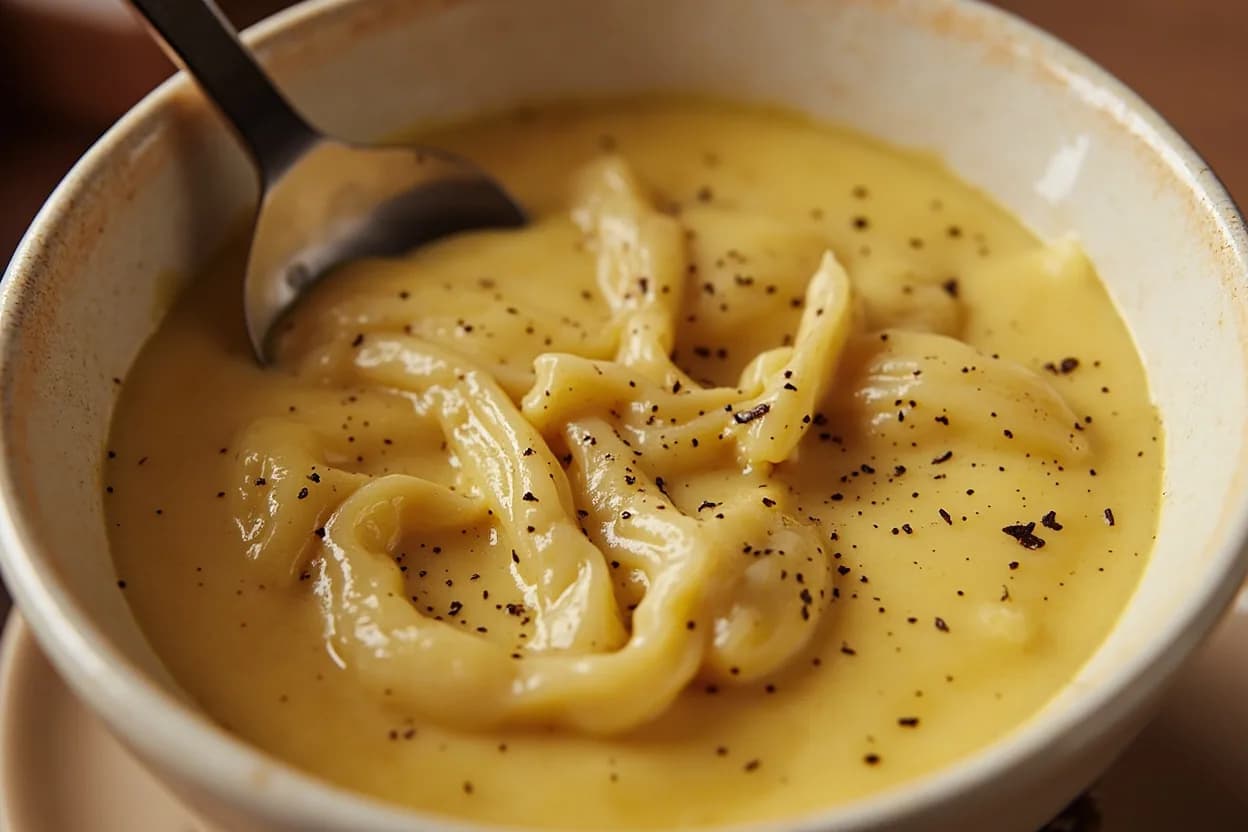
- Fondue coats a bread cube smoothly and drips in a slow, thick ribbon rather than streaming off
- Surface has a light, satiny sheen — not a greasy puddle of separated fat
- Kirsch or wine aroma present but not overwhelming — alcohol still in solution
- A figure-eight stir with a fondue fork meets even, uniform resistance throughout the pot
- Signs of overheating: grainy texture, fat pooling at the rim, increasingly stringy or rubbery pull
How to check
- Clip a candy or probe thermometer to the side of the caquelon and maintain 60–70°C via the burner flame adjustment
- Stir in a figure-eight pattern every 2–3 minutes; resistance should be consistent and smooth
- Dip a cold bread cube: it should emerge evenly coated with a 3–5 mm layer that holds without sliding off
- If fondue tightens, add a small splash of warm white wine and stir vigorously to re-emulsify
The science behind it
The upstream step — cheese must reach its melt point before the fondue emulsion forms
Fondue is stabilised by acid and alcohol, not lecithin; understanding emulsion physics helps diagnose and rescue a broken pot
- Starch Stabilisation
Many recipes whisk cornstarch into grated cheese before melting; gelatinised starch thickens the aqueous phase and buffers against protein aggregation
- Acid's Role in Dairy
Low pH keeps casein proteins repulsive; fondue made with water instead of wine is prone to seizing
- Maillard Crust (la croûte)
At the end of a fondue pot, residual cheese caramelises into a toasted crust — prized in Switzerland as la religieuse
Appears in
References
- 1.On Food and Cooking — Harold McGee (Scribner, 2004), Dairy chapter — emulsification of cheese
- 2.The Art of the Cheeseboard — Jill Donenfeld (Clarkson Potter, 2016)
- 3.Modernist Cuisine — Myhrvold et al. (The Cooking Lab, 2011), Volume 4: Dairy emulsions
- 4.Swiss Milk Producers official fondue guide (Schweizerische Käseunion / Switzerland Cheese Marketing)
Confidence: high
Notes
Rescuing a broken fondue
If the fondue separates — fat pooling, protein clumping — remove from heat immediately. Whisk in a tablespoon of warm dry white wine or a teaspoon of lemon juice, then stir vigorously in a figure-eight. The acid re-charges the caseins and the mechanical action re-disperses the fat. A slurry of 1 tsp cornstarch dissolved in wine can also re-bind a stubborn split. Return to low heat, not high.
Kirsch and the ethanol effect
Traditional Swiss recipes add a shot of kirsch (cherry eau-de-vie) at the end. Beyond flavour, the ~40% ABV adds a burst of ethanol that further disrupts protein aggregation and keeps the emulsion silky. It also lowers the fondue's effective set point slightly, giving more forgiveness at the low end of the service range.