Bread & Dough Doneness
Génoise Spring-Back Test
Also: sponge spring-back, genoise doneness test, sponge cake finger test, skewer clean test
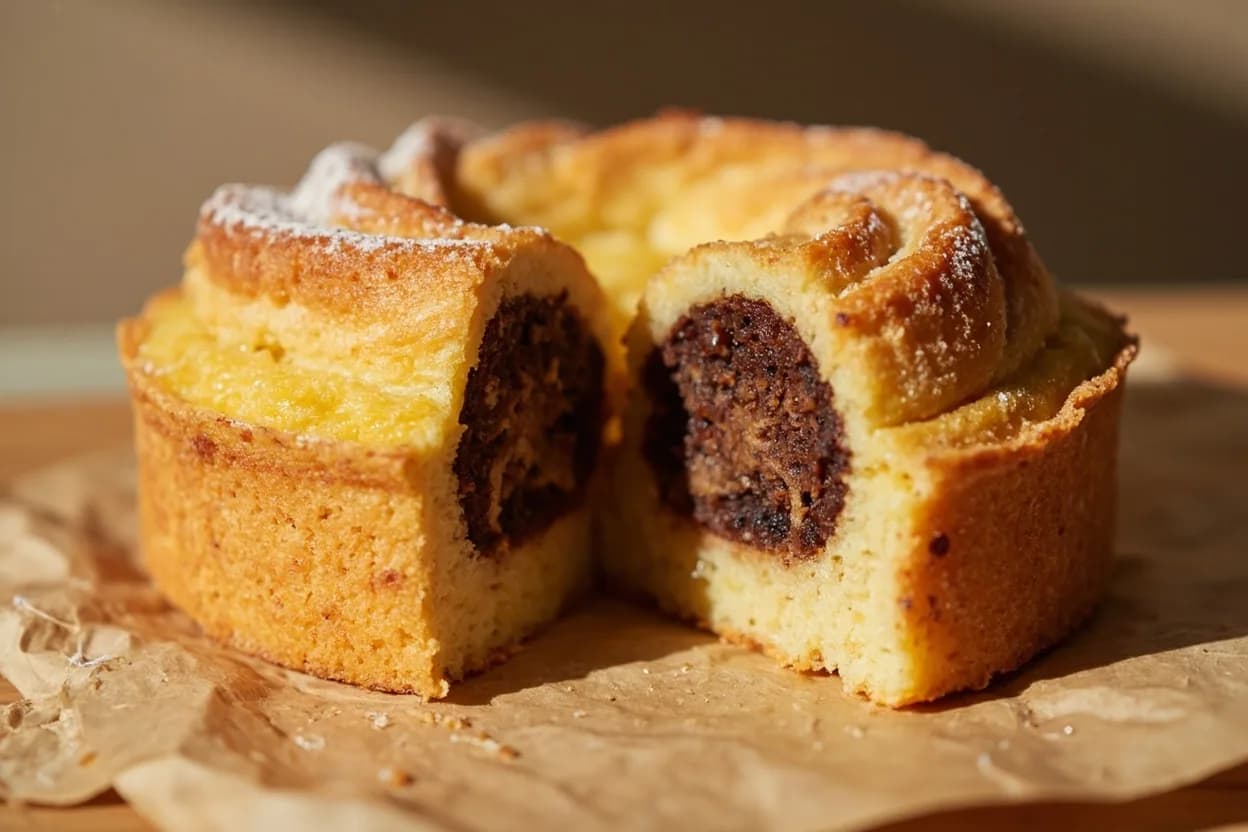
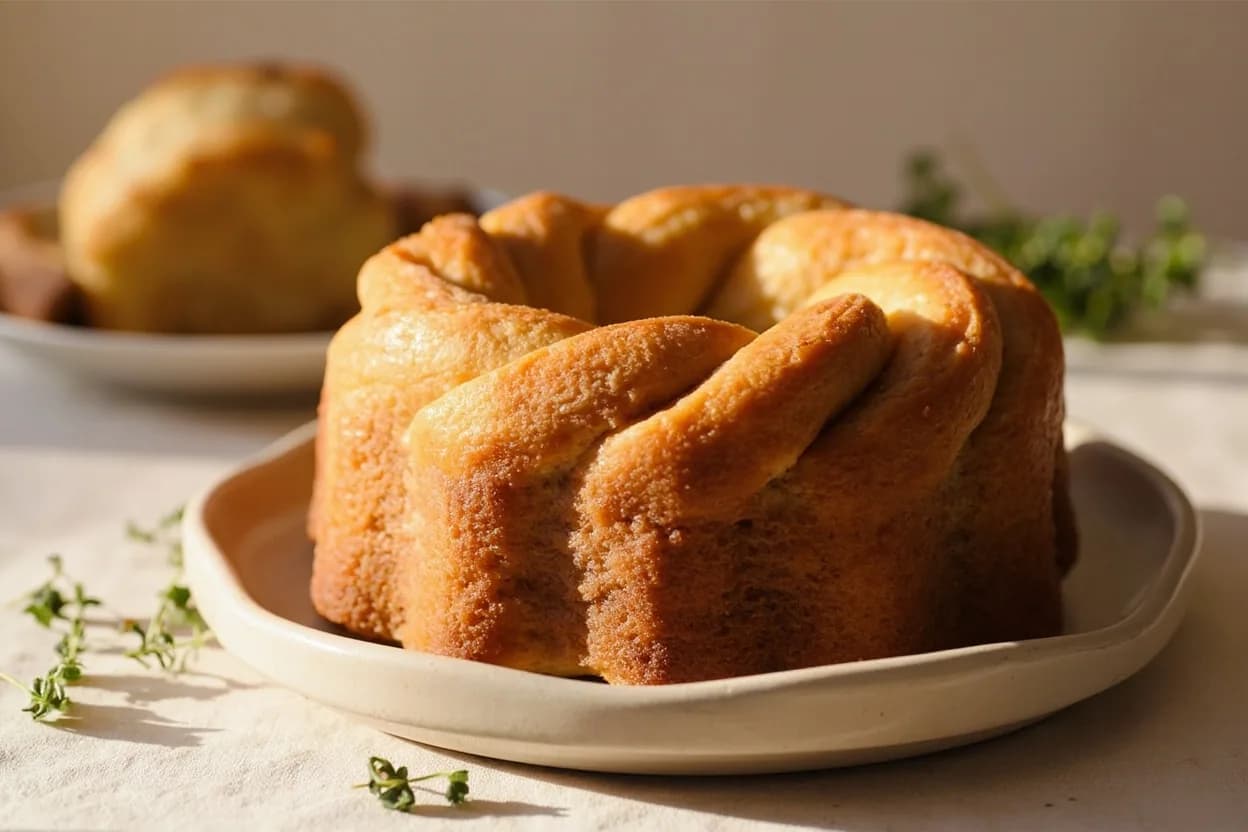
A baked génoise sponge is done when the center bounces back fully under a gentle press, the skewer exits clean, and the edges draw slightly away from the pan.
Génoise (and related whole-egg foam sponges) rely on a set protein-and-starch network to hold their airy structure. Doneness is assessed by three concurrent tests: the spring-back test (gently pressing the center — a fully baked sponge rebounds immediately with no indent remaining), the skewer test (a thin wooden or metal skewer inserted in the center exits with no wet batter clinging, though a few moist crumbs are acceptable), and edge retraction (the sponge sides visibly pull a millimeter or two from the pan wall). Internal temperature at the center should reach 95–98°C (203–208°F). Colour is a secondary cue — a pale golden top — but must not be used alone as the leading indicator, since génoise can brown on the exterior while the center remains underbaked.
In photos

What happens
The egg foam matrix in génoise is set by the coagulation of egg proteins (primarily ovalbumin and ovomucin) which denature between 80–85°C; by 96°C the center is fully coagulated. Simultaneously, the small amount of flour gelatinizes its starch, contributing additional structural rigidity. The baked starch-protein lattice is what gives génoise its characteristic springy, resilient crumb — unlike butter-rich cakes that remain soft and yielding at the same temperature. The edge retraction occurs as the outermost portion of the sponge contracts slightly as moisture evaporates and proteins tighten.
What to look for
- Gentle center press leaves no dimple — surface springs back immediately
- Skewer or cocktail stick withdrawn from the center shows no wet batter, at most a few moist crumbs
- Sponge edges have pulled 1–2 mm from the pan sides all around
- Top surface is pale gold, even, and no longer appears wet or glossy
- A faint, toasty egg-and-vanilla aroma, no raw-egg or raw-batter smell
How to check
- Place two fingers lightly on the center and press about 1 cm — remove and observe: the indent should vanish within 1 second
- Insert a thin skewer or cake tester vertically into the deepest center point; withdraw and examine the tip
- Run a finger along the pan edge — feel whether the sponge has retracted from the ring
- Insert an instant-read thermometer at a 45° angle into the center: target 95–98°C
Carryover & resting
Génoise has minimal carryover due to its low fat content and rapid moisture dissipation. Remove from the oven promptly at doneness and invert or leave in the pan for only 5–10 minutes before unmoulding onto a wire rack. Over-resting in the pan traps steam, which can make the base dense and wet. Cool completely before slicing or soaking.
The science behind it
- Whole-egg foam method
The technique that creates génoise: whole eggs and sugar are whipped to ribbon stage before flour and butter are folded in — the resulting foam determines crumb openness
- Protein coagulation (eggs)
The irreversible setting of egg proteins that gives génoise its spring-back elasticity
- Ribbon stage
The upstream mixing check — eggs and sugar beaten until pale, thick, and falling in ribbons — that determines sponge volume before baking
- Soaking syrup (bombe)
Génoise is almost always soaked with flavored syrup after baking to restore moisture and add flavor; correct doneness (fully set, not wet) ensures even syrup absorption without sogginess
Appears in
References
- 1.Patisserie: Mastering the Fundamentals of French Pastry — Christophe Felder
- 2.The Professional Pastry Chef — Bo Friberg
- 3.On Food and Cooking: The Science and Lore of the Kitchen — Harold McGee
- 4.Baking and Pastry: Mastering the Art and Craft — The Culinary Institute of America
Confidence: high
Notes
Why the spring-back test works
In an underbaked génoise, the center egg foam matrix is still partially liquid; pressing it displaces the unset material and leaves a lasting indent. Once protein coagulation is complete, the elasticity of the set network is sufficient to push back against the light pressure of two fingers. This makes the spring-back test a direct proxy for protein set — more reliable than color alone for a pale sponge.
Génoise vs. biscuit cuillère
Biscuit cuillère (ladyfinger sponge) uses separated eggs and behaves differently — its drier, meringue-enriched structure sets faster and springs back even before full protein coagulation. Do not apply the same time or temperature assumptions; instead rely on skewer and color for ladyfingers.