Fish & Seafood Doneness
Hot-Smoked Fish Finished Internal Temperature
Also: hot-smoked salmon temperature, hot-smoked trout done temp, smoked fish internal temp
Hot-smoked fish is fully cooked when the thickest part reaches 63°C (145°F) — it is flaky, opaque throughout, and safe to eat without further preparation.
Hot smoking applies both heat and smoke simultaneously, cooking the fish to a safe internal temperature while imparting smoke flavor and a drier, more shelf-stable texture than fresh fish. The USDA and most food safety authorities cite 63°C (145°F) as the minimum safe internal temperature for fish, held for 15 seconds, which denatures fish proteins fully and kills pathogens including Listeria monocytogenes. Hot-smoked salmon, trout, mackerel, and whitefish are all finished fish products — they are not raw, unlike cold-smoked preparations. The finished texture is firm, flaky, and deeply bronzed, with smoke penetration throughout the fillet.
In photos

What happens
As fish temperature rises in the smoker, muscle proteins denature progressively: myosin begins denaturing around 50°C, collagen softens and gelatinizes from 55°C, and actin (the tougher protein) denatures at 65–70°C. The window between myosin and actin denaturation (roughly 50–65°C) is where the most desirable textures live — moist, flaking, yielding. Smoke compounds (phenols, carbonyls, acids) penetrate the surface, contributing to color (the golden-brown pellicle), preservation (phenols have antimicrobial activity), and flavor. At 63°C internal, the fish is fully safe, the flesh flakes cleanly along the myomere lines, and the fat layers in salmon and mackerel have rendered enough to distribute flavor.
What to look for
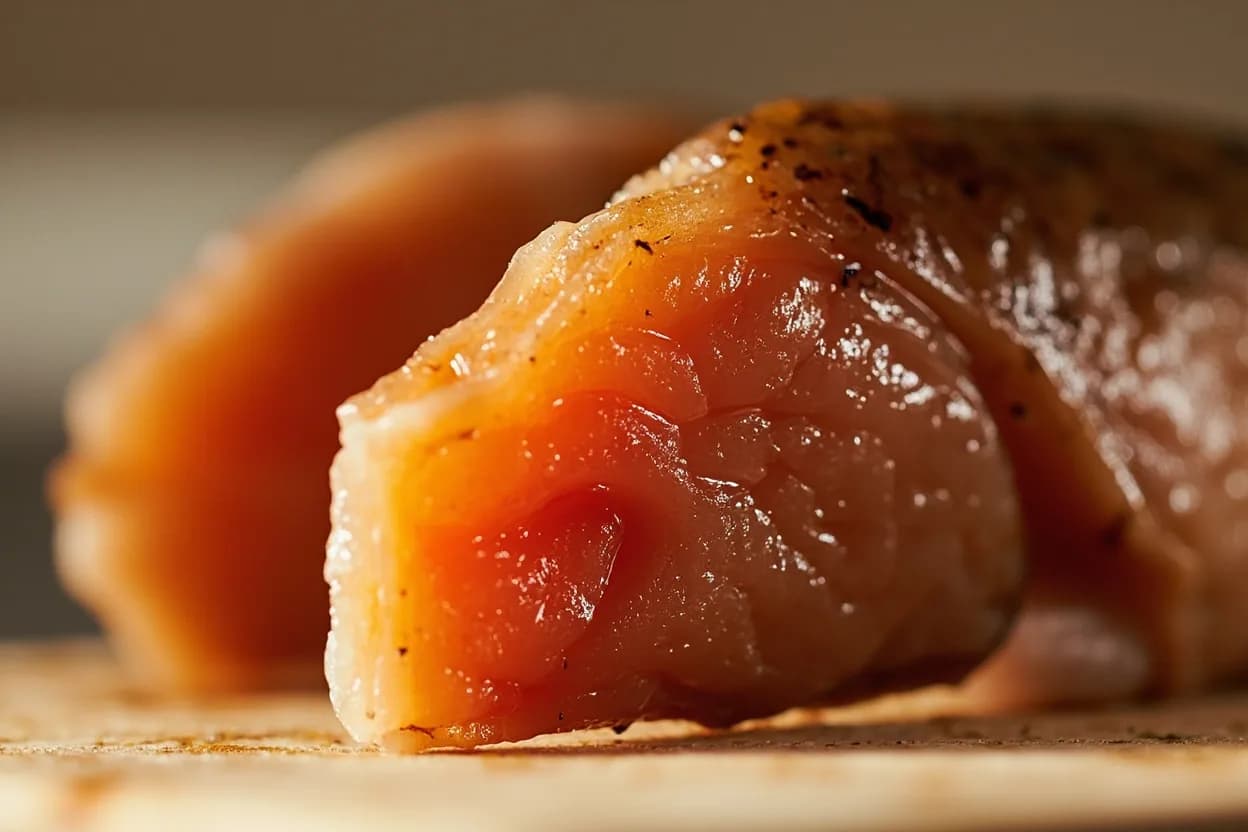
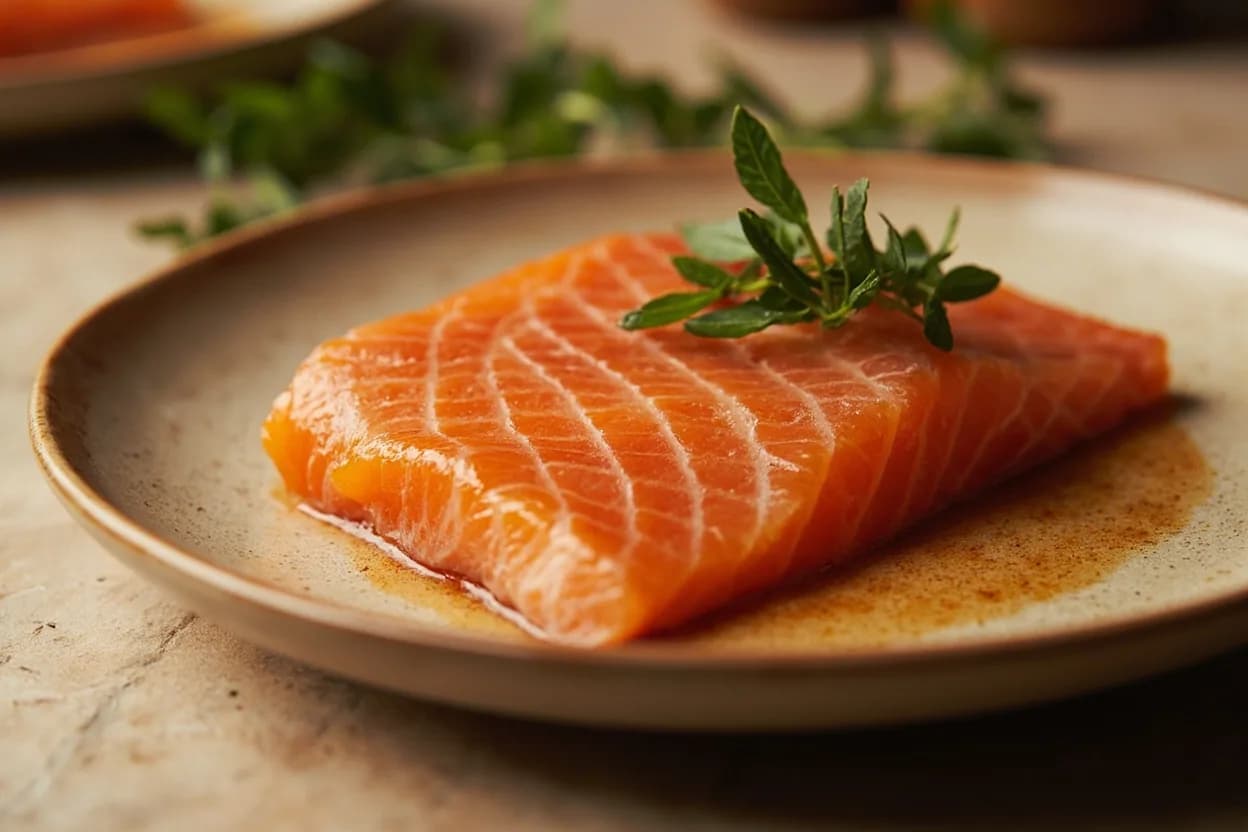
- Flesh changes from translucent and raw-pink to fully opaque throughout — check the center of the thickest part
- Surface develops a lacquered bronze or mahogany pellicle (the dried protein-smoke film that forms on the surface before smoking intensifies)
- Flesh flakes cleanly along natural myomere separations when pressed lightly with a fork
- Fat on salmon or mackerel appears rendered and translucent at the surface rather than raw and white
- Smoke ring: a pink band 2–4 mm deep under the surface on pale fish is a visual marker of proper smoke penetration
- Aroma is deeply smoky and cooked, not raw or oceanic
How to check
- Insert an instant-read thermometer into the thickest part of the fillet, parallel to the flesh and avoiding the skin — target 63°C (145°F)
- For a whole fish, probe the thickest part just behind the pectoral fin, angling toward the backbone
- Flake test: press gently with a fork — at target temp, flesh separates into clean, moist flakes without resistance
- Color check: slice into the thickest part and confirm fully opaque flesh with no translucent raw center
- Note: many hot-smoked fish recipes target 71°C (160°F) for a drier, more shelf-stable product; the 63°C endpoint gives the most moist result
Food safety
Carryover & resting
Fish carries over 2–3°C after removal from the smoker if allowed to rest — pull from the smoker at 60–61°C (140°F) if targeting the minimum 63°C endpoint. For larger whole fish, carryover can reach 4–5°C, so pull slightly earlier.
The science behind it
- Cold-Smoked Fish Safety
Cold smoking does not cook fish and is not a pathogen kill step — a fundamentally different product and safety profile
- Pellicle Formation
The surface drying step before smoking that allows smoke compounds to adhere and forms the characteristic lacquered crust
The pink outer band on smoked fish caused by nitric oxide from wood smoke reacting with myoglobin — aesthetic, not a safety indicator
- Fish Protein Denaturation
Myosin (50°C) and actin (65°C) denaturation temperatures bracket the optimal hot-smoked fish texture window
- Brine Penetration
Pre-smoking brine (salt, sugar, sometimes aromatics) firms the flesh and seasons it before heat and smoke are applied
- Kippered Herring
Traditional British hot-smoked herring — a fully cooked product reaching the 63°C endpoint, unlike bloater (cold-smoked)
Appears in
References
- 1.USDA Food Safety and Inspection Service. Safe Minimum Internal Temperature Chart. USDA, 2023.
- 2.FDA. Fish and Fishery Products Hazards and Controls Guidance, 4th ed. U.S. Food and Drug Administration, 2011.
- 3.Ruhlman, Michael, and Polcyn, Brian. Charcuterie: The Craft of Salting, Smoking, and Curing. W. W. Norton, 2005.
- 4.McGee, Harold. On Food and Cooking: The Science and Lore of the Kitchen. Scribner, 2004.
- 5.Bøknæs, N. et al. 'Quality of Thawed Cod Fillets Stored in Modified Atmosphere at 0°C.' LWT — Food Science and Technology, 2002.
Confidence: high
Notes
63°C vs. 71°C: A Matter of Intent
The difference between pulling hot-smoked salmon at 63°C versus 71°C is significant: at 63°C the fish is moist, yielding, and suitable for immediate consumption (refrigerate and use within days). At 71°C it is drier, more deeply smoked, more traditionally 'kippered' in character, and longer-lived. Both are safe; the choice is about the product you are making.
The Pellicle Is Not Optional
Skipping the pellicle drying stage — typically 1–4 hours air-drying or overnight uncovered in the fridge after brining — results in a wet surface that won't take smoke evenly, produces a steamed rather than smoked texture, and fails to develop the characteristic bronzed skin. The pellicle is what makes hot-smoked fish look and taste like hot-smoked fish.