Legume Doneness
Hummus Base: Chickpea Overcook for Silkiness
Also: chickpea overcook, silky hummus stage, ultra-soft chickpea, hummus chickpea doneness
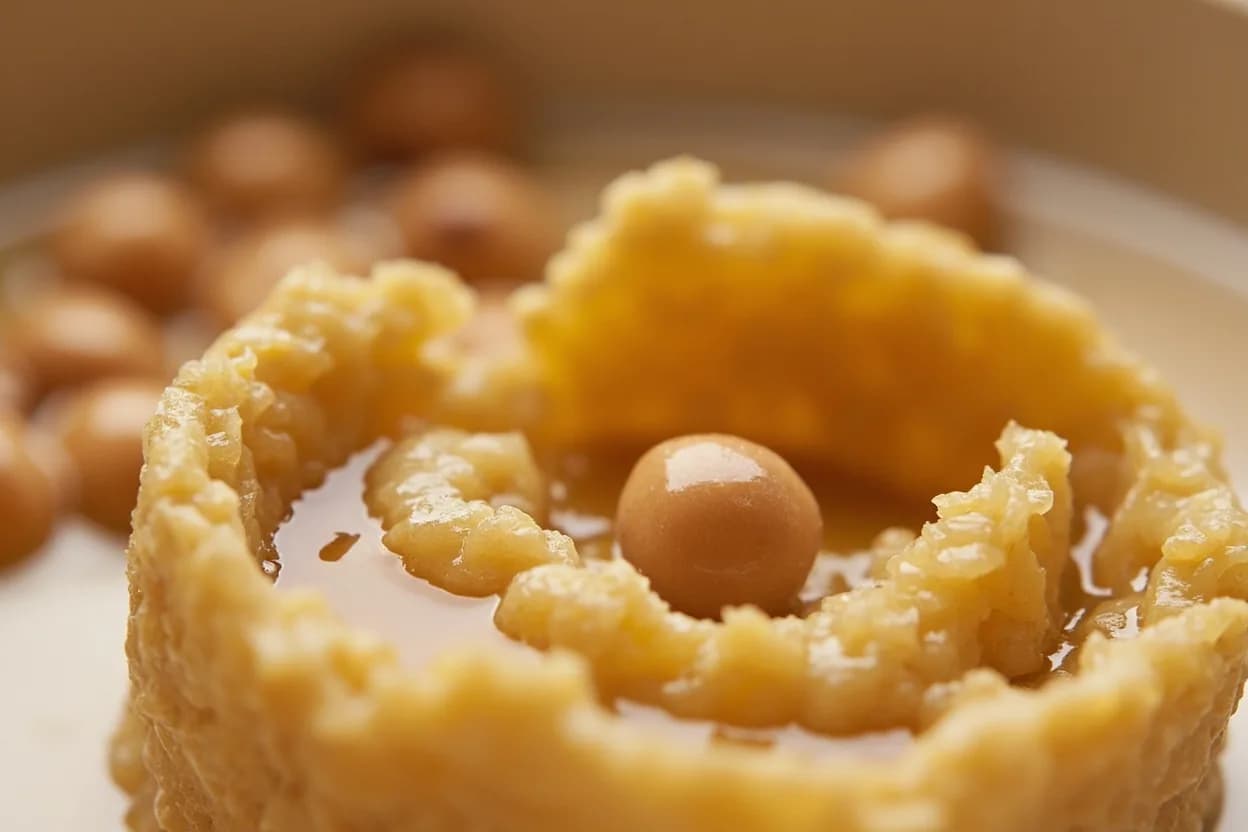
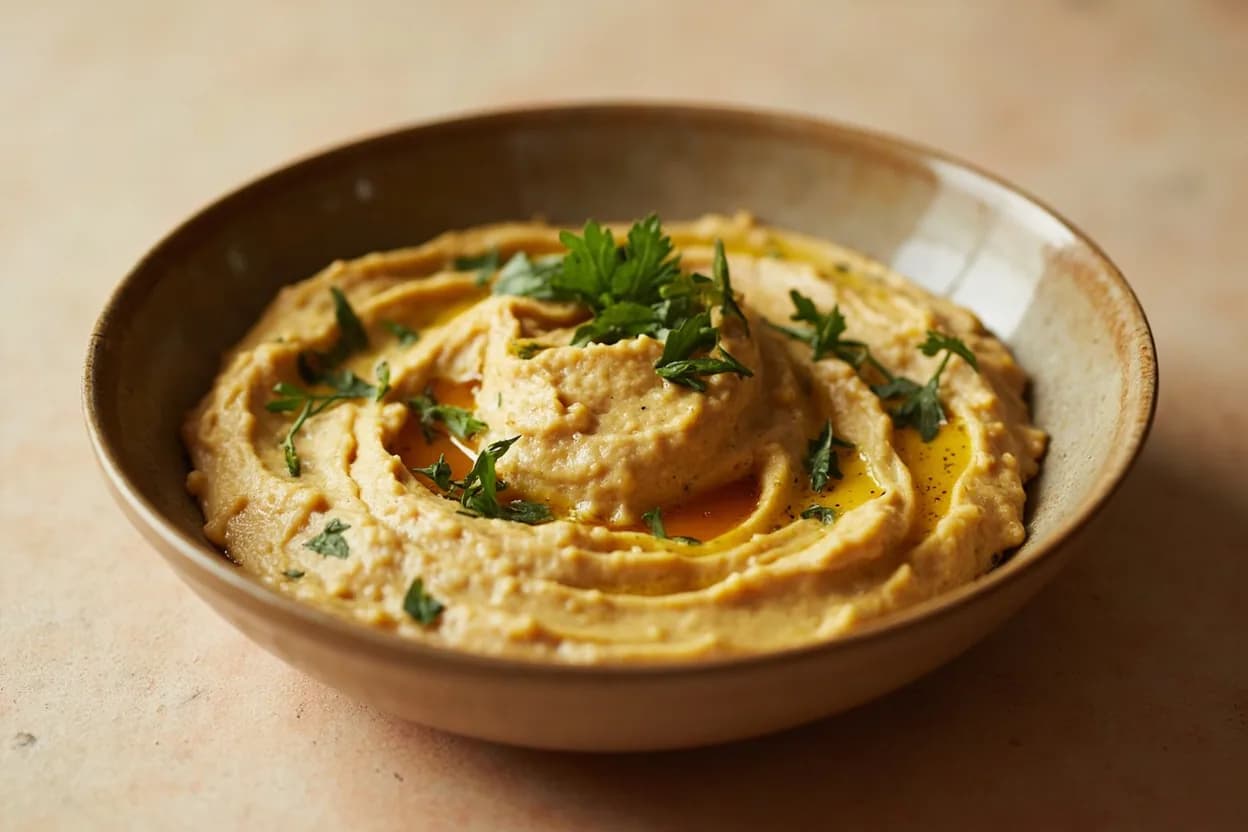
For restaurant-grade hummus, chickpeas must be cooked well past normal doneness until skins slip freely and centers collapse to an almost molten softness.
The hummus-base overcook stage is an intentional extension of chickpea cooking beyond the standard 'fully cooked' endpoint, specifically for use in pureeing into smooth dips and spreads. At this stage the seed coat (testa) detaches easily and floats free in the cooking water, and the cotyledon interior is so thoroughly gelatinized that it offers almost no resistance — pressing a single chickpea between two fingers causes it to dissolve entirely. This degree of cook, approximately 30–60 minutes past normal doneness depending on starting conditions, is the technical prerequisite for the ultra-smooth, cloud-like texture of Levantine hummus in the style of Yotam Ottolenghi, Sami Tamimi, or the classic Abu Hassan in Tel Aviv. Standard 'done' chickpeas, even when processed for 10 minutes in a food processor, will yield a slightly granular hummus; overcook-stage chickpeas blend to a silk.
In photos

What happens
Beyond the standard fully cooked stage, continued heat and hydration degrade the hemicellulose and pectin of the cell walls to the point where inter-cell cohesion fails. Starch granules have long since fully gelatinized and now begin to break down into soluble dextrins, making the interior paste-like. The protein matrix loses all elasticity. The testa — which is composed of tightly bound cellulose, cutin, and tannins — softens and detaches because the adhesive pectin layer between testa and cotyledon dissolves completely. In a blender or food processor, this stage allows the mechanical blades to completely disrupt the remaining cell structure, yielding a sub-micron-particle paste that gives silky hummus its characteristic creamy-to-airy mouthfeel.
What to look for
- Seed coats split open and drift free in the cooking liquid without any pinching
- A single chickpea pressed between two fingers dissolves completely with zero resistance
- The cooking water is visibly starchy — thick, milky-white, and almost broth-like
- Chickpeas are beginning to break apart at the seam when disturbed in the pot
- The aroma shifts from neutral nutty to a slightly sweet, almost caramel-edged legume smell
How to check
- Skin-slip test: gently rub a chickpea between fingers — the skin should slide off with zero friction
- Two-finger press: press a chickpea between thumb and forefinger with no more pressure than a handshake — it should dissolve completely to paste
- Visual check of cooking liquid: should be cloudy and milky, not clear
- Spoon stir: stir the pot; a few chickpeas should break apart at the seam — most remain whole but are visibly inflated and trembling
Carryover & resting
Carry-on from residual heat in a covered pot can push chickpeas from this stage into complete disintegration. Drain immediately once the skin-slip test is satisfied, and run briefly under cold water if not processing within the next 10 minutes.
The science behind it
The standard endpoint chickpeas pass through on the way to hummus-base overcook
- Emulsification (hummus)
The silky texture is not just chickpea softness — it requires vigorous emulsification of tahini, olive oil, and chickpea water (aquafaba) while processing hot chickpeas
- Aquafaba
The starchy cooking water from the overcook stage is high in dissolved proteins and starches; used in place of cold water when blending to help emulsify
- Ice water technique
Processing hot, overcooker chickpeas with ice-cold water creates a temperature differential that aids in producing an aerated, voluminous texture
- Baking soda method
Adding 1/4 tsp baking soda per cup of dried chickpeas during soaking or cooking raises pH, accelerating pectin breakdown and dramatically shortening the time to skin-slip stage
Appears in
References
- 1.Jerusalem: A Cookbook — Yotam Ottolenghi & Sami Tamimi
- 2.Plenty More — Yotam Ottolenghi
- 3.The Food Lab — J. Kenji López-Alt
- 4.On Food and Cooking — Harold McGee
Confidence: high
Notes
The baking soda shortcut
Adding a small amount of baking soda (sodium bicarbonate) — either to the soaking water or the pot — raises the pH of the cooking environment. In alkaline conditions, pectin hydrolysis accelerates dramatically, softening chickpea cell walls in roughly half the time required without it. The risk: too much baking soda (more than 1/4 tsp per cup dry beans) imparts a soapy flavor and can cause the chickpeas to disintegrate before the processor can finish. Use with restraint.
Hot vs. cold processing
Professional hummus operations — from Abu Hassan in Jaffa to Zahav in Philadelphia — blend chickpeas while still steaming hot. Heat reduces viscosity, allows fat from tahini to emulsify more completely, and produces a lighter, airier final texture. Cold chickpeas blended with cold tahini produce a denser, more paste-like hummus. The difference is significant enough that processing temperature is now understood as a primary technical variable, not a matter of taste.
Aquafaba use
The milky, starchy cooking liquid from the overcook stage (aquafaba) is not just a convenience — it is superior to fresh water as the blending liquid. The dissolved proteins and polysaccharides act as emulsifiers, helping to bind the olive oil and tahini into a stable, creamy dispersion. Add it gradually during blending, tablespoon by tablespoon, until the desired looseness is achieved.