Sugar & Candy Stages
Isomalt Working Temperature
Also: isomalt casting temp, isomalt pulled sugar temp, isomalt sugar work
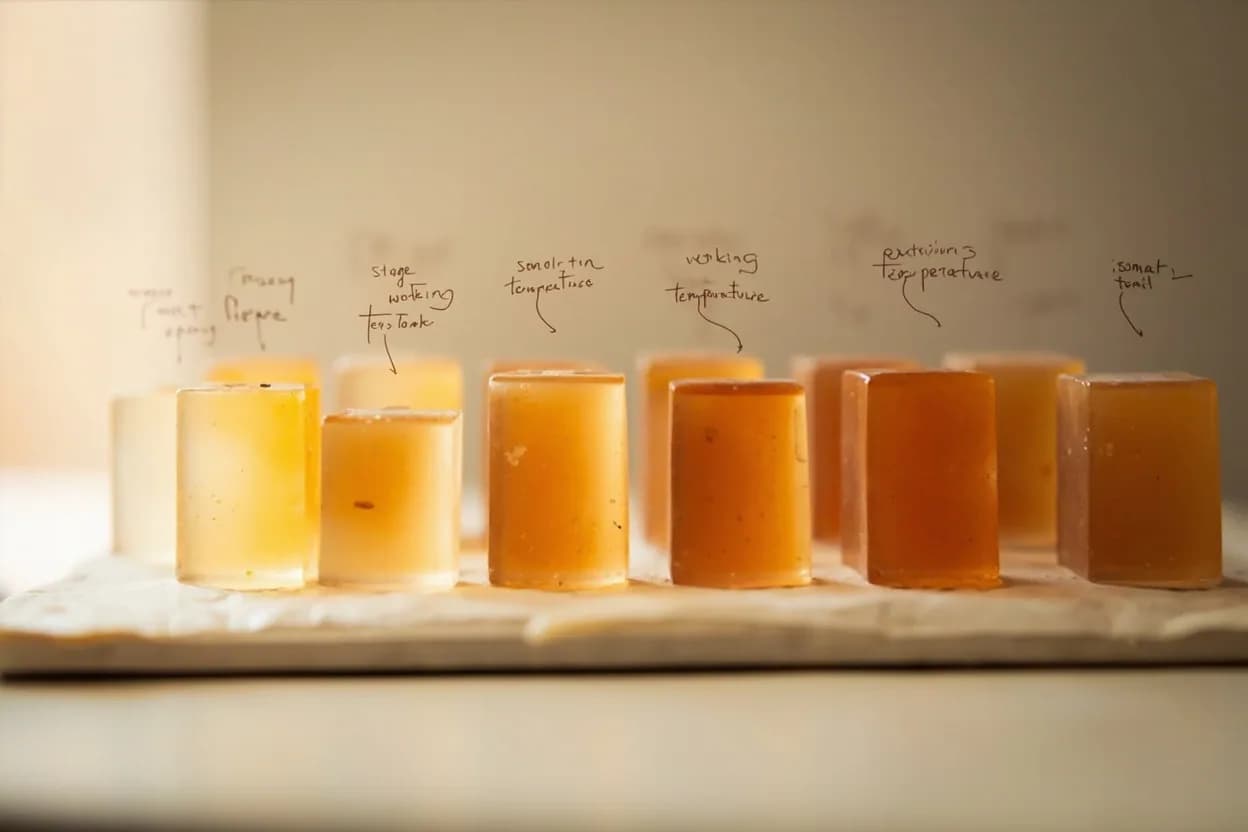
Cast at 155–165°C and worked at 70–80°C, isomalt behaves like sucrose but resists crystallization and humidity far better — the professional's choice for durable sugar showpieces.
Isomalt is a sugar alcohol (disaccharide polyol) derived from sucrose by hydrogenation. It has a melting point range of 145–150°C and is typically cooked to 155–165°C (311–329°F) for casting and pulling work. Unlike sucrose-based pulled sugar, isomalt does not require added glucose or acid to prevent crystallization — its molecular structure is inherently resistant to crystal nucleation. It is significantly more hygroscopic-resistant than sucrose, meaning finished pieces hold their structure longer in humid environments. The working (manipulation) temperature for pulling and blowing is slightly higher than sucrose-based sugar: around 70–80°C, where the mass is plastic and ductile. Isomalt is used extensively in competition pâtisserie, showpiece construction, sugar art, and anywhere durability and clarity are paramount.
In photos
What happens
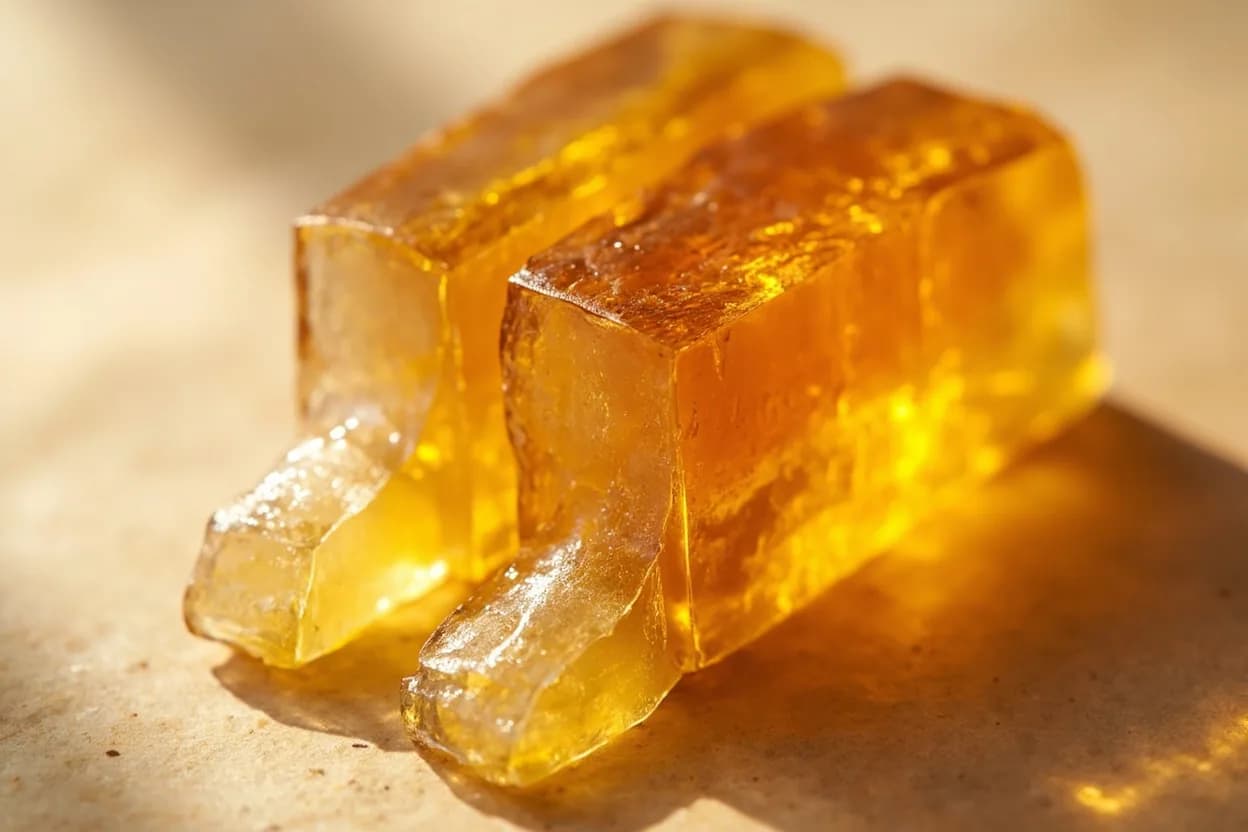
At 155–165°C, isomalt melts fully and all residual water evaporates, producing a clear, colorless melt with very low viscosity. Unlike sucrose, isomalt does not caramelize readily at these temperatures — it remains near-colorless, making it ideal for crystal-clear cast pieces and jewel-like decorative elements. Its glass transition temperature is slightly higher than sucrose-based candy, which is why the working temperature for manipulation is 70–80°C rather than 65–70°C. During pulling, the polymer chains align similarly to sucrose-based sugar, generating sheen, but isomalt transmits light with higher clarity. The crystallization kinetics are much slower, so the workable window during pulling and blowing is longer than with sucrose.
What to look for
- Melt appearance: colorless to very pale yellow; does not brown readily at casting temperature
- Working texture at 70–80°C: smooth, supple, less tacky than sucrose-based sugar; pulls cleanly with a silky feel
- Sheen when pulled: brilliant, glassy shine; transmits light with exceptional clarity
- Sound: silent during pulling; any cracking means the mass is below working temperature
- Taste: mildly sweet, about half the sweetness of sucrose; slight cooling effect due to negative heat of dissolution
How to check
- Infrared thermometer: aim at the surface of the mass for rapid, non-contact readings
- Pull test: take a small tab and stretch — should elongate evenly without tearing; if it resists, return to heat lamp
- For casting: pour into mold when fluid and clear; bubbles indicate residual moisture — cook longer or degas briefly
- Check humidity in the workspace: isomalt is still hygroscopic; above 60% RH pieces will begin to absorb moisture within hours
Food safety
The science behind it
Sucrose-based equivalent technique; isomalt offers longer working window and better humidity resistance
- Hard Crack Stage
Sucrose equivalent cooking target; isomalt reaches the equivalent state at a slightly lower temperature
- Sugar Glass
Cast isomalt cools to a brittle, optically clear glass used for window effects, edible jewels, and mosaic panels
- Hygroscopy
The tendency of sugar to absorb atmospheric moisture; isomalt's lower hygroscopy vs. sucrose is its main practical advantage
Appears in
References
- 1.Sucre d'Art — Stéphane Tréand
- 2.The Art of the Chocolatier — Ewald Notter
- 3.Modernist Cuisine: The Art and Science of Cooking — Myhrvold et al.
- 4.Professional Baking — Wayne Gisslen
Confidence: high
Notes
Isomalt vs. Sucrose: When to Choose Which
For high-humidity environments or pieces that need to last more than a few hours outside controlled storage, isomalt is the professional default. For traditional pulled-sugar flavor and texture in applications where the piece will be consumed immediately (e.g., spun sugar nests on a plated dessert), sucrose-based sugar still produces a more nuanced flavor. Isomalt is essentially flavorless compared to caramelized sucrose — its advantage is entirely structural and optical.
Remelting Isomalt
A significant practical advantage of isomalt over sucrose-based sugar is that it can be remelted multiple times without significant degradation or color shift. Leftover pieces can be collected, remelted, and reused, which is economically important in competition contexts where large quantities of showpiece work generate off-cuts and failed attempts.
Coloring Isomalt
Isomalt's near-perfect clarity makes it an ideal base for vivid, jewel-like colors. Add powdered fat-soluble food colorants or oil-based gel colors to the hot melt just before casting or at the start of the pulling stage. Water-based colors can cause sugar to seize or cloud. Metallic luster dusts can be brushed onto cooled pieces for a gilded or iridescent effect.