Sugar & Candy Stages
Jaggery & Palm Sugar Syrup Soft-Ball Stage
Also: gur soft-ball, palm sugar ball stage, panela bola suave
The soft-ball stage for unrefined sugars, reached at 112–116°C (234–240°F), used in South Asian and Southeast Asian sweets.
Jaggery (raw cane sugar from India) and palm sugar (from coconut, date, or palmyra palms across Southeast Asia) reach the soft-ball stage — equivalent to refined sucrose — at approximately 112–116°C (234–240°F). At this concentration, a drop of hot syrup rolled between fingers under cold water forms a soft, pliable ball that flattens at room temperature. Because unrefined sugars contain significant molasses solids, mineral salts, and natural invert sugars, they behave slightly differently from white sugar: they brown more readily, resist crystallization through the natural invert-sugar content, and carry complex flavor compounds that persist through the cooking process.
In photos


What happens
As water boils away, sucrose concentration rises and the boiling point climbs above 100°C. At 112–116°C, roughly 85% of the water has been driven off. The molasses fraction in jaggery and palm sugar contains natural invertase residues and organic acids that partially hydrolyze sucrose into glucose and fructose, lowering the tendency to crystallize sharply and producing a smoother, softer set than equivalent white-sugar syrups. The Maillard-ready amino acids and reducing sugars in the molasses fraction accelerate browning at these temperatures, so color and aroma develop faster than with refined sugars.
What to look for
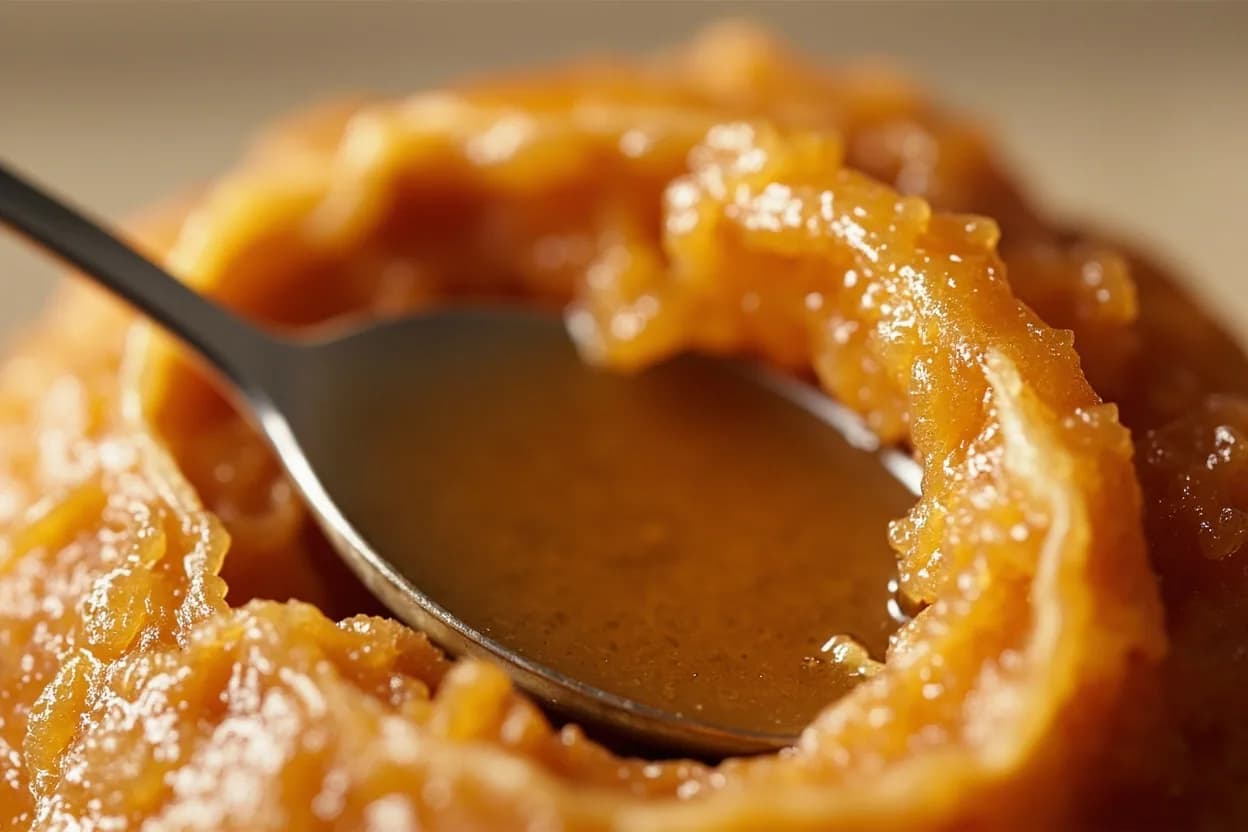
- Syrup turns deep amber to toffee-brown and smells of caramel, molasses, and toasted coconut (for palm sugar)
- Bubbles become slower and more viscous as water concentration drops
- A thin stream poured from a spoon holds a brief ribbon before breaking
- Cold-water test: drop forms a soft, squishable ball that yields like putty and flattens when pressed
- Syrup feels noticeably thicker and slower when stirred
How to check
- Use a calibrated candy thermometer clipped so the bulb does not touch the pan bottom; read 112–116°C
- Cold-water test: drop a small amount of syrup into a bowl of cold water, then fish it out and roll between thumb and forefinger — it should form a soft ball that collapses easily
- Spoon test: lift a spoon and let syrup fall — it should sheet and form a two-strand tail before breaking
- For altitude adjustment, subtract approximately 1°C for every 300 m above sea level
The science behind it
- Soft-Ball Stage (refined sugar)
Identical temperature range for white sucrose; unrefined sugars reach the same physical stage but with additional flavor and color development
- Invert Sugar
Jaggery's natural glucose-fructose mix mimics added invert sugar in preventing crystallization
Amino acids and reducing sugars in jaggery accelerate browning at soft-ball temperatures
- Pectin Interaction
Acid in some palm sugar types can affect fruit-based confections; balance with added pectin or adjust pH
Appears in
References
- 1.On Food and Cooking — Harold McGee
- 2.The Oxford Companion to Sugar and Sweets — Darra Goldstein (ed.)
- 3.Indian Sweets — Anil Batra
- 4.Southeast Asian Food — Rosemary Brissenden
Confidence: high
Notes
Why unrefined sugars behave differently
Jaggery and palm sugar are not simply 'flavored white sugar.' They contain 5–20% moisture at purchase, plus mineral salts (calcium, potassium, iron), natural invert sugars, and hundreds of volatile flavor compounds created during open-pan evaporation. This means their effective sucrose concentration is lower than labeled, they reach target temperatures faster than an equal weight of white sugar, and they are more forgiving of slight overcooking before hard-crack territory because the invert fraction resists recrystallization. A recipe developed for white sugar may need the temperature target raised by 1–2°C to achieve the same texture when substituting jaggery.
Regional naming
Jaggery is called gur (Hindi/Punjabi), bellam (Telugu), vellam (Tamil), and molasses block (some English texts). Palm sugar includes coconut sugar (nariyal shakkar), date palm sugar (khajur gur), toddy palm sugar (taal gur), and Southeast Asian variants — nam tan peep (Thailand), gula jawa or gula aren (Indonesia), gula melaka (Malaysia). Each has distinct flavor, sweetness intensity, and moisture content, all of which shift the precise soft-ball temperature slightly.