Cheese & Dairy Doneness
Labneh Draining: Soft vs. Firm Set
Also: strained yogurt set, yogurt cheese consistency, labneh texture stages
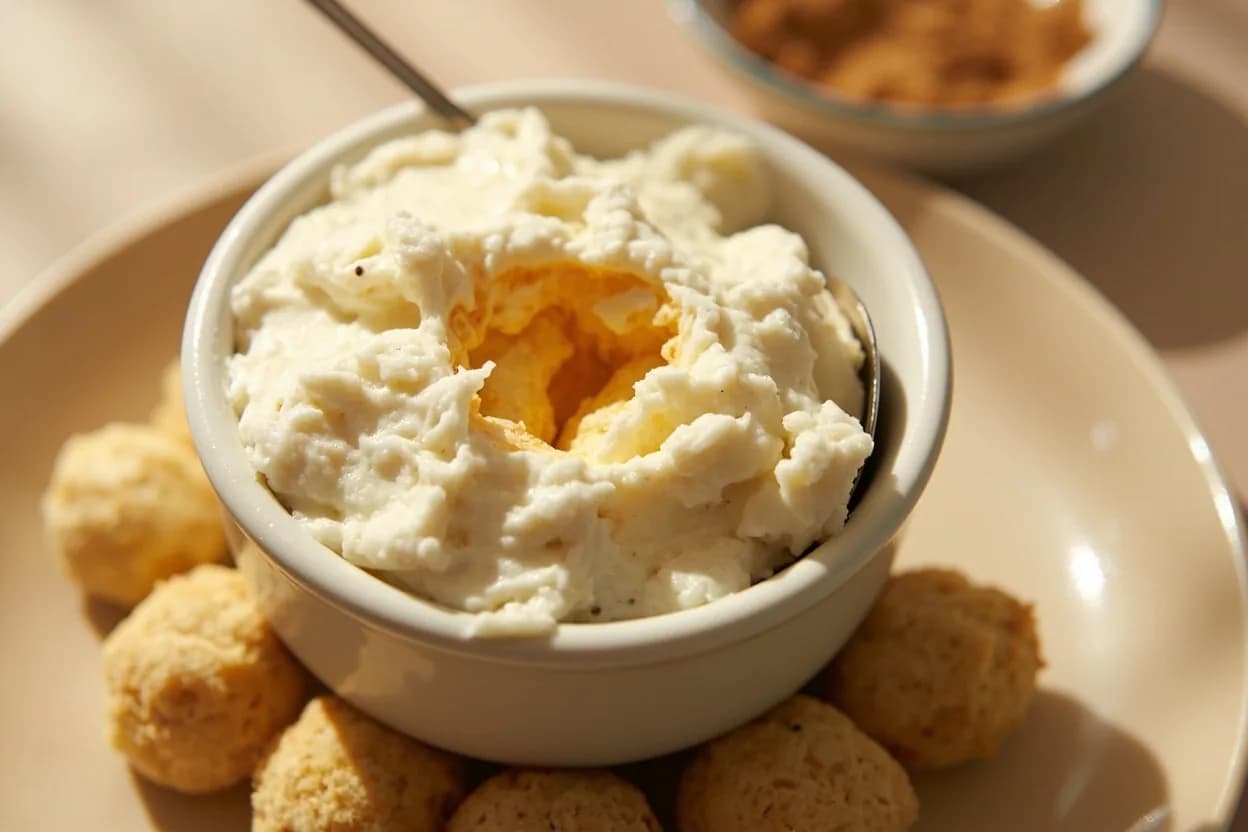
Time, not temperature, determines labneh's texture — 12 hours yields a spreadable cream-cheese consistency; 24–48 hours produces a firm, sliceable or ball-rollable result.
Labneh (also labne, labaneh, kishk bil laban) is yogurt concentrated by draining whey through a cheesecloth, muslin, or fine-mesh bag under refrigeration. Unlike cooked cheeses, its doneness is purely a function of elapsed drainage time and the starting yogurt's protein content. A 12-hour drain removes roughly 30–40% of the yogurt's water, leaving a thick, spreadable product (~20–22% protein). Continuing to 24–48 hours removes 50–60% of moisture, producing a firmer body that holds its shape when sliced or rolled into balls. Beyond 48 hours the surface dries further and labneh can be cured in olive oil and herbs for weeks.
In photos


What happens
Yogurt's gel is formed by acidified casein clusters; gravity and osmotic pressure pull whey (water, lactose, whey proteins) through the cloth while the casein network concentrates and compacts. At 12 hours the matrix is loosely compacted — fat globules and casein micelles are closer together but still mobile, giving a creamy, spoonable texture. By 24–48 hours the casein mesh has tightened significantly; the product is cohesive enough to be moulded, sliced, or formed into balls without slumping. Salt added before or during draining draws additional moisture via osmosis and seasons throughout. Refrigerating during drainage is essential to inhibit pathogen growth as lactic acid bacteria activity slows at low temperatures.
What to look for
- 12h (soft): spoonable, texture like thick crème fraîche or cream cheese; holds a light peak when dropped from a spoon but levels within seconds
- 24h (medium): holds a distinct spoon-dragged furrow without closing; can be spread with gentle pressure
- 36h (firm): sliceable with a knife; edges are clean; moulded balls hold their shape at room temperature for several minutes
- 48h+ (very firm): surface begins to dry slightly; interior is dense and slightly grainy; balls can be rolled without sticking to palms
- Whey in the collection bowl: clear to pale yellow and abundant through the first 12h; slows to an occasional drip by 36–48h
- Sour aroma intensifies progressively as lactic acid concentrates
How to check
- Spoon test (soft): drop a tablespoon — it should mound and hold for 3–5 seconds before slumping
- Furrow test (medium-firm): drag a spoon through the centre; at 24h the furrow holds a clean edge
- Ball test (firm): wet palms lightly and roll a tablespoon into a sphere; it should hold without cracking or sticking
- Weigh the batch: a 500 g starting yogurt should yield approximately 300–320 g at 12h and 220–250 g at 48h
- Whey check: when the drip has reduced to near nothing, the batch is at maximum drainage for that cloth grade
Food safety
The science behind it
The spontaneous expulsion of whey from a gel network — the mechanism that drives labneh draining
Salt added to yogurt before draining creates an osmotic gradient that accelerates whey expulsion
- Acid Coagulation
Labneh's starting gel is formed by lactic acid reducing pH to ~4.6, near casein's isoelectric point
- Fromage Blanc / Quark
European cousins — similarly drained acid-set dairy products differing mainly in starter culture and fat content
- Kishk
Extended dehydration of labneh mixed with bulgur; represents the extreme end of the draining/drying continuum
Appears in
References
- 1.Jerusalem — Yotam Ottolenghi & Sami Tamimi (Ten Speed Press, 2012)
- 2.Falastin — Sami Tamimi & Tara Wigley (Ten Speed Press, 2020)
- 3.On Food and Cooking — Harold McGee (Scribner, 2004), Fermented milks and fresh cheeses
- 4.Cheese and Culture — Paul Kindstedt (Chelsea Green, 2012)
Confidence: high
Notes
Fat content matters
Full-fat yogurt (3.5–4% fat) produces a richer, more unctuous labneh that is less prone to graininess at the firm stage. Low-fat or non-fat yogurt drains faster but yields a leaner, slightly chalky product that can turn rubbery if pressed too long. Greek yogurt (already strained once) reaches soft-set in 6–8 hours and firm-set by 18–24 hours due to its lower initial moisture.
Oil preservation
Firm labneh balls (48h drain) submerged in good olive oil with dried herbs, chilli flakes, and garlic develop a deeper, more complex flavour over 1–2 weeks as the oil infuses. The oil does not cook the labneh — it simply excludes oxygen and acts as a preservative medium. This technique is traditional across the Levant, Greece, and parts of North Africa.