Lamb Doneness
Lamb Chop Doneness Stages
Also: lamb chop temperature, rack cutlet doneness, loin chop internal temp, grilled lamb chop doneness
Quick-cook lamb chops move from rare blush to well-done in a narrow window — visual and temperature cues differ meaningfully by cut thickness.
Lamb chops — whether rack cutlets (côtelettes), loin chops (double-boned T-shape), or blade chops — are thin, fast-cooking cuts where the difference between rare and well-done can be 90 seconds on a hot grill. Unlike a whole leg or shoulder, there is no meaningful collagen-melt benefit to pursue: chops are from the loin and rack muscles (longissimus dorsi, spinalis), which are tender at every temperature. The goal is hitting the preferred colour window (rosy pink for most Western palates, just-grey for some Middle Eastern preparations) while achieving a well-developed Maillard crust on the exterior — a difficult combination that demands high heat and precise timing.
In photos

What happens
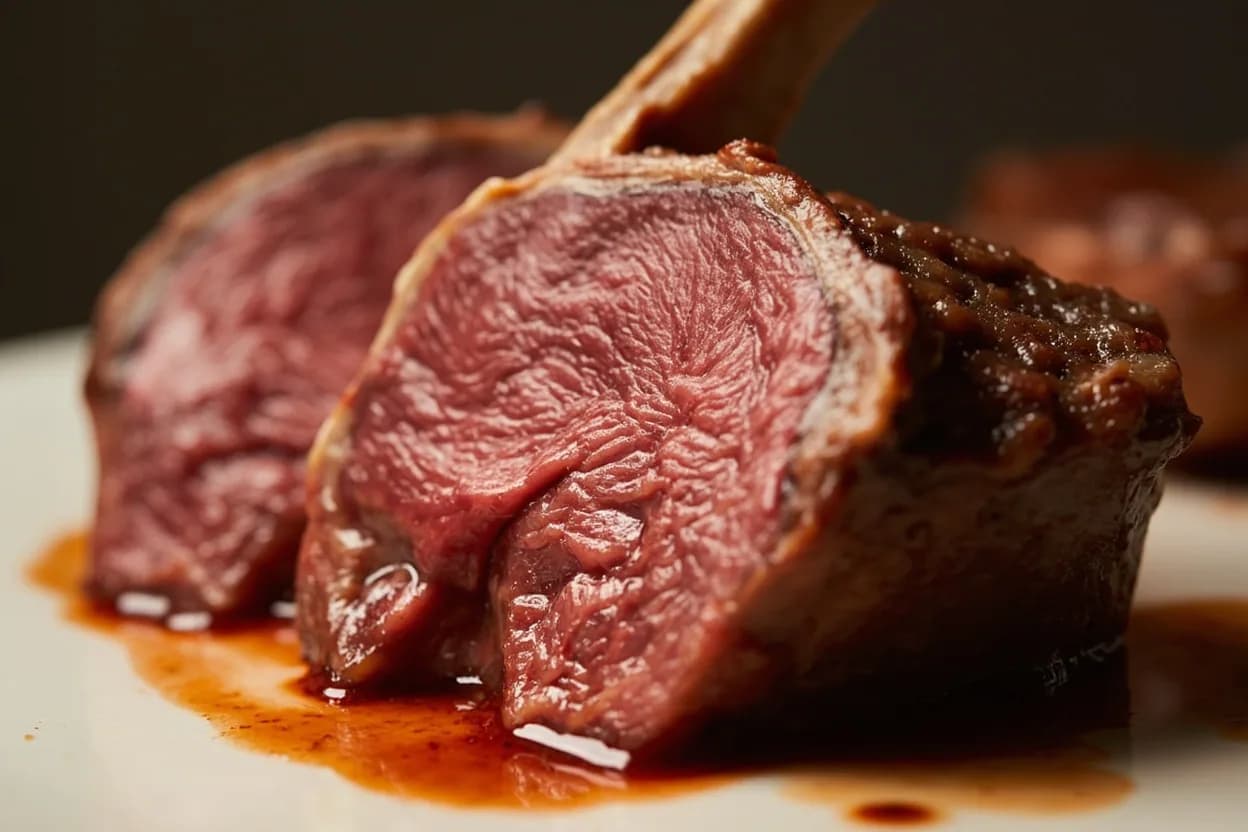
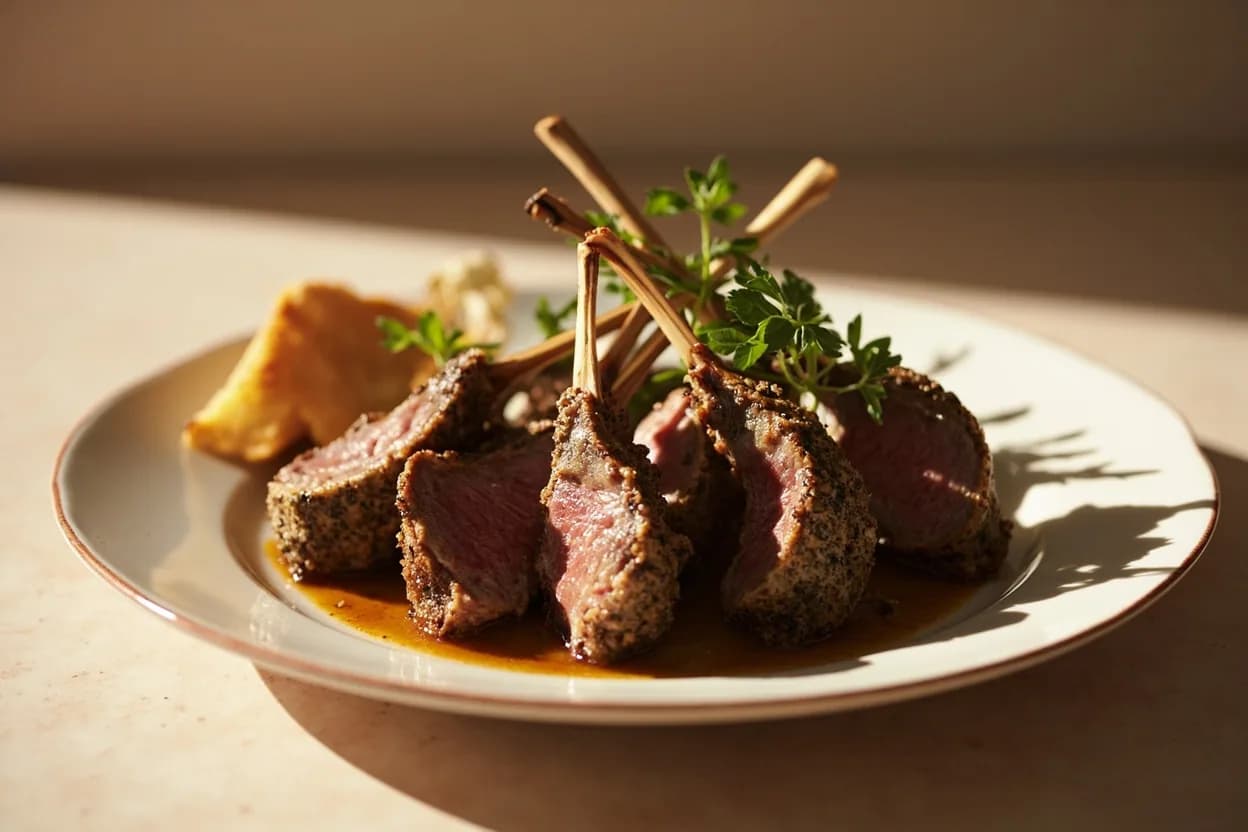
At 57°C (135°F): myosin has denatured; the chop is warm throughout but still feels soft and yielding; interior is bright pink-red. At 60–63°C (140–145°F): the classic medium-rare window — pink deepens to a vivid rosy hue as haem iron reacts with heat; fat in the small chop eye is warm and beginning to liquefy; the lamb's characteristic gamey-sweet aroma is at maximum. At 65–68°C (150–155°F): pale pink centre persisting; juices clear-pink; texture is noticeably firmer but still tender. At 71°C (160°F): the eye muscle turns grey throughout; loin fat renders fully; flavour shifts from iron-rich to more neutral. At 74°C+ (165°F+): well-done; dry, dense texture; the lamb flavour is muted but the crust is pronounced.
What to look for
- Rare (57°C): soft, yielding spring-back under finger; interior bright red-pink; juices pool red on the plate
- Medium-rare (60–63°C): firm but with spring; interior vivid rosy pink all the way to the bone; small bead of juice at the cut surface; fat in the eye is silky
- Medium (65–68°C): pale blush at centre; juices run clear-pink at the cut; firmer but still giving
- Medium-well (70°C): thin line of pink at dead centre only; juices clear; firm and slightly resistant; fat fully rendered and pooled
- Well-done (74°C+): uniformly grey-brown; dry; juices absent or very clear; the crust-to-interior ratio is highest
How to check
- Thermometer (most reliable): insert probe through the side of the chop, parallel to the bone, into the centre of the eye muscle — avoid the bone itself which reads lower
- Touch test: press the meaty eye of the chop firmly with a fingertip — compare to known reference points (thumb pad = rare, thumb knuckle = medium-rare, thenar eminence firm = medium)
- Time-and-flip method for uniform cutlets: on a 250°C grill/griddle, 2 minutes per side for medium-rare on a 1.5 cm cutlet; add 30 seconds per side per additional 5mm of thickness
- Visual incision: nick the thickest part of the eye near the bone with a small knife — the colour 2–3 mm in is the centre reading
- Watch the bone: on a thin rack cutlet, when the meat visibly pulls back 3–4 mm from the bone tip, the exterior proteins have contracted — typically medium internal
Food safety
Carryover & resting
Thin chops (1–1.5 cm, e.g. French-trimmed rack cutlets) carry over only 1–2°C and should be pulled precisely at target temperature. Thick loin chops (2–3 cm) carry over 3–5°C — pull 2–3°C below target and rest 3 minutes. The small thermal mass of a chop means carryover is brief and stops quickly.
The science behind it
Crust development on a chop requires surface temperature above 150°C — achieved instantly on a hot grill while the interior is still below 60°C
- Carryover Cooking
Minimal in thin cutlets, meaningful in thick loin chops — adjust pull temperature accordingly
The same temperature milestones apply across all lamb cuts, but chops have far less thermal mass and move through them faster
Thick lamb chops (3+ cm) benefit from low-oven pre-cook to 55°C followed by a hot sear — produces edge-to-edge even doneness
- Lamb Fat Melting Point
The cap fat on a thick loin chop renders fully only at 65°C+, which is why some chefs prefer medium over medium-rare for loin chops specifically
Appears in
References
- 1.The Food Lab — J. Kenji López-Alt (W. W. Norton, 2015)
- 2.USDA FSIS Safe Minimum Internal Temperature Chart (FSIS, 2023)
- 3.Meat Science — R. A. Lawrie & D. A. Ledward (Woodhead Publishing, 7th ed., 2006)
- 4.On Food and Cooking — Harold McGee (Scribner, 2004)
- 5.The Complete Meat Cookbook — Bruce Aidells & Denis Kelly (Houghton Mifflin, 1998)
Confidence: high
Notes
Thickness Changes Everything
A 1 cm French-trimmed rack cutlet and a 3 cm thick loin chop share the same target temperatures but behave like entirely different proteins on the grill. The cutlet needs 90 seconds per side at maximum heat to hit medium-rare — rest one second too long and it overshoots. The thick loin chop needs 4–5 minutes per side at medium-high heat, followed by a rest, or risks a raw centre hidden under a well-done crust. Recipes that give a single time for 'lamb chops' without specifying thickness are the source of most chop-cookery failures. Always check thickness with a ruler or by eye and adjust from there.
The Case for Well-Done Loin Chops
While medium-rare is the Western default for chops, several great traditions cook lamb chops to 70°C+. Roman scottadito ('burnt fingers') are thin cutlets grilled hard and fast until the bone tip can be held bare-handed — this is closer to medium-well. Turkish ızgara köfte and Lebanese shawarma chops are grilled to full doneness, with the fat expected to be fully rendered and crisped. The rendered-fat-as-flavour model only works at 70°C+ when enough fat has liquefied to baste the meat's surface — choosing medium-rare here would leave the fat solid and waxy.