Lamb Doneness
Lamb: Doneness Stages
Also: lamb internal temperature, lamb rare to well-done, lamb cooking temps
Rare (57°C) through well-done (74°C+): how lamb's myoglobin and inter-muscular fat behave across the full doneness spectrum.
Lamb occupies a distinct place in the doneness spectrum: it carries more myoglobin than pork or chicken yet less than beef, producing a vivid rosy pink at medium-rare that many cuisines consider the ideal eating temperature. Its inter-muscular fat is saturated and waxy, melting fully only above 60–65°C, which makes the difference between the unctuous richness of a properly cooked rack and the greasy, tallowy quality of over-chilled or undercooked cuts. Modern food-safety guidance (USDA, 63°C/145°F with a 3-minute rest for whole cuts) aligns comfortably with medium-rare preferences, making lamb unusually agreeable between culinary ideal and safety compliance.
In photos
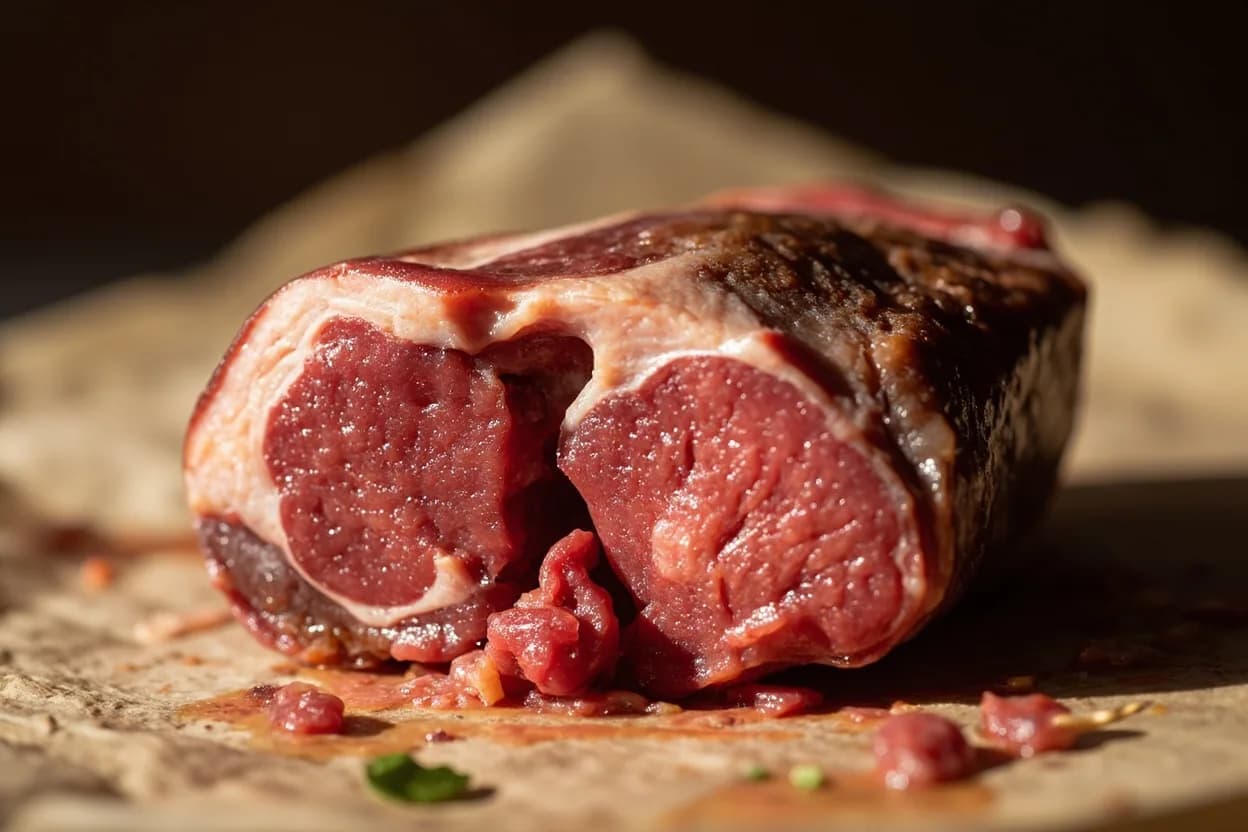
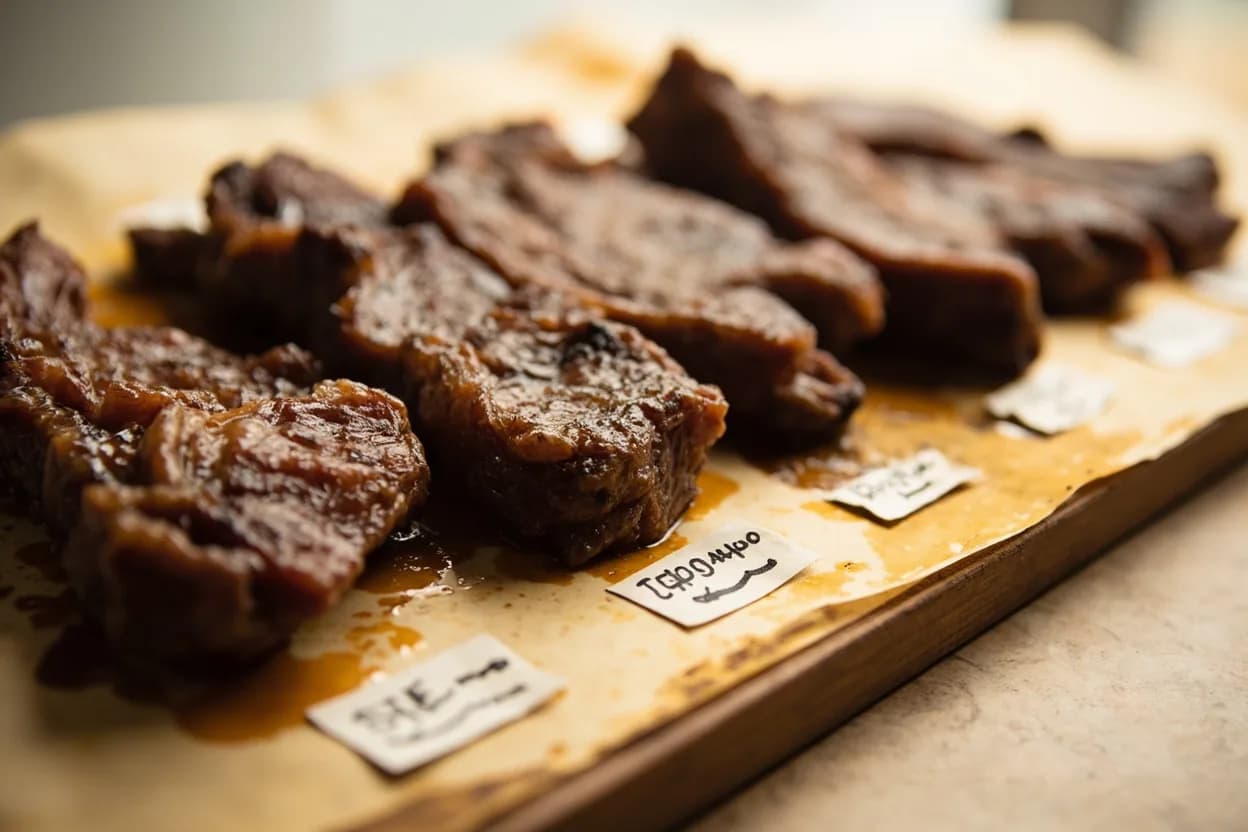

What happens
At 57°C (135°F): myosin denatures, texture firms slightly from raw, but actin remains largely intact — the meat is still tender and visually bright pink-red. The lamb's characteristic fat begins to soften. At 60–63°C (140–145°F): the ideal window — myofibrillar proteins continue to contract, pressing some moisture out, but the inter-muscular fat reaches full lubrication, compensating with richness. Pink is vivid and even. At 66–68°C (150–155°F): actin begins to denature; juices turn from red-pink to clear; texture is noticeably firmer. At 71°C (160°F): well-done territory — most myoglobin is denatured and oxidised, producing brown/grey colour throughout; fat is fully rendered. Above 74°C (165°F): the lamb fat, which has a higher melting point than beef tallow, begins to feel dense on the palate as some fractions re-solidify on cooling; texture is dry and grey.
What to look for
- Rare (57°C): bright red-pink throughout; very soft, near-raw give under finger pressure; juices run deep red
- Medium-rare (60–63°C): vivid rosy pink, especially at the centre; warm throughout; juices run pink-red; springy but yielding
- Medium (65–68°C): pale pink centre transitioning to light brown at edges; juices run clear-pink; firmer spring-back
- Medium-well (68–71°C): thin blush of pink at the very centre only; predominantly grey-brown; minimal juice; notably firmer
- Well-done (74°C+): uniformly grey-brown throughout; juices run completely clear; texture dense and dry
How to check
- Thermometer: insert probe horizontally into the geometric centre of the eye muscle (rack/loin) or the deepest muscle mass, avoiding bone and fat seams
- For a rack of lamb: probe through the meaty end parallel to the bone into the longissimus dorsi — do not touch the rib bone
- Finger test: with the back of two fingers, press the cooked surface — rare is as soft as the fleshy part of your thumb relaxed; medium-rare is as firm as the thumb joint slightly flexed
- Visual carve check: cut into the thickest piece of a resting joint; lamb colour reads true faster than beef because the myoglobin concentration is lower
- Rest at least 5 minutes before carving: the temperature will equilibrate across the joint and carryover will complete
Food safety
Carryover & resting
Carryover varies dramatically by cut size. A rack of lamb (1.2 kg) resting tented under foil for 10 minutes rises 4–6°C — pull at 57°C (135°F) for medium-rare (63°C). A half leg (1.5 kg) carries over 6–8°C — pull at 55°C (131°F). Single loin chops have minimal carryover (1–2°C) and should be pulled at target temperature.
The science behind it
- Myoglobin Denaturation
Lamb's myoglobin content sits between pork and beef; it denatures to grey-brown above 70°C, governing the visual pink-to-grey colour shift
- Lamb Fat Melting Point
Lamb fat is more saturated than beef tallow (melting point ~44–55°C for various fractions), affecting mouthfeel and palatability at different temperatures
- Carryover Cooking
Large lamb joints carry over 5–8°C; chops carry over 1–2°C — the differential requires different pull temperatures
- Lamb Shoulder & Leg: Low-and-Slow
The same myoglobin/fat system applies to braise-until-pull-tender at 90–95°C, a wholly different goal from chop/rack doneness
- Maillard Crust Formation
Surface temperatures of 150–180°C create the characteristic browned crust on a seared rack before the interior has left rare territory
Appears in
References
- 1.The Food Lab — J. Kenji López-Alt (W. W. Norton, 2015)
- 2.On Food and Cooking — Harold McGee (Scribner, 2004)
- 3.USDA FSIS Safe Minimum Internal Temperature Chart (FSIS, 2023)
- 4.Modernist Cuisine Vol. 3: Animals and Plants — Nathan Myhrvold et al. (The Cooking Lab, 2011)
- 5.Meat Science — R. A. Lawrie & D. A. Ledward (Woodhead Publishing, 7th ed., 2006)
Confidence: high
Notes
Why the World Disagrees on Lamb Doneness
In France, agneau is served saignant (bloody, 55–57°C) or rosé (58–62°C); well-done lamb is considered a culinary error. In the UK, a 'pink' leg roast is the weekend standard at 63–65°C. Much of the Middle East and Central Asia roasts lamb to 71°C+ because the dishes (shawarma, mechoui, dum pukht) rely on prolonged fat rendering and textural collapse rather than juiciness. In New Zealand, the world's largest lamb exporter, medium (65°C) is standard. Understanding doneness in the context of the preparation, not just a single temperature, is essential.