Lamb Doneness
Lamb Shoulder & Leg: Low-and-Slow Collagen Breakdown
Also: lamb shoulder pull temperature, lamb braising endpoint, fall-from-bone lamb, lamb slow roast doneness
Target 90–95°C for pull-tender lamb shoulder; 85–90°C for fall-from-bone braised leg — both demand collagen dissolution rather than juice-preservation.
Lamb shoulder and the shank end of the leg are collagen-rich, heavily worked muscles. At conventional medium-rare temperatures (60–65°C), their intramuscular collagen remains intact as rubbery cords and sheaths, making these cuts unappealing if served rare. The correct culinary goal is a second doneness plateau: sustaining the meat at 90–95°C long enough for the collagen network to hydrolyse into gelatin, which lubricates every fibre from within. The result — soft enough to shred with a spoon, self-basted by released gelatin — is the foundation of iconic dishes from mechoui to Greek Easter lamb to Irish stew. This is an entirely different logic than chop/rack cookery: success is measured in texture transformation, not juice retention.
In photos
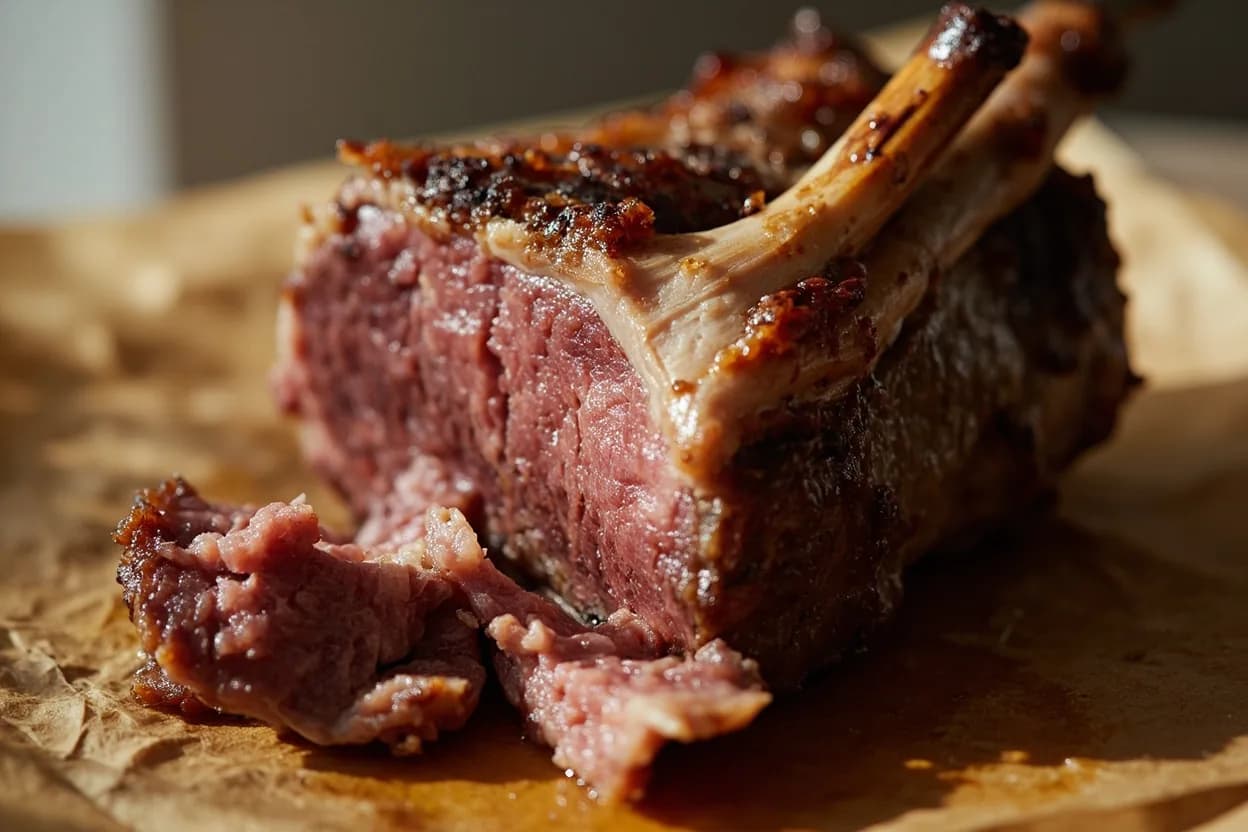

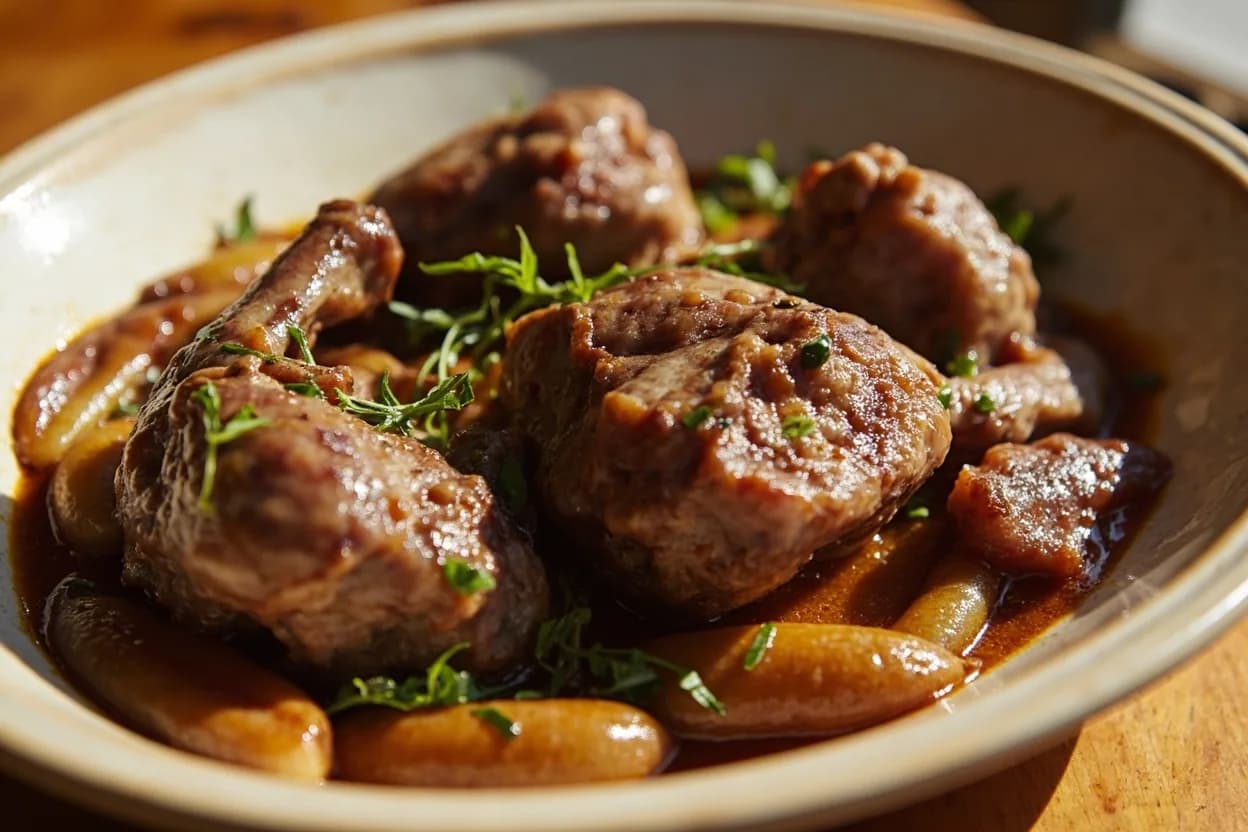
What happens
As lamb shoulder rises from 65°C to 90°C, the myofibrillar proteins (myosin and actin) have long since denatured and the muscle fibres have contracted fully, squeezing out most free moisture. What reverses this apparent over-cooking is the collagen. Between 85–96°C, the triple-helix collagen molecules in connective tissue sheaths unwind and hydrolyse into gelatin chains that permeate the surrounding meat, creating a self-basting environment. Fat cells rupture and render, further lubricating the now-separated muscle bundles. At the optimum 90–95°C window, every fibre is gelatine-coated and slides past its neighbours — this is the yielding, shredding quality that distinguishes a properly cooked shoulder. Above 96°C for extended periods, the gelatin over-hydrolyses into smaller peptides, the muscle fibres become cottony and dry rather than lusciously tender.
What to look for
- The bone (if bone-in) rotates freely and pulls away cleanly from the joint
- The meat surface jiggles visibly when the roasting pan is shaken — a sign the gelatin is fully mobile within the tissue
- A two-pronged fork or spoon can divide the meat into chunks with lateral pressure alone, no cutting
- The braising liquid or rendered pan juices are thick and coating — they set to a soft gel at room temperature
- The outer surface may appear very dark or caramelised while the interior has transformed from dense-firm to yielding
- Aroma is deeply sweet and savory simultaneously — Maillard products from the surface combined with sweet gelatin vapour
How to check
- Probe thermometer inserted at the thickest point of the shoulder muscle mass, avoiding the scapula bone: target 90–95°C (194–203°F)
- Poke test: insert a skewer or probe with no resistance — it should slide through as if through soft butter at multiple points
- Shred test: grip the shoulder with tongs or forks and apply lateral pressure — the muscle should separate along natural seams without tearing
- Bone wiggle (bone-in shoulder): grip the exposed bone end and rotate — full doneness is confirmed when it turns 360° with gentle pressure
- Braising liquid consistency: lift a spoon of liquid and let it fall — at doneness it should coat the back of the spoon in a thin, slightly viscous sheet
Food safety
Carryover & resting
A whole bone-in lamb shoulder (2–2.5 kg) resting uncovered for 20–30 minutes loses very little temperature if the collagen has fully melted — the gelatin acts as a thermal reservoir. The shoulder can be held in its covered roasting pan at 80°C oven for up to 1–2 hours without quality degradation, making it ideal for entertaining. Unlike delicate rack cookery, there is no risk of 'overshooting' by a few degrees at this end of the spectrum.
The science behind it
The same biochemical transformation as tripe/tendon but occurring within and around intact muscle fibres
- Second Plateau Effect
Analogous to the beef brisket stall: as collagen hydrolyses and fat renders, temperature rise slows despite constant heat input
Chop and rack temperatures (57–74°C) reflect a completely different goal — juiciness over texture transformation
- Braising Temperature
Maintaining 90–95°C in the braising liquid ensures the collagen-melt window is continuously applied to submerged cuts
- Maillard Crust Formation
Many slow-roast shoulder preparations begin at 230°C to build crust, then drop to 150°C to slowly drive the interior to 90°C
Appears in
References
- 1.Modernist Cuisine Vol. 3: Animals and Plants — Nathan Myhrvold et al. (The Cooking Lab, 2011)
- 2.The Food Lab — J. Kenji López-Alt (W. W. Norton, 2015)
- 3.On Food and Cooking — Harold McGee (Scribner, 2004)
- 4.The River Cottage Meat Book — Hugh Fearnley-Whittingstall (Hodder & Stoughton, 2004)
- 5.Meat Science — R. A. Lawrie & D. A. Ledward (Woodhead Publishing, 7th ed., 2006)
Confidence: high
Notes
The 90°C Floor — Why Lower Temperatures Fail
Some recipes suggest cooking lamb shoulder at 70–75°C for 8–12 hours (very-low-and-slow). At these temperatures, collagen does hydrolyse — but slowly and incompletely. The result is often a cut that is tender but not shred-tender: the muscle bundles separate with a knife but will not pull. True pull-apart quality, where you can rest two spoons on the shoulder and have it divide effortlessly, requires the 90–95°C window. Sous vide practitioners who cook at 74°C for 24–36 hours report similar results to traditional 90°C braising, demonstrating that the extended time partly compensates for the lower temperature.
Bone-In vs Boneless
Bone-in shoulder is preferred for low-and-slow because the bone acts as an internal conductor, helping the deepest muscles reach temperature faster, and the bone marrow enriches the surrounding meat. Boneless rolled shoulder, by contrast, has no temperature 'highway' and takes longer at the centre — the roll should be loosened before cooking if a very tight roulade was tied. For braised leg (whole gigot), the femur is a useful temperature probe target: when the joint where the femur meets the acetabulum feels loose through the skin, the collagen around the hip socket has melted — a traditional French test.