Offal & Specialty Cuts
Liver Pâté & Chicken Liver Mousse Set Temperature
Also: pâté internal temperature, chicken liver mousse doneness, liver pâté 70°C, mousse set point
70°C / 158°F is the precise internal set point for liver pâté and mousse — just cooked through for a creamy, blendable texture that becomes grainy and dry if even slightly exceeded.
Chicken liver mousse and classic pâté de foie de volaille depend on cooking liver to exactly the right internal temperature before blending or pressing. At 70°C (158°F), liver proteins have denatured fully — eliminating food-safety concerns — while retaining enough internal moisture and fat emulsification to blend into an ultra-smooth, creamy mousse or slice cleanly as a dense, yielding terrine. Below this temperature the mousse tastes raw and the texture is slimy; above approximately 75–78°C, the proteins contract sharply, expelling moisture and producing a dry, grainy, granular texture that no amount of cream or butter can fully rescue during blending.
In photos

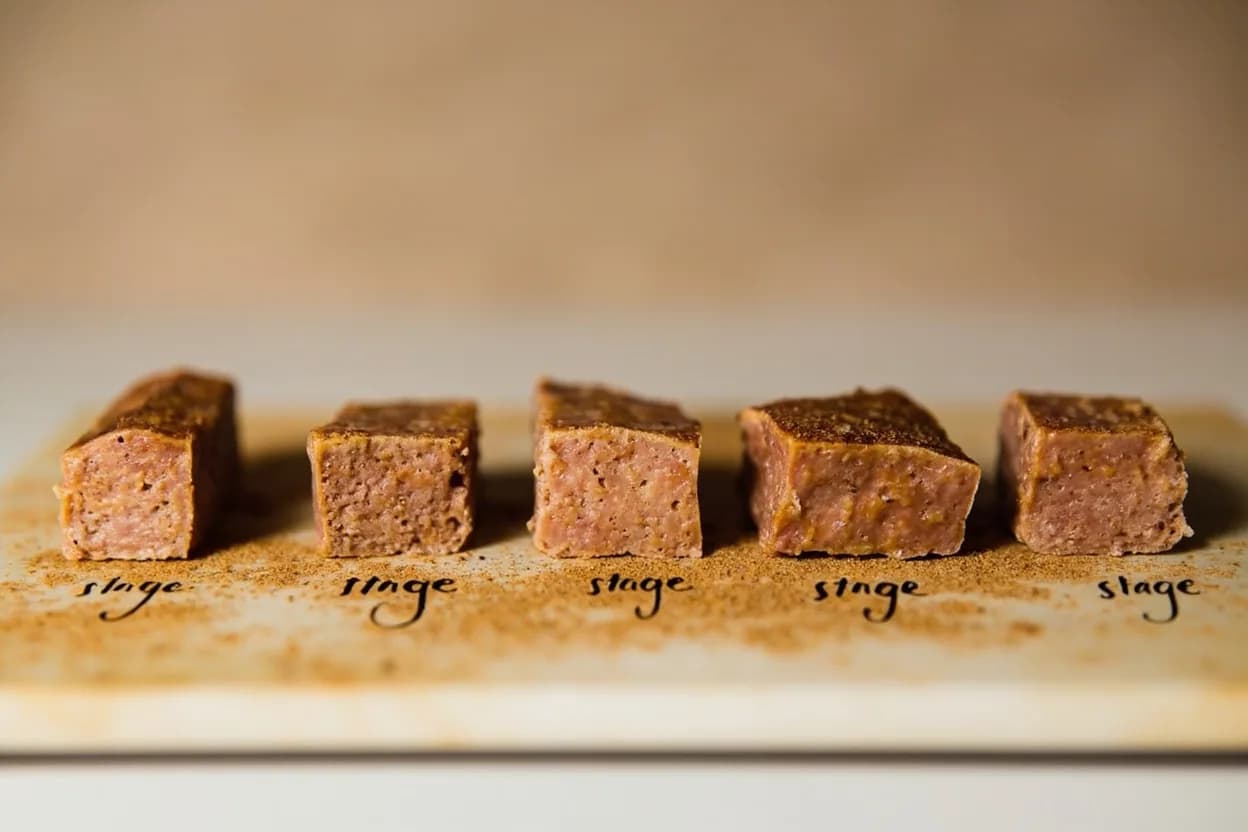

What happens
Liver is rich in water-soluble proteins (including heat-sensitive albumins) and contains glycogen, myoglobin, and a high density of mitochondria-associated proteins. At 70°C, the bulk of these proteins reach their denaturation endpoint: they unfold and cross-link, setting the matrix. Simultaneously, intracellular fat droplets — which are responsible for mousse richness — remain emulsified within the set protein network rather than separating as free fat. Beyond 75°C, protein shrinkage expels both free water and emulsified fat, and further Maillard browning of the outer surface intensifies bitter compounds. The result above 75°C is a cooked-through, granular, bitter-tasting liver that cannot be rescued by additional blending.
What to look for
- Cut surface of cooked livers should show uniform pale pinkish-brown throughout, with no red or purple translucency at the center
- Cooked livers feel just firm under finger pressure — not soft and slippery (underdone) or hard and dry (overdone)
- Blended mousse at this temperature takes on a very smooth, ribbon-like consistency when processed; it coats a spoon thickly
- No pooling of separated fat or watery exudate in the blending bowl — fat is emulsified
- Aroma is savory and rich, with a mild iron note — not sharp, sulphurous, or raw
How to check
- Insert a thin probe thermometer into the thickest liver lobe; check several pieces for consistency
- For terrine (bain-marie oven method): probe the center of the packed terrine through the foil cover at 70°C; remove from oven immediately
- For pan-seared approach (then blended): sear until just firm to touch and no longer pink at center (~3–4 min per side over medium heat), verify center temperature before blending
- For sous vide: hold at 65°C for 30 minutes achieves pasteurization and the correct texture for chicken liver mousse without reaching 70°C drying point
- Cool rapidly in an ice bath before blending to prevent carryover pushing past 75°C
Food safety
Carryover & resting
Liver in a hot pan or terrine carries over quickly — remove from heat at 68–69°C and let residual heat complete the job. In a terrine, the water bath holds heat effectively; verify the center before cooling in ice.
The science behind it
- Protein denaturation temperature
Liver's rapid protein set-and-shrink behavior is the defining factor in this narrow window
- Emulsification in liver mousse
Fat must remain emulsified within the protein network — overcooking breaks the emulsion
- Bain-marie (terrine cookery)
Gentle water bath heat prevents the outside of a terrine from overcooking while the center catches up
- Sous vide pasteurization
Lower-temperature, longer-hold alternative that achieves food safety while preserving moisture
- Foie gras just-set center
Related principle applied to fattened liver at 54°C; the fat-protein ratio difference shifts the target
Appears in
References
- 1.Charcuterie: The Craft of Salting, Smoking, and Curing — Michael Ruhlman & Brian Polcyn (W. W. Norton, 2005)
- 2.The River Cottage Meat Book — Hugh Fearnley-Whittingstall (Hodder & Stoughton, 2004)
- 3.On Food and Cooking: The Science and Lore of the Kitchen — Harold McGee (Scribner, 2004)
- 4.Under Pressure: Cooking Sous Vide — Thomas Keller (Artisan, 2008)
- 5.UK Food Standards Agency Guidance on Campylobacter in Liver Pâté (FSA 2012)
Confidence: high
Notes
The grainy mousse problem
The single most common failure in chicken liver mousse is overcooking. Even 5°C above target produces a noticeably sandy, granular texture after blending that no emulsifier or cream addition will fully mask. The off-texture comes from denatured and contracted protein aggregates that the blender cannot fully break down. Prevention is straightforward: use a thermometer, pull at 69–70°C, cool in an ice bath immediately. Some chefs deliberately target 65°C sous vide to get even more silky texture, relying on time-temperature pasteurization rather than hitting 70°C.
Butter and cream in the blend
Classic French chicken liver mousse adds cold butter in stages during blending (often 50–100% of the liver's weight) and sometimes heavy cream or crème fraîche to build richness and extend the emulsification. The liver must be warm but not hot when blending begins — blending ice-cold cooked liver produces a dull, heavy texture, while blending hot liver causes the butter to separate immediately. Around 50–55°C is the ideal blending temperature for incorporating cold butter progressively.