Beef Doneness
Meat Carryover Temperature Rise
Also: carryover cooking, resting temperature rise, residual heat cooking, pull-temp adjustment
After leaving the heat, meat continues to cook as residual energy from the hot exterior migrates inward, raising the internal temperature by 2–10°C (3–18°F) during rest.
Carryover cooking is the continued rise in internal temperature that occurs after meat is removed from a heat source. When meat is on a grill, in an oven, or in a pan, the exterior reaches a temperature far higher than the interior; the thermal gradient drives heat from the hot outer layers toward the cooler center. When the heat source is removed, this gradient does not immediately equalize — residual energy continues to flow inward, raising the internal temperature during the rest period. The magnitude of carryover depends on the thickness and mass of the cut, the cooking method (dry heat produces more carryover than moist heat), and the temperature differential between exterior and interior at the moment of pulling. For practical purposes: pull meat 2–10°C (3–18°F) before the target done temperature to account for carryover and avoid overcooking.
In photos
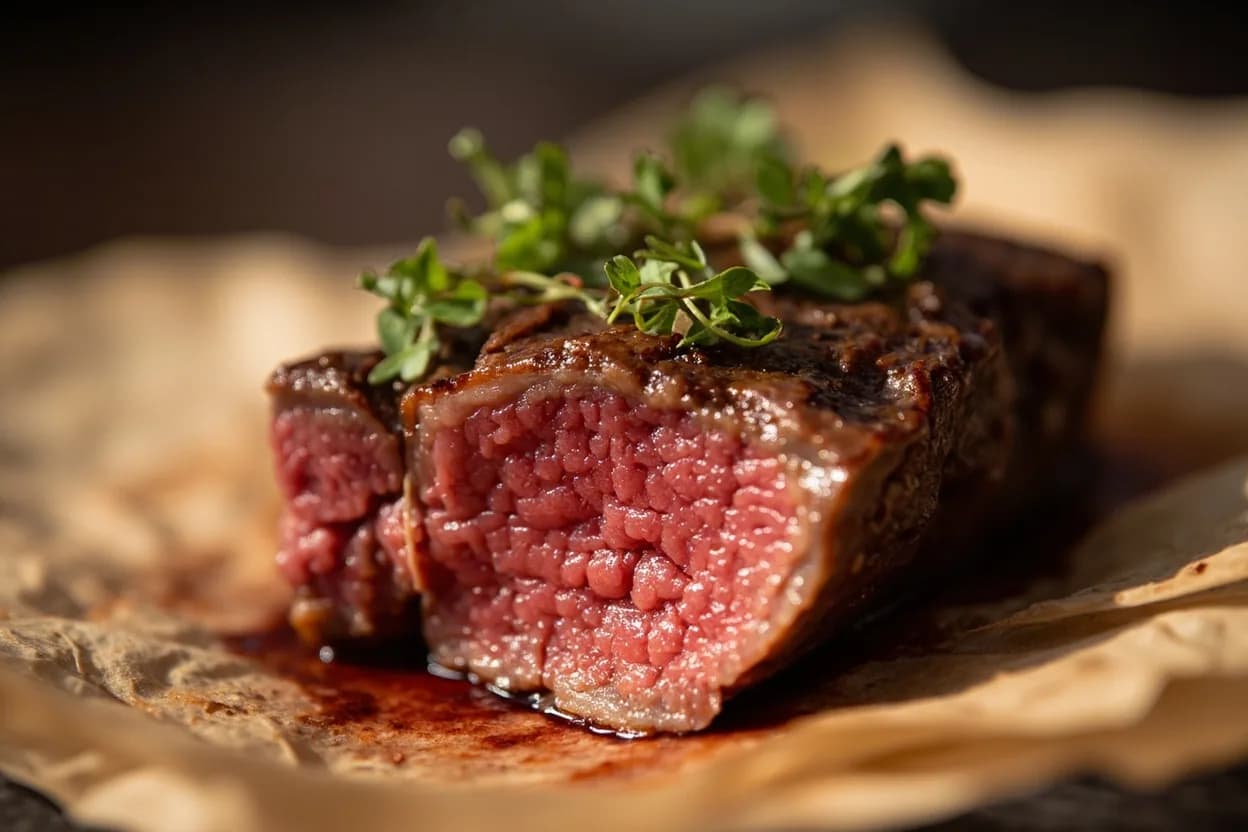

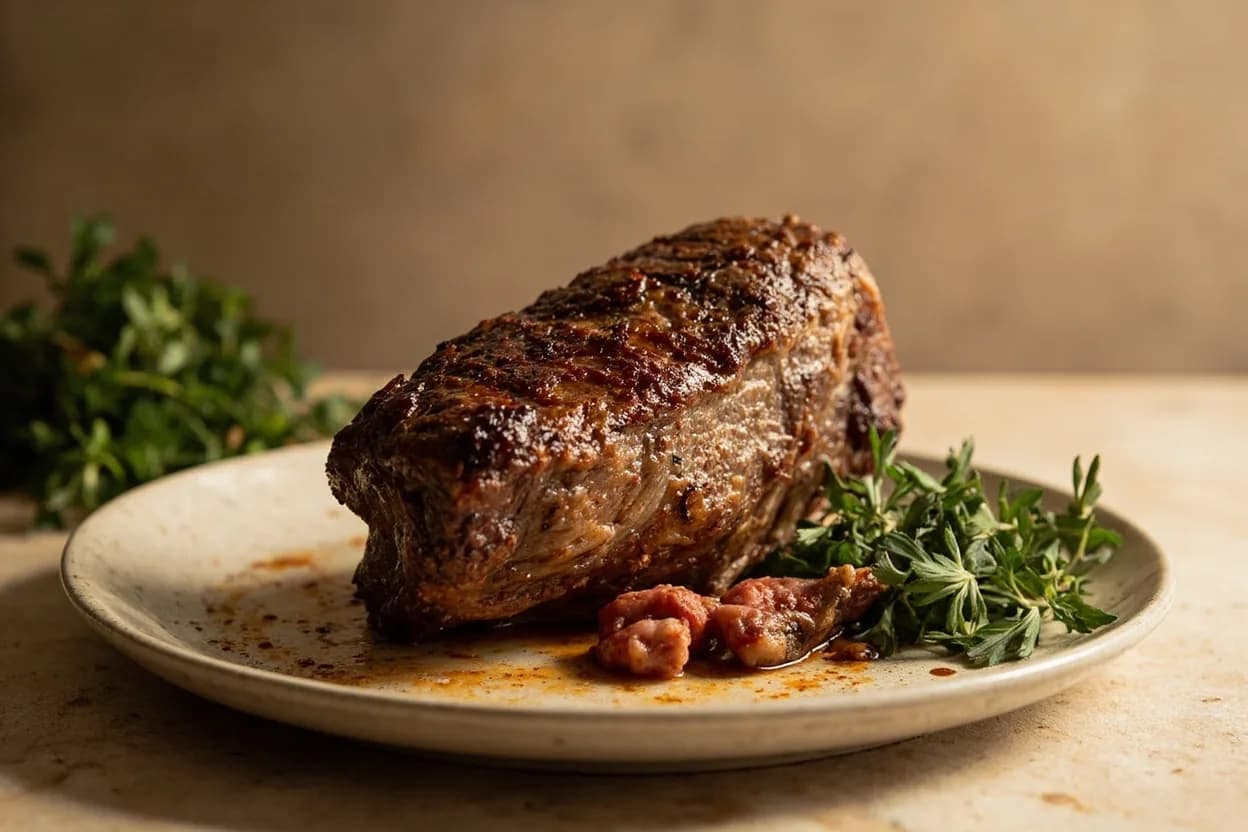
What happens
During high-heat cooking, the exterior of the meat reaches temperatures far above the interior. When removed from heat, energy stored in the hot outer layers (which may be at 180–220°C / 356–428°F for a seared steak) continues to conduct inward along the temperature gradient. For small, thin cuts (chicken breast, thin steak), carryover is modest — 2–5°C — because the exterior cools rapidly and the gradient collapses quickly. For large roasts (prime rib, whole tenderloin), the exterior retains heat for much longer, driving sustained inward conduction of 7–10°C or more. High-heat methods (broiling, grilling, high-temp roasting) generate steeper exterior-interior gradients and thus more carryover than low-and-slow methods. Sous vide, where the entire cut equilibrates to a single temperature, produces almost zero carryover. Resting the meat on a rack (rather than a cutting board) allows air circulation, slowing exterior cooling and modestly increasing carryover.
What to look for
- Thermometer reading climbs 2–10°F within the first 2–5 minutes of resting, then plateaus and begins to fall
- Surface of the cut feels very hot to the touch at pull time; it should cool to warm during the rest period
- Juices that run when the meat is cut at the end of rest are clear and pinkish-red (for medium-rare beef), not flooding — resting has allowed juice redistribution
- For large roasts, a probe left in during rest will show the characteristic rise-then-fall curve
How to check
- Leave an instant-read or leave-in probe in the meat during rest and observe the temperature curve — the peak of the curve is the true done temperature
- Pull meat when the thermometer reads target temperature MINUS the expected carryover (e.g., pull a prime rib at 120°F for a target of 130°F medium-rare)
- For thick steaks (1.5 inches+), expect 5–8°F of carryover after a high-heat sear; for thin steaks, 2–4°F
- Tent loosely with foil to slow surface cooling and maintain a warmer resting environment — this increases carryover slightly and maintains serving temperature
Carryover & resting
Carryover is the phenomenon being described in this entry; the key practical rule is to pull meat early and let the rest complete the cooking. The rest period itself (minimum 5 minutes for steaks, 20–30 minutes for large roasts) serves two functions: allowing carryover to complete and allowing juices to redistribute as muscle fibers relax.
The science behind it
The rest period serves dual purposes: completing carryover cooking and allowing juice redistribution — these are distinct phenomena that happen simultaneously
- Steak Doneness Temperatures
All target steak temperatures assume the final rested temperature — pull temp must be adjusted downward by the carryover amount for each cut
- Prime Rib / Standing Rib Roast Done Temperature
Large rib roasts show 8–12°F of carryover after a 450°F high-heat finish; pulling at 120°F targets a 130°F medium-rare result
- Sous Vide Precision
Sous vide eliminates carryover by cooking at the exact target temperature throughout — no pull-temp adjustment needed
Low-oven cooking followed by high-heat sear minimizes carryover because the exterior-interior gradient is minimal at the time of searing; only 2–3°F adjustment needed
Appears in
References
- 1.The Food Lab — J. Kenji López-Alt
- 2.On Food and Cooking: The Science and Lore of the Kitchen — Harold McGee
- 3.How to Read a French Fry — Mark Schatzker
- 4.Modernist Cuisine: The Art and Science of Cooking — Nathan Myhrvold et al.
- 5.The Professional Chef, 9th Edition — The Culinary Institute of America
Confidence: high
Notes
Carryover by Cut Size (Practical Reference)
Thin steaks (under 1 inch): 2–4°F carryover; pull at target minus 3°F. Thick steaks (1.5–2 inches): 5–8°F; pull at target minus 5–7°F. Large roasts (4+ lbs, high-heat method): 8–12°F; pull at target minus 10°F. Low-and-slow smoked cuts: 2–4°F (minimal gradient at pull time). Sous vide: 0–1°F (negligible).
The Resting Myth: 'Juices Redistribute'
Resting does allow juices to redistribute — but the mechanism is not that muscle fibers 'relax and reabsorb juices.' What actually happens is that the thermal gradient causing muscle fiber contraction eases as the interior and exterior temperatures equalize. As the fibers at the center cool slightly from their peak, they contract less forcefully, allowing juice that was being squeezed toward the surface to remain in the interior when cut. Cutting immediately after pulling from heat results in more juice loss because the fiber contraction is at its maximum. Carryover completion and juice redistribution both improve during the same rest window.
High-Heat Finish (Reverse Sear) and Carryover
The reverse sear method (low oven to near-target temperature, then high-heat sear) is popular precisely because it minimizes carryover. The meat enters the searing stage with a nearly uniform internal temperature, so the brief high-heat sear adds only a thin hot exterior layer — producing 2–3°F of carryover rather than 8–12°F. This gives greater control over the final done temperature.