Aromatic & Fat Doneness
Miso Soup No-Boil Rule
Also: miso dissolution temperature, miso serving temperature, misoshiru no-boil
Miso must be dissolved into broth held below a simmer — no hotter than 70–75°C — to preserve its volatile aromatics and living beneficial bacteria.
The miso soup no-boil rule is the culinary and scientific principle that miso paste should be added to dashi or other broth only when that liquid is below simmering — optimally 65–75°C (149–167°F) — and should never be boiled once dissolved. Boiling drives off the volatile ester and aldehyde compounds responsible for miso's complex aroma, kills the living Aspergillus oryzae enzymes and Lactobacillus bacteria present in unpasteurized miso, and flattens the soup's flavor profile to a blunt saltiness. Miso added just before serving, with heat immediately cut, retains full aromatic depth.
In photos
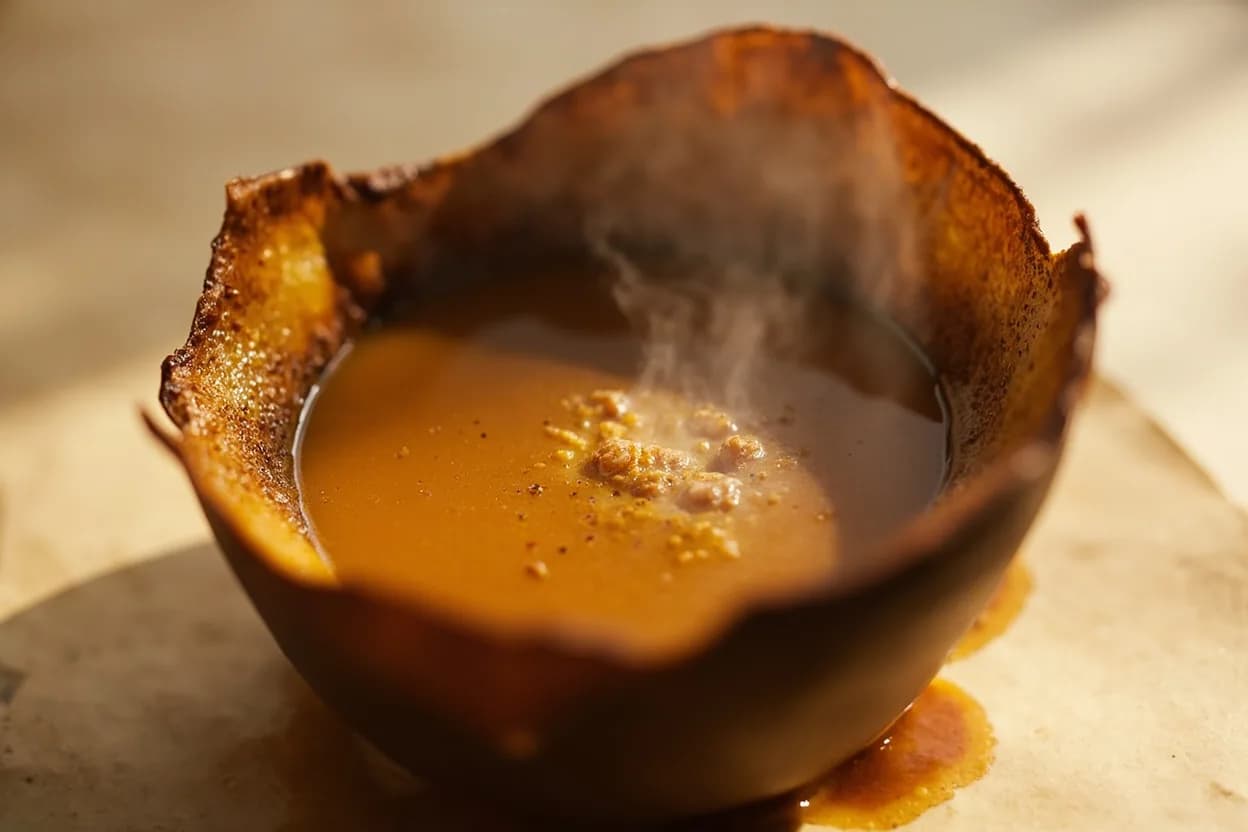

What happens
Miso is a complex fermented matrix of proteins, sugars, amino acids (especially glutamates providing umami), organic acids, alcohols, esters, and aldehydes produced by Aspergillus oryzae (koji mold) and lactic acid bacteria over months or years of aging. Its flavor has three layers: the deep umami base of glutamic acid (heat-stable), the balanced acidity of lactic and acetic acids (heat-stable), and the top-note aromatic volatiles — ethyl esters, furfurals, benzaldehyde, pyrazines — that are highly heat-labile. At 75°C+ these volatile compounds evaporate within minutes. Beyond 80°C, living enzymes in unpasteurized miso are denatured. At full boil (100°C), live bacteria die and the soup loses its aromatic complexity within seconds, becoming flat and overly salty-tasting despite unchanged sodium content.
What to look for
- Properly made miso soup has a layered aroma: savory dashi base plus a warm, slightly sweet, fermented top-note as you bring the bowl close
- Color remains uniform golden-brown or deep red-brown — boiling creates a foamy, separated surface
- Broth at correct temperature appears gently steaming, not bubbling
- First sip delivers immediate umami complexity followed by a lingering fermented depth; boiled miso tastes flat and one-dimensionally salty
- Tofu, wakame, and garnishes remain gently warmed through, not waterlogged or color-stripped
How to check
- Thermometer check: bring dashi to a gentle simmer (~85°C), then reduce heat until temperature drops to 70–75°C before whisking in miso
- Visual: look for a calm steam with no active bubbling before adding miso
- Stir miso into a ladle of hot broth first (a traditional Japanese technique) to dissolve clumps before stirring the smooth paste into the pot — this prevents adding cold paste directly to the pot and reflex-heating to compensate
- Once miso is incorporated, taste immediately and serve — do not hold hot on the stove
Food safety
The science behind it
The foundational umami broth base for miso soup, made from kombu and katsuobushi (or iriko/niboshi); its glutamate content is what makes miso dissolution work so effectively.
- Koji fermentation
Aspergillus oryzae mold breaks down grain/soy proteins and starches during miso aging, producing the glutamates, free amino acids, and precursor compounds for miso's flavor.
- Volatile aromatic loss
Esters and aldehydes formed during fermentation are the same category of heat-labile compounds subject to loss in wine, sake, and fermented dairy when heated above 70–80°C.
- Umami (glutamic acid)
The heat-stable backbone of miso's flavor — boiling destroys the top-notes but not the base umami, which is why boiled miso still tastes 'like miso' but seems blunter.
Appears in
References
- 1.Japanese Farm Food — Nancy Singleton Hachisu
- 2.The Japanese Kitchen — Hiroko Shimbo
- 3.On Food and Cooking — Harold McGee
- 4.The Art of Fermentation — Sandor Ellix Katz
- 5.Japan: The Cookbook — Nancy Singleton Hachisu
Confidence: high
Notes
Pasteurized vs. unpasteurized miso
Commercial shelf-stable miso has often been heat-pasteurized, killing the live cultures before it reaches the consumer. The no-boil rule remains valid for aromatic quality regardless — but the argument about killing beneficial bacteria applies specifically to artisan, refrigerated, unpasteurized miso. In Japan, high-quality miso from regional producers is almost always unpasteurized ('namazume' or 'nama' miso).
The ladle dissolution method
Japanese home cooks traditionally scoop a ladleful of hot dashi, hold the miso in a fine-mesh spoon or strainer over it, and press the paste through while swirling — this dissolves the miso before it ever touches the full pot, distributes it evenly, and allows the cook to control salt level by taste. This method also means the pot never needs to return to heat after miso addition.
Red vs. white miso
The no-boil rule applies to all varieties, but the stakes differ. Delicate shiro (white) miso has the most fragile aromatics and turns unpleasantly sour and dull when boiled even briefly. Robust hatcho miso (long-aged, very dark) loses less perceptibly because its volatile fraction is smaller relative to its intense umami mass — but quality still suffers.