Technique-Specific Doneness
Pork Belly Braised Tender (Chopstick Test)
Also: chopstick test, skewer piercing test, pork belly tender, dong po rou doneness, braised pork belly doneness
Pork belly is braised to doneness when a chopstick or thin skewer slides through both the fat and meat layers without resistance, indicating full collagen conversion and fat softening — typically after 90–120 minutes at a gentle simmer.
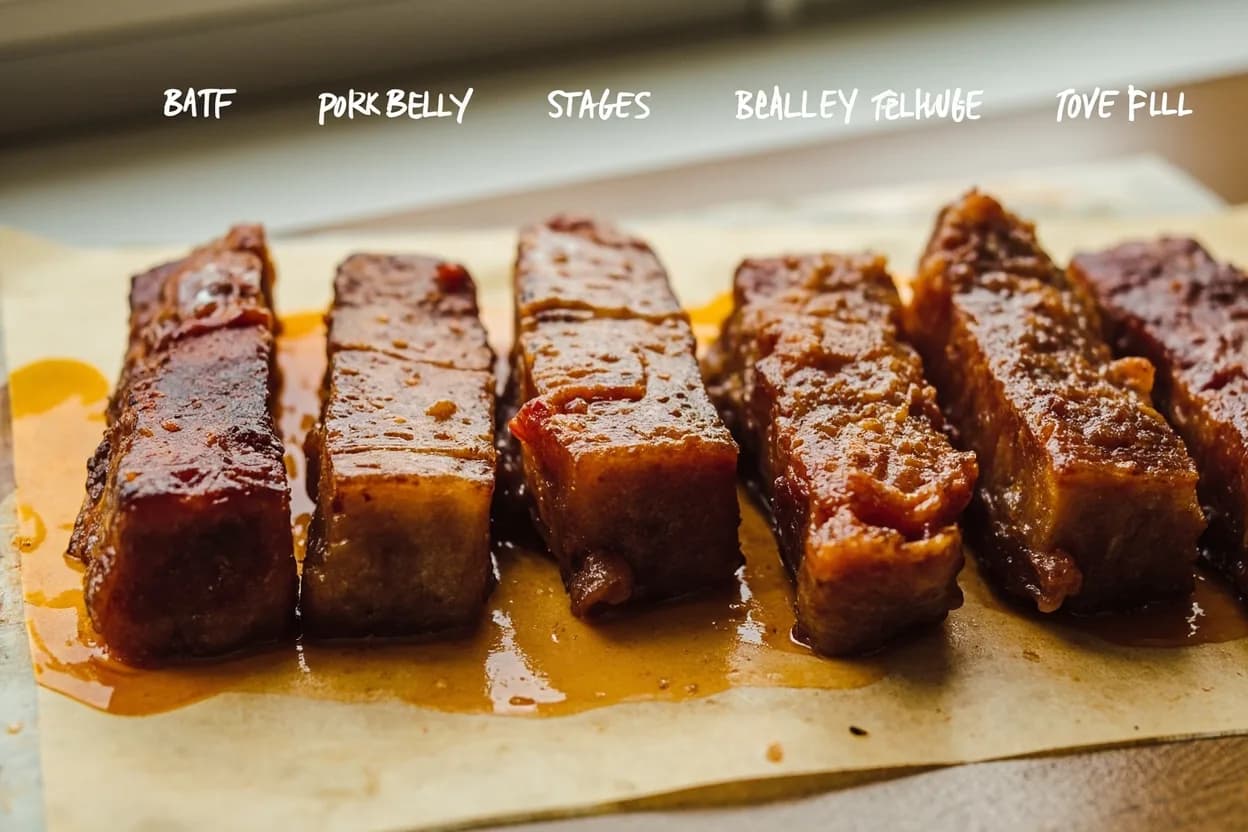
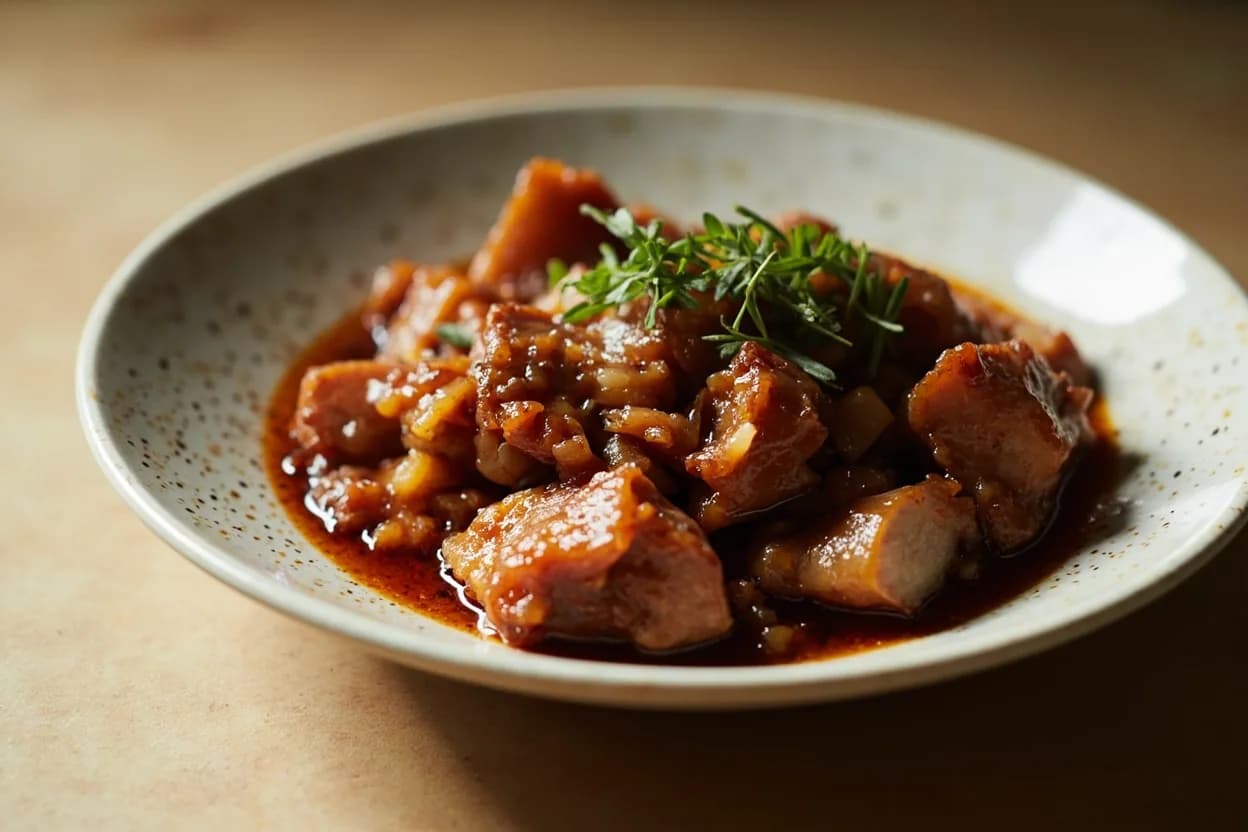
The chopstick test is the traditional East Asian method for gauging the doneness of long-braised pork belly. When a single chopstick pressed vertically into the thickest part of a piece of braised pork belly enters and exits cleanly — no resistance from fat, no springing back from connective tissue — the dish is done. At this point, the thick cap of subcutaneous fat has become translucent and yielding (not dissolved), the collagen in the skin and intramuscular tissue has fully converted to gelatin, and the meat itself is tender enough to cut with a spoon. A thermometer reading is neither traditional nor particularly useful here: the relevant change is structural (rheological), not primarily thermal, since the braise is held at a near-constant low simmer throughout.
In photos

What happens
Pork belly is roughly 50% fat and 50% lean muscle with a thick skin layer of collagen-rich dermis. During prolonged braising, collagen (types I and III) begins converting to soluble gelatin above 70°C; full conversion requires both temperature and time — at 90°C this takes 90+ minutes for thick belly pieces. The fat cap does not melt away: pork adipose fat (mostly monounsaturated and saturated triglycerides) remains solid at braise temperatures and instead softens into a lush, custardy consistency as connective tissue holding fat cells dissolves. Simultaneously, muscle fibres that tightened initially above 60°C relax as their surrounding collagen converts, making them pull apart easily. The skin becomes gelatinous and almost translucent, clinging to the fat without being rubbery.
What to look for
- Chopstick or skewer enters and exits without resistance at any point in the piece
- Fat layer appears semi-translucent, almost glassy, rather than opaque white
- Skin has softened from leathery to soft and yielding; it jiggles when the pot is shaken
- Braise liquid has thickened noticeably from extracted gelatin
- Meat pulls apart in layers along muscle grain without effort
How to check
- Chopstick test: insert a single chopstick or thin metal skewer through the thickest point, passing through skin, fat, and meat — it should slide in and out with no resistance and no tugging
- Jiggle test: gently shake the pot or use tongs to nudge a piece — fully done belly will wobble gelatinously
- Knife pressure test: lay a piece on a surface and press with the side of a knife — it should flatten without tearing and spring back very slowly
- Probe thermometer: internal temperature will be 85–90°C, though this alone does not confirm structural doneness — always confirm with the chopstick test
Food safety
Carryover & resting
Carryover is negligible for long braises since the meat is already at equilibrium with the liquid temperature. If resting out of liquid, the fat cap will firm slightly as it cools. Overnight refrigeration (served the next day, reheated in the braising liquid) dramatically improves texture as gelatin sets and is re-melted.
The science behind it
The key transformation: collagen type I and III unwind and dissolve into soluble gelatin above 70°C given sufficient time
- Braise temperature management
A rolling boil toughens muscle fibres and emulsifies fat into the liquid (cloudy braise); a gentle simmer at 90–95°C is essential
- Pork belly skin preparation
Blanching and scoring skin before braising allows seasonings to penetrate and skin to soften evenly
- Resting in braising liquid
Cooling in the liquid allows gelatin to re-set and flavours to penetrate further; next-day belly is often superior
- Fat rendering vs. fat softening
At braise temperatures, pork fat softens but does not render (melt out) — true rendering requires sustained temperatures above 120°C in a dry or oil environment
Appears in
References
- 1.On Food and Cooking — Harold McGee (Scribner, 2004)
- 2.The Food Lab — J. Kenji López-Alt (W. W. Norton, 2015)
- 3.Land of Fish and Rice — Fuchsia Dunlop (W. W. Norton, 2016)
- 4.Every Grain of Rice — Fuchsia Dunlop (Bloomsbury, 2012)
Confidence: high
Notes
Why not use a thermometer?
Long braises bring the entire piece to within a few degrees of the liquid temperature after 30–40 minutes, so a thermometer reading confirms the protein is safe to eat but says nothing about whether collagen conversion is complete. Two pieces at identical internal temperatures may have completely different textures depending on their collagen content, fat distribution, and the size of the cut. The chopstick test is faster, more reliable, and has been refined over centuries of Chinese braising practice.
The next-day effect
Professional Chinese kitchens routinely braise pork belly a day ahead. Cooling in the liquid allows the extracted gelatin to set back into the meat and fat, firming the piece enough to slice cleanly. When reheated gently, the gelatin re-liquefies and the fat goes silky again. The flavours also penetrate more deeply overnight. This is not a shortcut: it is the correct technique.