Pork Doneness
Pork Belly: Rendering & Collagen Yield Stage
Also: pork belly crackling temperature, pork belly braising doneness, belly fat rendering, three-layer pork doneness
Pork belly requires two distinct thermal regimes: low, sustained heat (160–180°F / 71–82°C) for melt-in-mouth braised fat, or high surface heat (375°F+ / 190°C+) for crackling skin — both governed by collagen and fat chemistry.
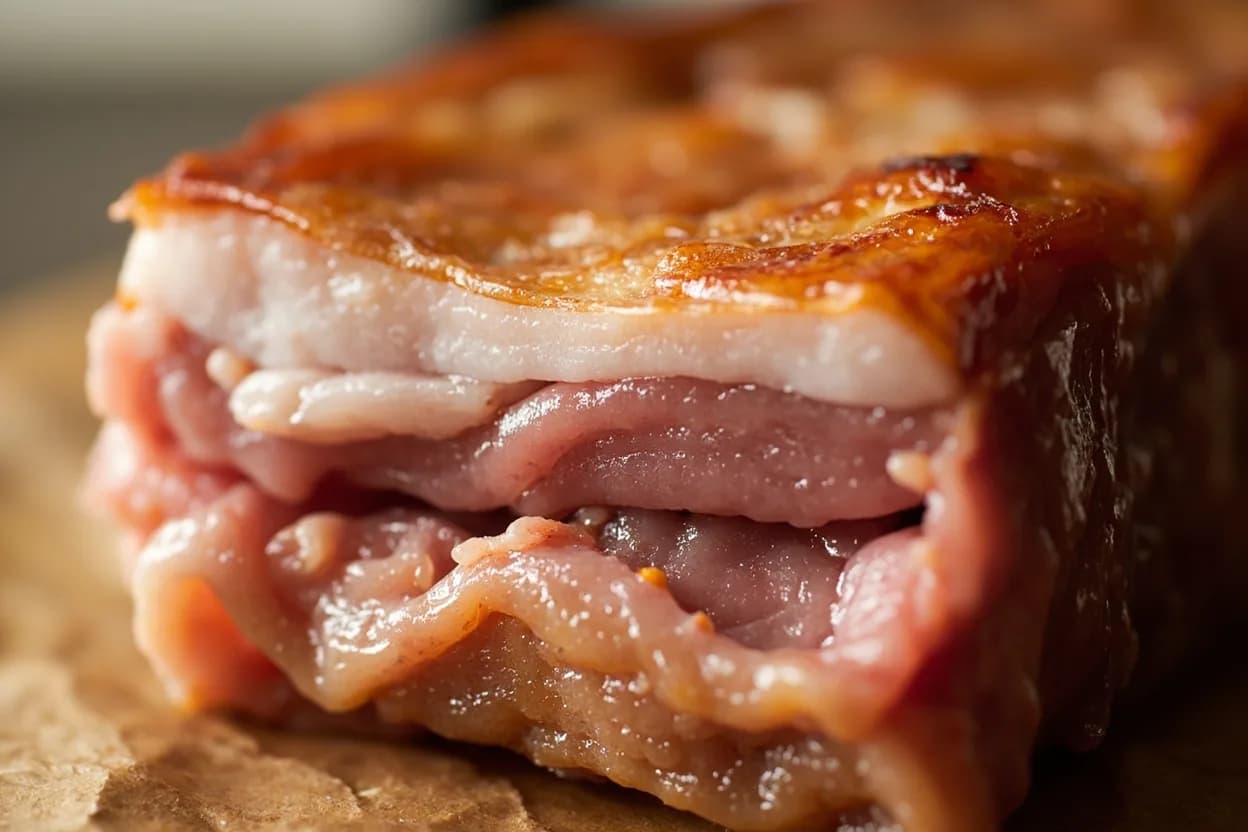
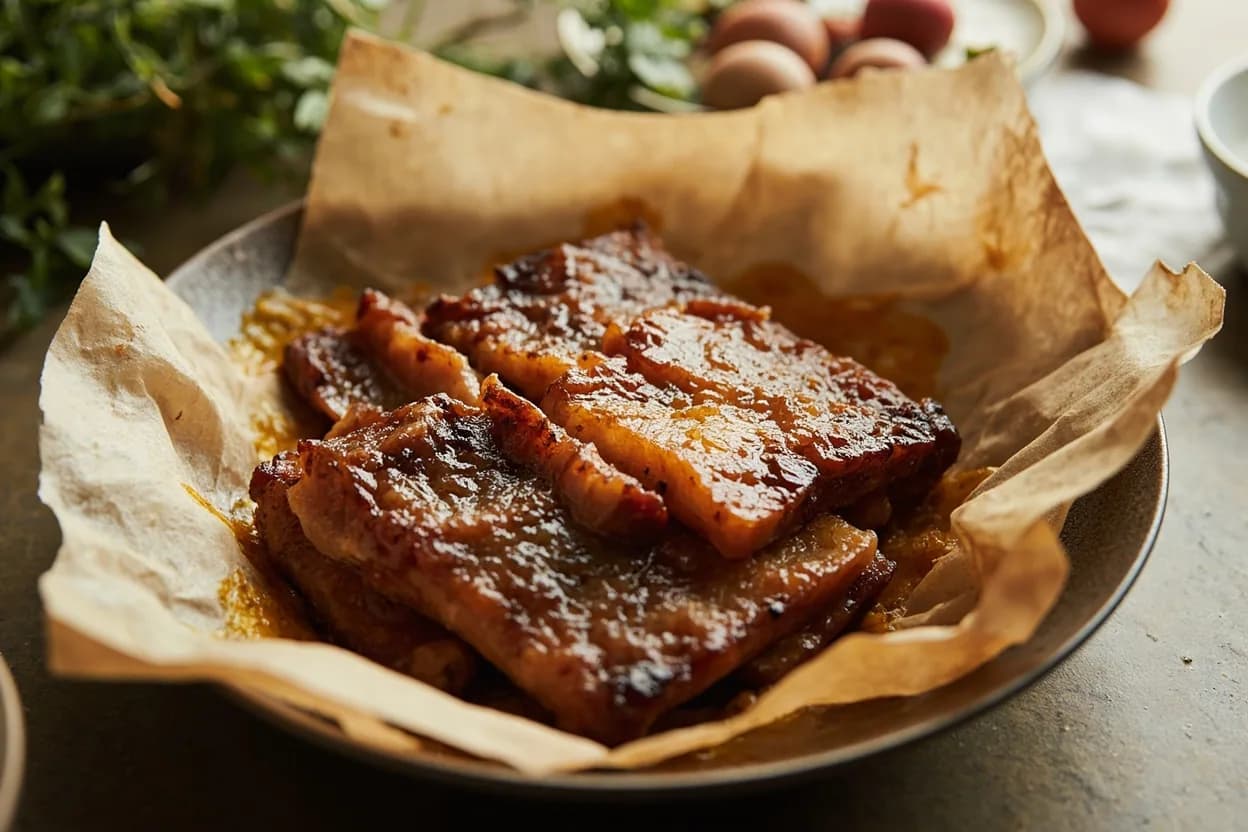
Pork belly is a stratified cut — alternating layers of skin, fat, and muscle — and each layer has its own thermal requirements. For braises and slow roasts aimed at silky, gelatinous fat: internal temperatures of 160–180°F (71–82°C) sustained over 2–4 hours convert subcutaneous and interlayer collagen to gelatin and partially render intramuscular fat, producing the quivering, melt-in-mouth texture prized in Hong Kong roast pork and Japanese kakuni. For crackling (British roast pork, Filipino lechon kawali, Chinese siu yuk), the skin surface must reach approximately 160–200°C (320–390°F) to drive off moisture, blister the dermis, and trigger the puffing reaction in the dried protein matrix — a phenomenon distinct from Maillard browning.
In photos

What happens
At 71–82°C internal: subcutaneous collagen (abundant in belly skin) begins hydrolyzing into gelatin; interlayer fat starts to liquefy and migrate through the muscle striations; muscle fibers tighten (they reached safe doneness at 63°C) but remain moist because surrounding gelatin holds water. This is the belly equivalent of the collagen-yield stage in shoulder braises, just at a lower sustained temperature because belly fat conducts heat efficiently. At the skin surface above 160°C: skin moisture flashes off, the dermal protein layer desiccates and then expands as trapped gas and steam escape, creating thousands of micro-bubbles — the hallmark of puffy crackling. The Maillard reaction runs simultaneously on the protein scaffold, producing the golden color and deep savory flavor of good crackling.
What to look for
- Braised belly: a skewer meets almost no resistance pushing through all three layers; the fat layer jiggles like soft set gelatin
- Braised belly: the meat layers separate cleanly along fat seams when pressed with a spatula
- Crackling: skin surface is uniformly blistered — a continuous field of tiny bubbles, not smooth patches alternating with raw skin
- Crackling: tapping the skin produces a hollow, brittle knock rather than a soft thud
- Crackling: the skin has contracted slightly and pulled away from the scored edges, showing a golden-amber color throughout
- Both methods: rendered fat has become semi-transparent rather than opaque white
How to check
- Braised belly: probe the thickest meat layer (not the fat) with an instant-read thermometer — target 71–82°C (160–180°F)
- Braised belly: skewer test — push a thin skewer through the full depth; it should pass through all layers with negligible drag
- Crackling: visual and tactile — look for uniform blistering across the entire skin surface with no smooth patches
- Crackling: tap test with a spoon; a crackling-ready skin rings hollow
- Crackling: surface temperature with an IR gun should read 160–200°C; if using an oven thermometer, the skin-side must be exposed to direct radiant heat or high-convection air
Food safety
Carryover & resting
Braised belly carryover is modest (3–5°F) due to the high fat content acting as a thermal buffer. Crackling applications benefit from a rest period of 5–10 minutes after oven removal — the skin crisps further as surface moisture evaporates into the air, and the internal fat re-solidifies slightly, making clean slicing possible.
The science behind it
Drives the unctuous mouthfeel of braised belly at lower sustained temperatures
- Fat rendering
Interlayer fat liquefaction creates the characteristic translucent, marbled appearance of finished belly
Produces color and flavor on the protein scaffold of crackling skin
- Desiccation and puffing
The unique physical mechanism behind crackling — distinct from browning reactions
- Scoring technique
Cross-hatching or pin-pricking the skin accelerates moisture loss and promotes uniform crackling formation
Appears in
References
- 1.On Food and Cooking: The Science and Lore of the Kitchen — Harold McGee (Scribner, 2004)
- 2.The Food Lab — J. Kenji López-Alt (W. W. Norton, 2015)
- 3.Chinese Cooking Demystified — regional technique research on siu yuk and lechon methods
Confidence: high
Notes
The two-stage roast method
Many Chinese and Filipino crackling protocols separate the two thermal goals explicitly: first a low oven (150°C / 300°F) for 1.5–2 hours to render fat and set the internal collagen, followed by a blast at 220–240°C (425–465°F) or a deep-fry to puff the skin. This avoids the contradiction of needing sustained low internal heat while also needing extreme surface heat simultaneously.
Scoring and salt-drying
Traditional siu yuk technique dries the skin with salt and vinegar overnight in the refrigerator. The salt draws moisture from the dermis by osmosis; the dried, taut skin then puffs more uniformly when heated because there is less water to drive off at the critical moment. Skipping the drying step results in patchy, under-puffed crackling with hard, rubbery skin patches.