Vegetable Doneness
Potato: Fully Gelatinized Starch (No Graininess)
Also: potato fully cooked, potato knife-tender, starch fully gelatinized
The point at which potato starch granules have fully hydrated and swollen, eliminating the gritty, undercooked interior and yielding a smooth, cohesive texture throughout.
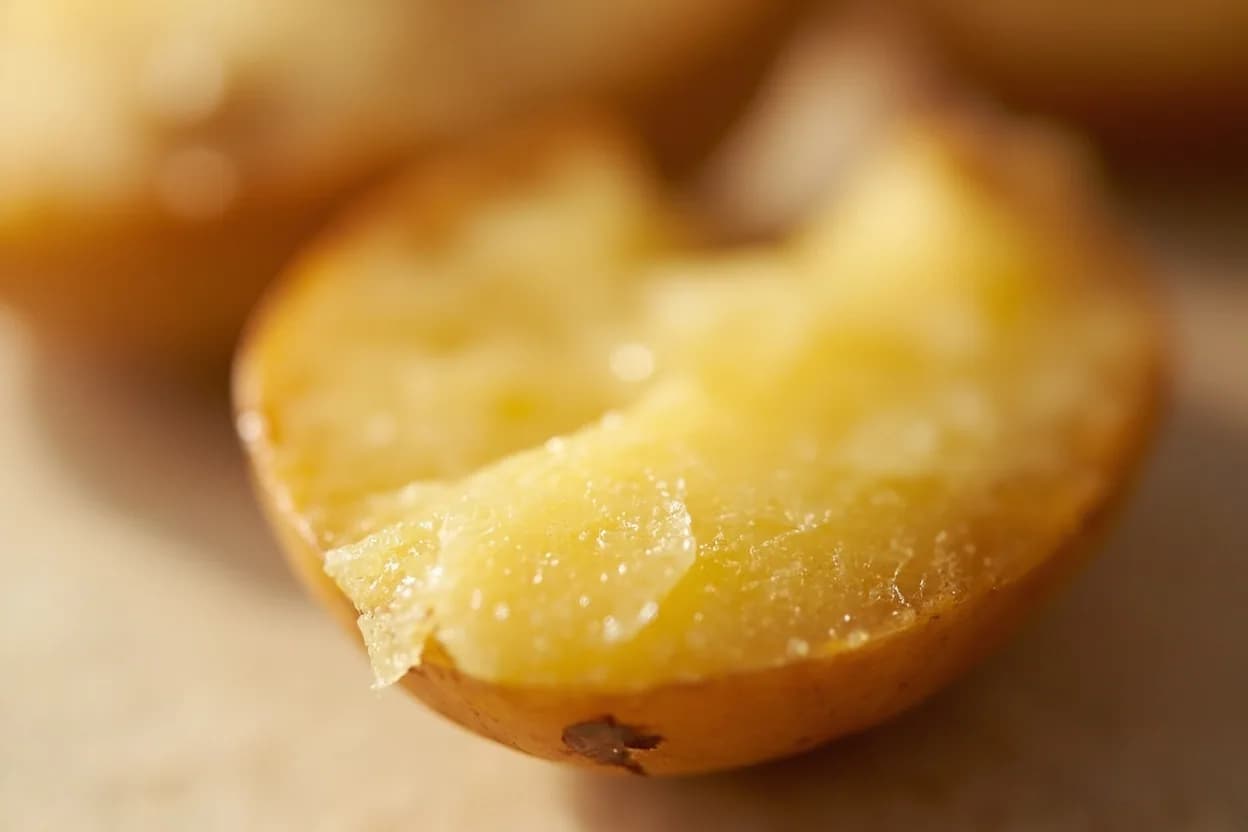
Raw potato starch exists as dense, tightly packed granules that are indigestible and feel gritty when bitten. As the potato heats in water above 60°C, granules absorb water and swell; by 75–85°C most granules have gelatinized. True full gelatinization — where no granule remains intact and no gritty pocket persists — requires the interior to reach and hold 85–95°C. At this stage a thin-bladed knife or skewer enters the flesh with zero resistance, and the texture is uniformly yielding throughout with no perceptible grain. The target is most critical for mashed potatoes, potato soups, and gnocchi, where residual graininess is immediately detectable.
In photos


What happens
Below 60°C, starch granules remain crystalline and absorb minimal water. Between 60–75°C, granules begin to swell irreversibly — this is gelatinization onset. From 75–85°C, the majority of granules rupture, releasing amylose and amylopectin into the surrounding water and softening the cell structure. Above 85–90°C (the internal target for a fully boiled potato), essentially all starch granules have gelatinized, and the protein matrix (primarily patatin) has fully denatured. The cell walls remain intact but weakened, allowing the flesh to separate cleanly under pressure. Extended boiling above 100°C surface exposure causes cell walls to rupture, releasing free starch into the cooking water and creating a waterlogged, gluey texture — the over-boiled potato collapse.
What to look for
- A thin knife or metal skewer slides through the thickest part of the potato with no resistance and no grating sensation
- The potato yields completely when pressed firmly — no hard core
- In whole potatoes, the skin begins to pull slightly away from the flesh at the surface
- A fork pressed against the surface causes the flesh to flake cleanly rather than compress rubbery
- Steam emerges readily from cracks in the skin when the potato is lifted from the water
How to check
- Insert a thin metal skewer or cake tester into the center of the largest piece — it should glide through with zero resistance; any drag or gritty vibration indicates undercooked starch
- For cubes, press one piece firmly between two fingers — it should yield fully and show no dense core
- For mashed-potato prep, cut one piece in half and taste a pinch from the center: zero grain or chalky texture indicates readiness
- Do not rely on visual cues alone — exterior softness lags well behind interior doneness for dense varieties (russet, Yukon Gold)
- For boiling whole medium potatoes (200 g): typically 20–25 minutes in salted water at a gentle boil; large potatoes (350 g+) require 30–35 minutes
Food safety
Carryover & resting
Fully gelatinized potatoes continue to soften very slightly from carryover heat in the 1–2 minutes after draining. For mashed potatoes, drain immediately and return to the hot dry pot to steam off surface moisture for 1–2 minutes, which concentrates flavor and prevents a watery mash. Do not let potatoes sit in the cooking water after reaching doneness — continued water absorption causes waterlogging and dilutes starch concentration.
The science behind it
The irreversible swelling of starch granules above ~60°C that transforms raw potato texture into the fully cooked state
- Retrogradation
Cooled, gelatinized starch partially re-crystallizes into resistant starch — the basis of cold potato salad's lower GI
- Potato variety selection
High-starch floury varieties (russet, Maris Piper) gelatinize more readily and mash smoother; waxy varieties (Charlotte, fingerling) hold shape and are better for salads
- Waterlogging
Over-boiling ruptures cell walls and saturates cells with water, making mash gluey and diluting flavor
- Gnocchi doneness
Fully gelatinized, steamed potato with minimal water absorption is the prerequisite for light, non-dense gnocchi
Appears in
References
- 1.On Food and Cooking — Harold McGee (Scribner, 2004)
- 2.The Food Lab — J. Kenji López-Alt (W.W. Norton, 2015)
- 3.Modernist Cuisine — Myhrvold, Young & Bilet (The Cooking Lab, 2011)
- 4.McGee on Food and Cooking — Harold McGee (Hodder & Stoughton, 2004)
Confidence: high
Notes
Why starting in cold water matters
Placing potatoes in cold water and bringing to a boil together allows even heat penetration from the outside in. Dropping potatoes into boiling water cooks the exterior rapidly while the interior remains raw longer, increasing the risk of a gluey skin/raw-center split. Cold-start is the professional baseline for boiled whole potatoes and quartered pieces alike.
The mash paradox
Fully gelatinized potato is the prerequisite for smooth mash — but over-working gelatinized starch after cooking (e.g. in a food processor or over-vigorous hand mashing) ruptures the swollen granules and releases free amylopectin chains, producing a gluey, elastic paste. The ideal mash uses a ricer or food mill, warm butter, warm cream, and minimal agitation to keep granules intact while dispersing fat.