Poultry Doneness
Poultry: Safe Internal Temperature
Also: chicken done temp, turkey safe temp, 165°F poultry, poultry minimum temperature
74°C/165°F is the USDA minimum for all poultry — chicken, turkey, duck, and game birds — ensuring Salmonella and Campylobacter destruction.
The USDA-established safe internal temperature for all poultry is 74°C (165°F), measured at the thickest point of the meat not touching bone. At this temperature, both Salmonella and Campylobacter — the two primary foodborne pathogens associated with raw poultry — are destroyed to a 7-log₁₀ reduction (a 10-million-fold kill) within seconds of exposure. This standard applies to chicken, turkey, ground poultry, and other birds including duck, quail, guinea fowl, and goose. Juices should run clear and there should be no pink coloration near the bone, though visual cues alone are not reliable and a calibrated thermometer is mandatory.
In photos
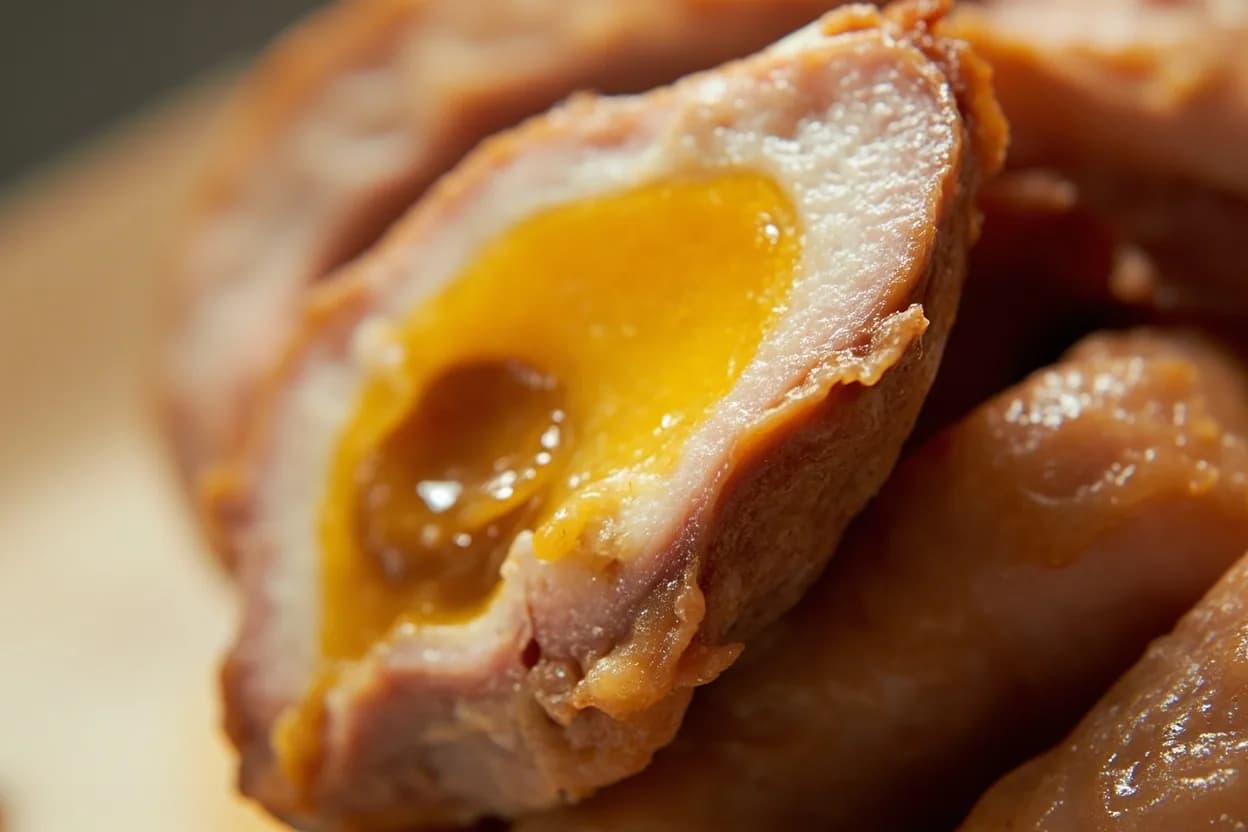
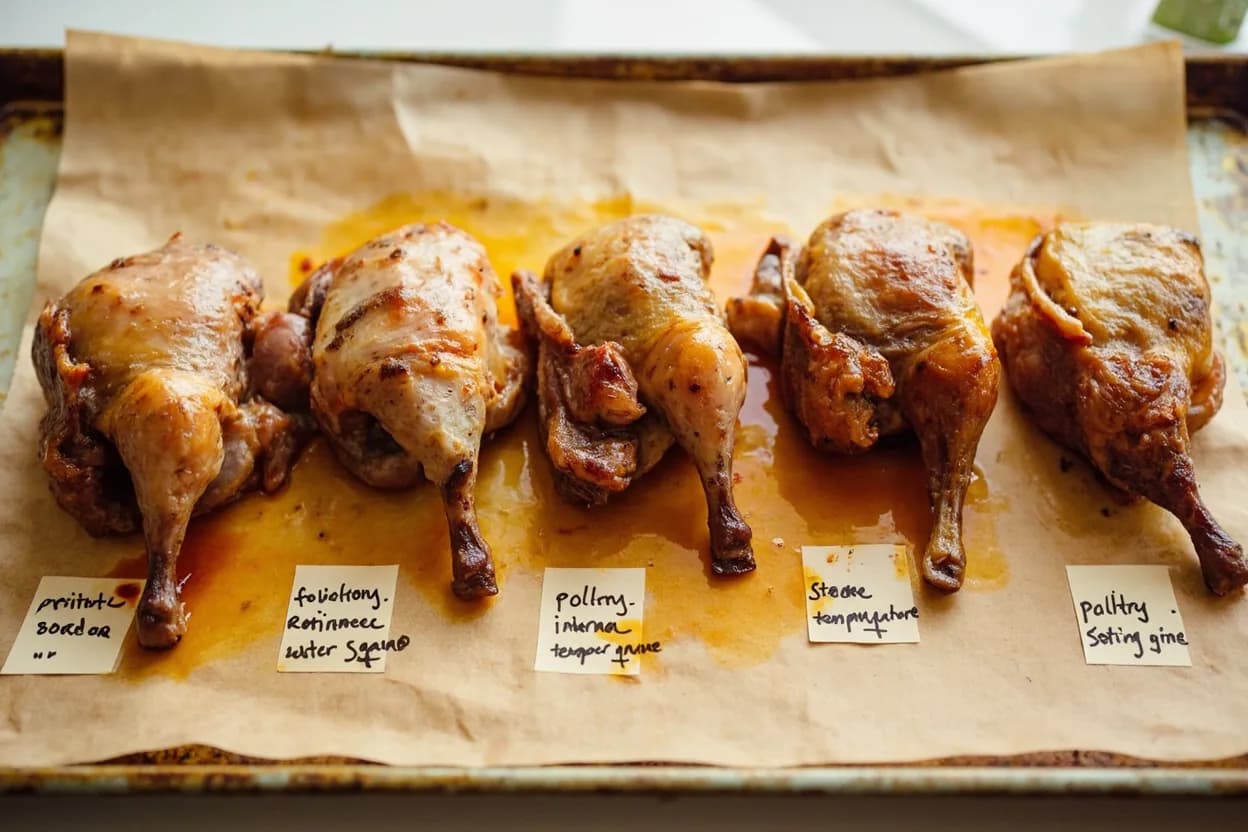
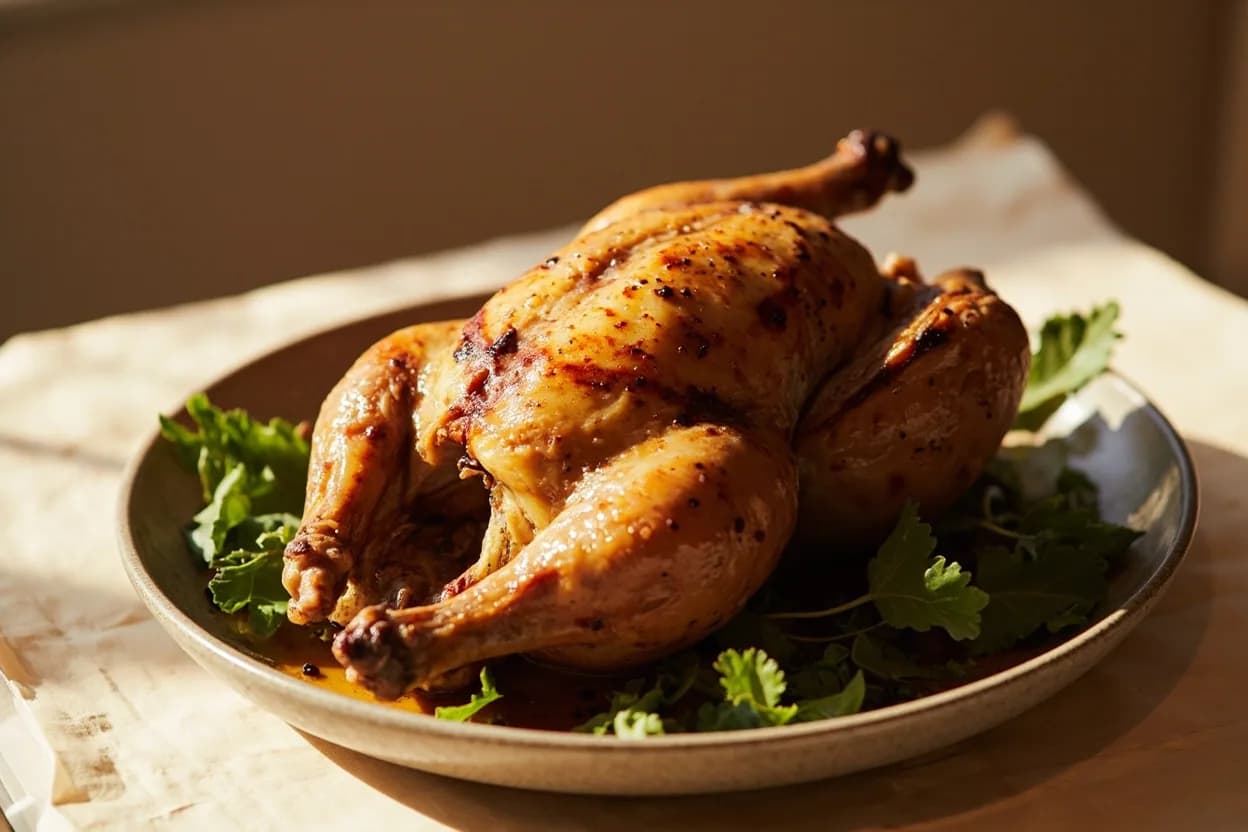
What happens
At 74°C, the major structural proteins of poultry muscle (myosin and actin) have both fully denatured. Myosin denatures around 50–55°C, producing initial firmness; actin denatures above 65–70°C, causing the dramatic moisture loss and toughening associated with overcooked poultry. By 74°C, all proteins are set, myoglobin (which gives raw meat its pink color) has denatured and oxidized to metmyoglobin (gray-brown), and collagen in connective tissue has begun converting to gelatin. Fat has rendered and the tissue is fully cooked. Critically, the Salmonella D-value (time for 90% kill) at 74°C is effectively instantaneous — well under one second — making this a rapid and complete safety threshold.
What to look for
- Juices run clear or faintly yellow when the thickest part is pierced — no pink or red liquid
- Meat near the bone shows no translucency or pink color (though note: some naturally pink myoglobin near bone can persist even at safe temps in young birds)
- Flesh feels firm and springs back when pressed; no raw or gelatinous give
- Leg joint moves freely and twists without resistance — an older but unreliable indicator
- Skin is golden and fully set; no soft, pallid patches
How to check
- Insert an instant-read thermometer into the thickest part of the thigh, away from the bone — the thigh is always the last part to reach temperature in a whole bird
- For a whole turkey or large chicken, check both thighs and the thickest part of the breast independently
- For ground poultry patties or meatballs, probe the geometric center
- For stuffed birds, the stuffing must also reach 74°C — thermometer probe should penetrate to the center of the cavity stuffing
- Allow 15 seconds at reading before accepting — some thermometers need equilibration time
Food safety
Carryover & resting
A whole roast chicken or turkey will carry over 3–5°C during resting. Pull from the oven at 70–71°C in the thigh and it will reach the safe 74°C minimum during a 10–15 minute rest. For smaller cuts (chicken breasts, thighs), carryover is 2–3°C; remove at 71–72°C. Always confirm with a thermometer after resting if you pulled early.
The science behind it
- Salmonella Kill Curve
The time-temperature relationship by which pathogens are eliminated — at 74°C the kill is near-instantaneous
- Myosin Denaturation
Begins around 50°C; responsible for initial firmness well below the safe temp threshold
- Actin Denaturation
Occurs above 65–70°C; primary cause of moisture loss and toughening in overcooked poultry
- Carryover Cooking
Residual heat continues cooking after removal from heat source — factor in when pulling poultry
- Resting
Essential post-cook hold that allows juices to redistribute and carryover to complete
Appears in
References
- 1.USDA Food Safety and Inspection Service: Safe Minimum Internal Temperature Chart (2024)
- 2.On Food and Cooking — Harold McGee
- 3.The Food Lab — J. Kenji López-Alt
- 4.FDA Food Code 2022
- 5.Modernist Cuisine — Myhrvold et al.
Confidence: high
Notes
The pink-near-bone phenomenon
Young commercially raised chickens often exhibit a distinctly pink band of color around the bones even when the meat has reached and exceeded 74°C. This is caused by two mechanisms: the bones of young birds are porous, allowing marrow pigments to leach outward during cooking, and carbon monoxide produced by gas ovens can react with myoglobin to form a stable pink compound (carboxymyoglobin) that persists at safe temperatures. This is a cosmetic, not a safety, concern. The thermometer is the only reliable arbiter.
Why 165°F and not lower?
Pasteurization is a function of both temperature and time. Chicken can technically be made safe at lower temperatures held for longer — at 60°C (140°F) held for 27.5 minutes, the same 7-log Salmonella reduction is achieved. The USDA 74°C standard is an instantaneous kill temp chosen because it is achievable reliably without precise time-holding in a home or restaurant kitchen. Sous vide practitioners exploit the time-temperature relationship to cook chicken breast safely at 60–63°C for extended periods, achieving juicier results while maintaining full pathogen control.